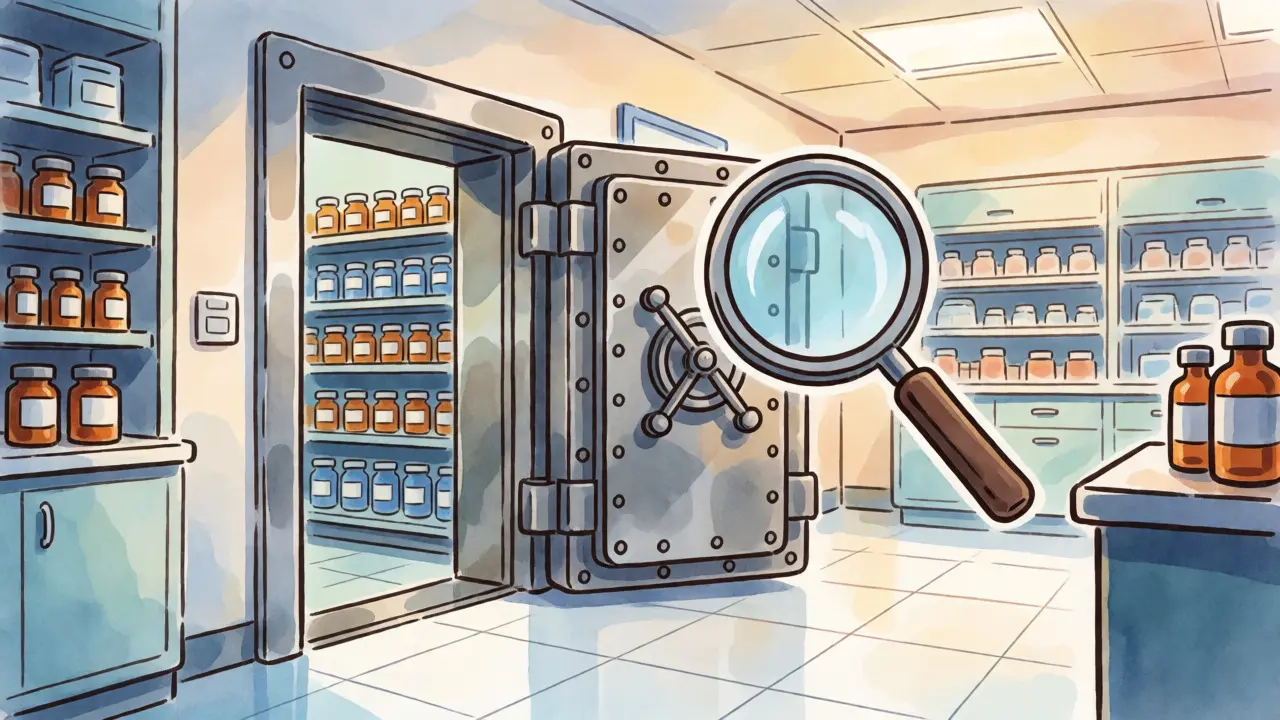
Imagine walking into a hospital pharmacy and noticing that the vault door is slightly ajar. It’s a small detail, but in the world of controlled substances, it’s a massive red flag. Drug diversion isn’t just about someone stealing pills; it’s a systemic failure in how we store, track, and secure medications like opioids and stimulants. With an estimated 37,000 diversion incidents occurring annually in U.S. healthcare facilities alone, getting your storage protocols right isn’t just good practice-it’s a legal necessity.
If you’re managing a pharmacy or working in a clinical setting, you know the stakes. The Drug Enforcement Administration (DEA) doesn’t just ask for locked doors; they demand effective controls that guard against theft and misuse. This guide breaks down exactly how to store controlled substances to prevent diversion, moving beyond basic locks to comprehensive strategies that actually work in high-pressure environments.
Understanding the Legal Framework for Storage
Before you buy new safes or install cameras, you need to understand the rules. The Controlled Substances Act (CSA) of 1970 created a "closed system" where every handler must register with the DEA. Under 21 CFR Part 1301, registrants are required to provide "effective controls and procedures" to prevent diversion. This isn’t vague advice. During inspections, which have increased by 37% since 2019, investigators look specifically at storage areas. If your setup doesn’t match your documented policies, you’re facing potential civil penalties averaging $187,500 per violation.
The key takeaway? Your storage solution must be defensible. You need to prove that access was limited, monitored, and logged. Whether you’re in a large hospital or a small clinic, the principle remains the same: if you can’t account for every milligram, you have a problem.
Physical Security: Beyond the Locked Cabinet
Most people think a padlock on a cabinet is enough. It’s not. The American Society of Health-System Pharmacists (ASHP) recommends limiting physical access points while maximizing electronic audit trails. For Schedule II drugs, this often means a safe or a securely locked cabinet bolted to the floor or wall. But here’s the catch: who has the key?
- Limit Access: Ideally, only one or two individuals should have access to bulk supplies. In smaller settings, this might mean the pharmacist-in-charge holds the primary key, with a backup held by a designated manager.
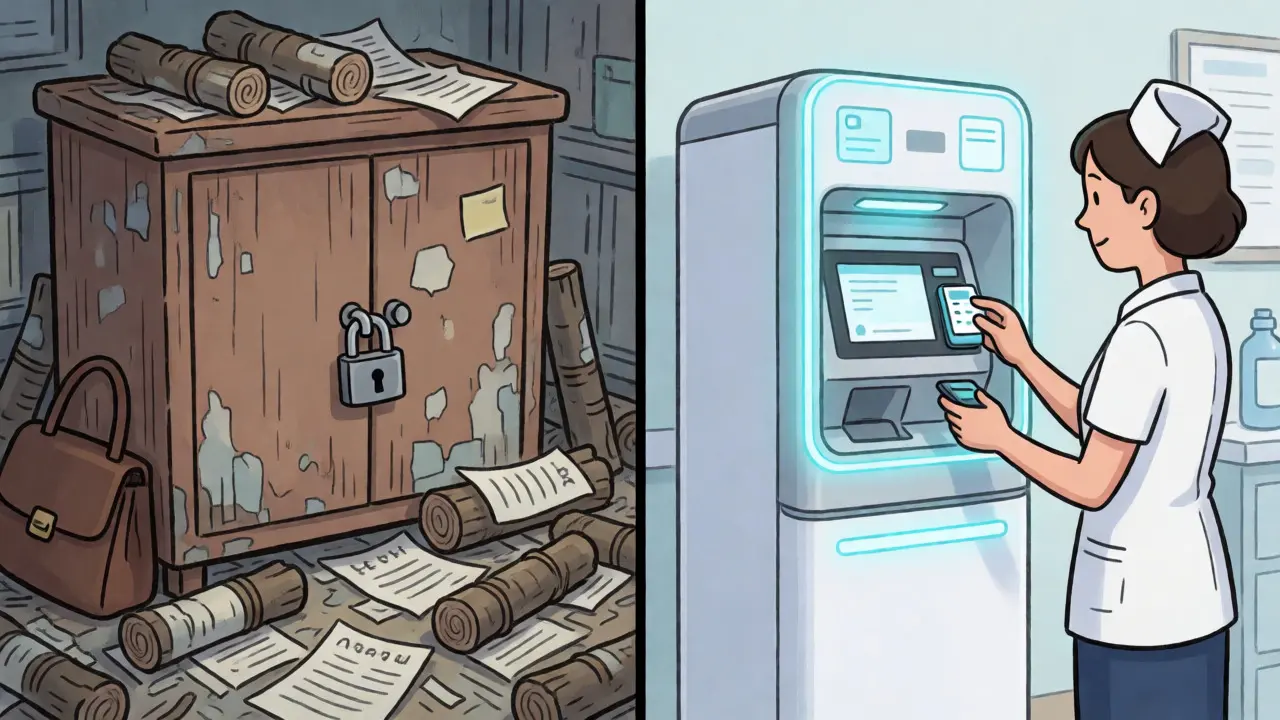
- Personal Items Policy: Ban bags, purses, and coats from medication storage areas. Studies show that personal items are used to conceal diverted drugs in nearly one-third of cases. Provide lockers outside the restricted zone.
- Visibility Matters: Don’t hide your storage units. Position them so they are visible to staff and surveillance cameras. Hidden corners are breeding grounds for unauthorized access.
For facilities handling significant volumes, consider upgrading to Automated Dispensing Cabinets (ADCs). These systems require dual authentication-often a badge scan plus a PIN or biometric input-to release medication. Facilities using ADCs report a 73% reduction in diversion incidents compared to those relying on manual logs.
The Role of Automated Dispensing Cabinets (ADCs)
ADCs are no longer a luxury for big hospitals; they’re becoming the standard for any facility serious about diversion prevention. Unlike traditional cabinets, ADCs create an immutable digital record of every transaction. When a nurse pulls morphine from an ADC, the system logs the time, the user, the amount, and the patient ID. This data allows pharmacists to spot anomalies quickly.
| Feature | Manual Storage | Automated Dispensing Cabinets (ADCs) |
|---|---|---|
| Diversion Risk | High (4.2x higher than automated) | Low (73% reduction reported) |
| Audit Trail | Paper-based, prone to errors | Digital, real-time, tamper-evident |
| Staff Time | 37% more time for inventory | Streamlined workflow |
| Initial Cost | Low | $45,000 - $75,000 per unit |
| Maintenance | Minimal | ~15% of purchase price annually |
However, ADCs aren’t a magic bullet. A common mistake is under-provisioning. One OR pharmacist noted that having a single ADC for twelve operating rooms created bottlenecks, leading to frequent manual overrides. Those overrides bypassed the security protocols, resulting in two diversion incidents within six months. Match your technology to your workflow volume.
Procedural Safeguards and Chain of Custody
Storage hardware is only half the battle. The other half is process. The ASHP Guidelines emphasize a "chain of custody" approach. This means tracking the substance from the moment it arrives at your loading dock until it reaches the patient or is destroyed.
Here are three critical procedural steps:
- Receiving Verification: Never accept shipments without immediate verification. Count tablets against invoices in front of a witness. Check for tampering signs like broken seals or mismatched lot numbers.
- Dual Control for High-Risk Transfers: For Schedule II drugs, require two authorized personnel to sign off on transfers between the central pharmacy and satellite locations (like ERs or ORs). This reduces the opportunity for single-person theft.
- Waste Witnessing: If a dose is wasted, it must be witnessed by another qualified person. Use video monitoring if possible. Without witnessing, "wasted" doses are a prime target for diversion.
Regular audits are non-negotiable. Conduct daily reviews of ADC override reports and weekly physical inventories of high-risk items. Look for outliers: Why did Nurse X pull 10 mg of hydromorphone when the protocol says 2 mg? Investigate immediately.
Training and Culture Change
You can have the best safes and software, but if your staff doesn’t care, diversion will happen. A survey of over 1,200 facilities found that 63% faced significant staff pushback when implementing stricter storage protocols. People hate change, especially when it adds steps to their day.
To overcome this, focus on education rather than punishment. Explain why the rules exist. Show them recent case studies where lax storage led to patient harm. Implement mandatory training sessions-not just once, but annually. Make sure every employee knows that reporting a near-miss is encouraged, not punished. A culture of transparency catches problems before they become headlines.
Also, consider behavioral monitoring. Some advanced systems now use AI to detect patterns indicative of diversion, such as pulling meds at unusual times or consistently wasting specific amounts. Pilot programs at major institutions like Johns Hopkins have reduced false positives by 63% while identifying 92% of incidents within 48 hours.

Disposal and Returns: Closing the Loop
Diversion doesn’t end when the drug leaves the shelf. It continues during disposal. Old stock, expired medications, and patient returns must be handled carefully. Use reverse distributors for returns and ensure destruction certificates are obtained and filed. Never throw controlled substances in the regular trash unless local regulations explicitly allow it (and even then, check DEA guidelines).
For partial doses or waste, follow the DEA’s requirements for witnessing and documentation. If you’re disposing of liquids, ensure the method renders them unretrievable. Improper disposal is a common loophole exploited by diverters.
Key Takeaways for Implementation
- Assess Your Risk: Map out every hand-off point in your facility. Identify where manual documentation occurs-these are your highest risk zones.
- Upgrade Gradually: If ADCs are too expensive, start with strict dual-control protocols and enhanced surveillance. Move to automation as budget allows.
- Document Everything: If it isn’t written down (or digitally logged), it didn’t happen. Keep records for at least two years, though some states require longer.
- Stay Updated: Regulations change. The DEA requires real-time inventory tracking for facilities handling over 10kg of Schedule II substances annually, effective January 1, 2025. Ensure your systems can handle this.
Preventing diversion is an ongoing process, not a one-time fix. By combining robust physical storage, smart technology, and a vigilant culture, you protect your patients, your staff, and your license.
What is the most important factor in preventing controlled substance diversion?
While physical security is crucial, limiting access is the most critical factor. Research indicates that securing supplies and limiting access to select healthcare personnel can reduce diversion risk by up to 89% when combined with behavioral monitoring. Fewer people with keys or codes means fewer opportunities for unauthorized removal.
Do I need automated dispensing cabinets (ADCs) if I am a small clinic?
Not necessarily. ADCs cost between $45,000 and $75,000 per unit, which may be prohibitive for small clinics. However, you must still maintain strict controls. Small facilities can effectively prevent diversion by using locked safes, enforcing dual-signature protocols for all transactions, and conducting frequent, unannounced physical inventories. The key is rigorous adherence to procedure rather than expensive technology.
How often should I conduct physical inventories of controlled substances?
Federal law requires a biennial (every two years) inventory, but best practices suggest much more frequent checks. Daily reviews of high-volume items and weekly full physical counts are recommended for active pharmacies. Additionally, perform random spot checks to deter complacency among staff who know the routine schedule.
What should I do if I discover a discrepancy in my inventory?
First, verify the count again to rule out clerical error. If the discrepancy persists, investigate immediately. Review access logs, interview staff involved, and check for documentation gaps. If theft or significant loss is suspected, you must report it to the DEA using Form 106 within one business day of discovery. Failure to report can lead to severe penalties.
Can personal bags be kept in the pharmacy storage area?
No. Personal items like bags, purses, and coats should be prohibited in medication storage areas. They provide easy concealment for diverted drugs. Provide secure lockers outside the restricted zone for staff to store personal belongings. This simple policy change addresses a contributing factor in approximately 31% of diversion cases.
Neil Sahli
September 4, 2026 AT 17:00Oh, fantastic. Another guide telling us to lock the door. Groundbreaking stuff here, truly revolutionary insights into the concept of... security. I’m sure the DEA investigators are just sitting around waiting for this specific revelation about 'effective controls' to change their lives.
Pramay Dattani
September 4, 2026 AT 20:25Why everyone always copy USA rules? We have own systems in India and they work fine without all these expensive machines costing 75k dollars! You people think money solves everything but it is just waste of tax payer cash. Our pharmacies are efficient and we dont need your fancy American bureaucracy to tell us how to count pills. It is arrogant to assume one size fits all when our population density is different and our resources are limited. Stop pushing western ideals on rest of world that has been managing healthcare for centuries before you existed.
Aurelio Haney
September 5, 2026 AT 07:33This is a solid overview, but let’s not pretend hardware fixes human nature. :)
The real issue is culture. If your staff feels undervalued or overworked, they will find loopholes in any system, no matter how sophisticated the ADC is. I’ve seen facilities spend hundreds of thousands on tech while ignoring basic morale issues. A happy pharmacist is less likely to divert meds than a burned-out one with a biometric scanner. :)
Falgun R Patel
September 6, 2026 AT 17:08I appreciate the holistic approach taken in this article. It reminds me that security is not merely a mechanical problem to be solved with locks and keys, but a philosophical challenge regarding trust and responsibility within a community.
We often focus so heavily on the punitive aspects of compliance-the fines, the audits, the fear of losing licenses-that we forget the underlying purpose: protecting the vulnerable patient. When we view storage protocols as an extension of care rather than just bureaucratic red tape, the implementation becomes more meaningful.
Perhaps the most profound takeaway is the idea of transparency. By creating a culture where near-misses are reported without fear, we build a collective conscience that is far more resilient than any physical barrier. It is about fostering an environment where integrity is valued above convenience. This shift in mindset is what ultimately sustains long-term safety.
Somnath Thombre
September 8, 2026 AT 01:25yeah pretty good read actually. i like the part about personal bags being banned. super simple fix but people always ignore it. also dual control is key. if two people sign off its way harder to steal quietly. good tips for small clinics too since not everyone can afford the big cabinets. keep it up!
Amanda SF
September 8, 2026 AT 18:48One must consider the sheer audacity of assuming that standard operating procedures are sufficient without addressing the psychological profile of the personnel involved. The emphasis on automated dispensing cabinets seems disproportionately weighted towards capital expenditure rather than operational efficacy. Furthermore, the assertion that training alone mitigates risk ignores the fundamental economic incentives driving diversion behaviors in understaffed environments. It is rather naive to believe that annual seminars constitute a robust defense against systemic leakage.
Kim Pender
September 10, 2026 AT 04:32the adc cost is crazy high though. $75k per unit? for a small clinic that's basically bankruptcy waiting to happen. paper logs suck but at least they're cheap. maybe they should mention cheaper alternatives besides just saying "upgrade gradually" because gradual doesn't help when you're bleeding money now.
Rebecca Makayla Crane
September 12, 2026 AT 03:54Literally obsessed with the stat about 37% increase in inspections 📈. Like, hello? The DEA is watching 👀. Also, banning purses? Iconic behavior 💅. My tote bag is my life, but I guess it stays outside the vault. #ComplianceQueen
Jim Bisesi
September 13, 2026 AT 13:23Just another listicle pretending to solve a complex behavioral issue with hardware. The bottleneck example with the single ADC for twelve ORs proves that buying tech without understanding workflow is just throwing money at the wall. Most places don't have the budget for AI monitoring either, so this guide feels disconnected from reality for anyone outside major hospital systems.