
When your kidneys are failing, a transplant isn’t just a medical procedure-it’s a lifeline. But getting one isn’t as simple as signing up. There’s a long, detailed process before you even get on the waitlist. And if you’re considering a living donor, there’s another layer of planning. This isn’t about fear or overwhelm. It’s about knowing what to expect, what’s required, and how to move forward without getting stuck.
How the Evaluation Process Really Works
The journey starts when your nephrologist says it’s time. Usually, that happens when your eGFR drops below 20 mL/min/1.73m². That’s not a guess-it’s a clear medical signal. Once referred, you’ll be assigned a transplant coordinator who becomes your main point of contact. They don’t just schedule appointments-they help you navigate the whole system. The evaluation isn’t one big test. It’s a series of 15 to 25 separate visits over weeks or months. You’ll see a nephrologist, a transplant surgeon, a social worker, a psychiatrist, a financial counselor, and often a dietitian and pharmacist. Each one checks a different piece. Medical tests include blood typing, liver and kidney function panels, HIV and hepatitis screening (using the latest fourth-generation tests), and immune system checks like HLA typing and monthly PRA tests. Your heart gets a full workout too: echocardiogram, EKG, chest X-ray, and a stress test to make sure you can handle the surgery. For men over 50, PSA testing is required. Women need mammograms and Pap smears. You’ll need hemoglobin above 10 g/dL, platelets over 100,000/μL, and albumin above 3.5 g/dL. If any of these are off, you’ll need to fix them first. Psychosocial evaluation is just as important. They don’t ask because they’re judging you. They want to know if you have someone to help you after surgery. Can you get to appointments? Can you afford the $32,000-a-year medication cost? Northwestern Medicine requires proof of at least $3,500 in liquid assets just for the first year’s co-pays. Insurance coverage is critical. Medicare covers 80% of transplant costs, but private insurers vary. Delays often happen because of insurance denials-24.1% of Medicaid patients face this. If your insurer says no to a test, don’t wait. Call your coordinator. Fight it. One patient on Reddit spent 17 appointments over 11 weeks just to finish evaluation. Another got it done in six because their coordinator coordinated everything.What Gets You Listed-and What Doesn’t
Not everyone who starts the evaluation gets listed. The transplant committee meets weekly to review each case. They look at three things: medical readiness, psychological readiness, and fairness. The top five reasons people don’t make it onto the waitlist? Active cancer (14.2%), severe heart disease (11.8%), uncontrolled infection (9.3%), BMI over 40 (8.7%), and a history of not following medical advice (7.9%). Here’s what surprises most people: psychosocial issues cause more failures than medical ones. Thirty-two percent of candidates are turned down because of things like lack of support, unstable housing, or inability to manage medications-not because their kidneys are too bad. Centers require you to demonstrate you understand your post-transplant meds. You’ll be asked to show how you’d take your pills daily, what happens if you miss one, and how you’d pay for them. If you can’t answer those questions confidently, you won’t be listed. Timing matters. Completing evaluation within 90 days of your first referral increases your five-year survival by 11.3%. High-volume centers-those doing over 100 transplants a year-finish evaluations 23% faster than smaller ones. If your center is slow, ask if you can transfer. You have the right to do so. The average wait time for a deceased donor kidney is 3.6 years. But if you complete your evaluation quickly, you’re more likely to get a transplant within two years.Living Donors: The Game Changer
Living donor transplants make up nearly 40% of all kidney transplants. Why? Because they work better. The one-year graft survival rate is 96.3% for living donor kidneys, compared to 94.1% for deceased donor kidneys. And you don’t have to wait years. A living donor can cut your wait time from years to months. But finding a donor isn’t easy. It starts with family, friends, coworkers-anyone who’s willing. They go through their own evaluation. Blood type must match or be compatible. They need to be physically healthy, with no history of diabetes, cancer, or kidney disease. Their kidney function must be normal. They’ll have the same heart and liver tests you do. They’ll also meet with a transplant social worker to make sure they’re not being pressured. The evaluation for a living donor used to take 6 to 8 weeks. Now, leading centers like Northwestern Medicine use rapid crossmatch protocols that cut it to 2 to 3 weeks. There’s also the Kidney Paired Donation Program. If your friend wants to donate but their blood type doesn’t match yours, they can donate to someone else-and you get a kidney from someone else whose donor matches you. In 2023, this program helped 1,872 people get transplants. Donors don’t get paid. But their medical costs are covered. Some employers offer paid leave. Some states have tax credits. There are nonprofit funds that help with travel and lost wages. You need to ask. Don’t assume it’s all covered.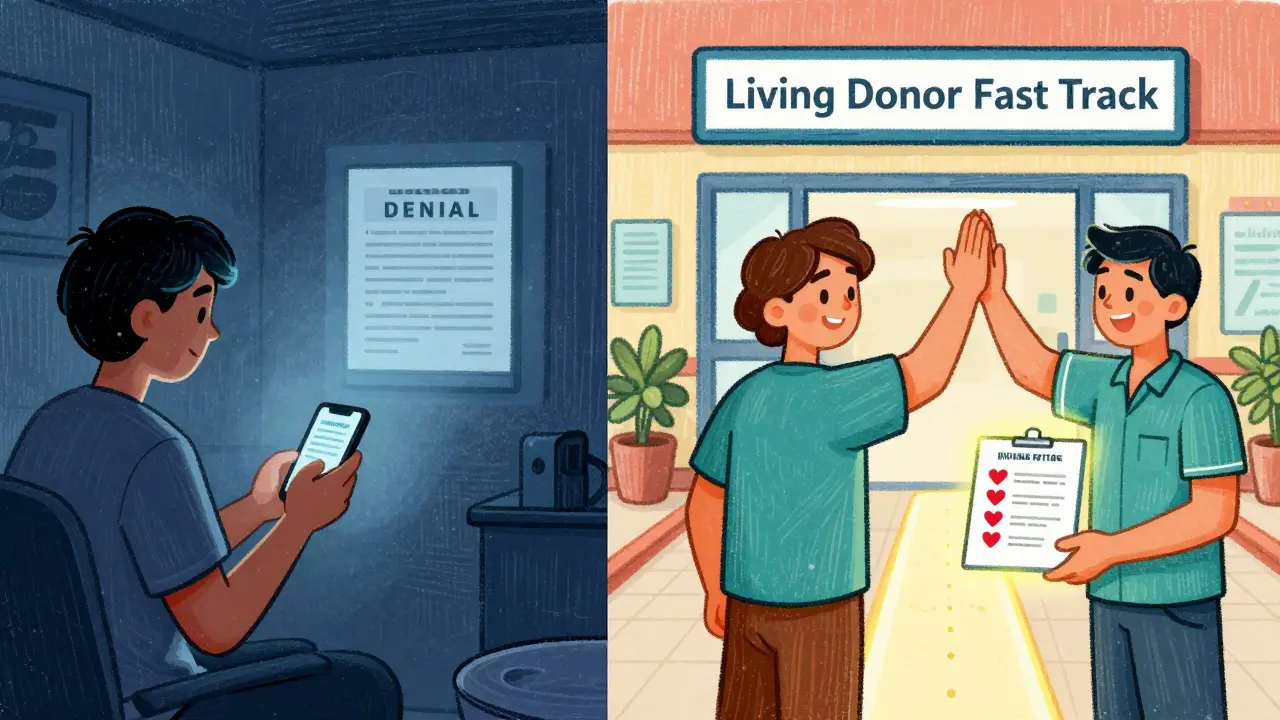
What Happens After You’re Listed
Once you’re on the waitlist, you’re not done. You’ll get a UNOS ID number. Your status changes based on your medical urgency. If you’re highly sensitized-meaning your body has built up antibodies against common tissue types-you’ll get priority. The 2024 OPTN update now prioritizes candidates with cPRA levels above 98%. That’s a big change. It means people who’ve had multiple transplants or blood transfusions are no longer stuck at the back of the line. You’ll need to keep in touch. Your coordinator will call if a kidney becomes available. You must be reachable 24/7. You’ll need to be able to get to the hospital within hours. You’ll also need to keep your health stable. If you gain weight, get an infection, or stop taking your meds, you can be temporarily removed from the list.Why Some People Don’t Make It
The system works, but it’s not perfect. Black patients still wait 28.4% longer than white patients on average. But centers that use structured pathways have cut that gap to just 12.1%. If your center doesn’t track racial disparities, ask them to. You have a right to equitable care. Other common reasons for delays? Missed appointments (18.3% of delays), insurance denials (24.1% of Medicaid cases), and incomplete paperwork. One patient on Reddit spent $8,200 out of pocket because their insurance didn’t cover a specific test. Keep every receipt. Track everything in a notebook or app. Your coordinator can help you appeal denials.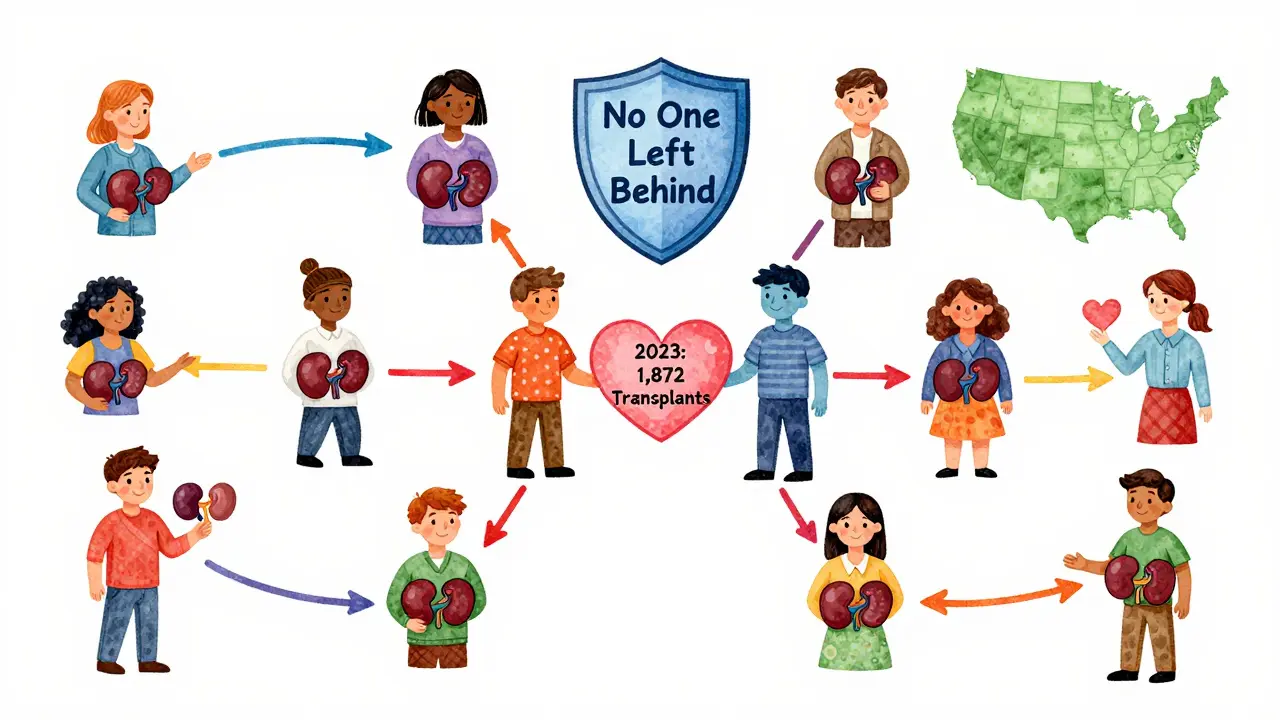
How to Prepare Right Now
If you’re in the evaluation phase, here’s what to do:- Get your medical records from the last 5 years-especially dialysis logs if you’ve had them.
- Bring the same support person to every appointment. They’ll remember things you miss.
- Use your patient portal. Check your test results. Don’t wait for a call.
- Call your insurance every week. Ask what’s covered. Ask what’s not.
- Start saving for medications. Even $50 a week adds up.
- Ask your coordinator: “What’s the next step? What do I need to do next week?”
What’s Changing in 2026
The End-Stage Renal Disease Transplant Act is rolling out new financial support. By 2026, CMS expects to cut evaluation abandonment rates by 15-20%. More centers are hiring coordinators. The goal is to complete 90% of evaluations within 120 days by 2027. HIV-positive patients can now receive kidneys from other HIV-positive donors-217 such transplants happened in 2023. That’s a huge leap from zero in 2013. You’re not alone. Over 102,000 people are on the waitlist right now. Many of them are doing exactly what you’re doing-showing up, asking questions, fighting for their next chance.How long does the kidney transplant evaluation take?
The evaluation usually takes 12 to 16 weeks for deceased donor candidates and 8 to 12 weeks for those with a living donor. High-volume transplant centers complete the process 23% faster. Completing it within 90 days of your first referral increases your chances of getting a transplant within two years by 22.7%.
Can I be denied a transplant even if my kidneys are failing?
Yes. Medical reasons like active cancer, severe heart disease, or uncontrolled infection can disqualify you. But psychosocial factors-like lack of support, unstable housing, or inability to manage medications-are actually the most common reason for denial, accounting for 32% of cases. You need to prove you can follow your medication plan and have someone to help you after surgery.
What if I don’t have a living donor?
You can still get a transplant from a deceased donor. About 60% of kidney transplants in 2023 came from deceased donors. The average wait time is 3.6 years, but being listed early and staying medically stable improves your odds. You can also join the Kidney Paired Donation Program if someone offers to donate but isn’t a match for you.
How much does the transplant evaluation cost?
Most tests are covered by insurance, but out-of-pocket costs can still reach $8,000 or more if some tests aren’t approved. Medicaid patients often face longer delays due to authorization issues. Keep all receipts and appeal denials. Your transplant coordinator can help you file appeals and connect you with financial aid programs.
What happens if I’m not approved for a transplant?
You’ll be told why. Some reasons are temporary-like needing to lose weight or control an infection. You can reapply after fixing the issue. Other reasons, like active cancer, are permanent. In those cases, your care team will help you explore other options like dialysis or clinical trials. You still have access to full medical care.
Sumit Mohan Saxena
February 28, 2026 AT 12:48The evaluation process for kidney transplantation is a meticulously structured clinical pathway designed to optimize long-term graft survival and patient adherence. Each component-from HLA typing to psychosocial screening-is evidence-based and grounded in decades of transplant outcomes research. The requirement for liquid asset verification, while stringent, reflects the reality that non-adherence to immunosuppressants is the leading cause of late graft failure. Institutions like Northwestern Medicine implement these protocols not as barriers, but as safeguards against preventable complications. It is not punitive; it is prophylactic.
Katherine Farmer
March 1, 2026 AT 13:09Let’s be real-this whole system is a bureaucratic labyrinth designed to filter out the ‘undeserving.’ The psychosocial evaluation isn’t about support-it’s about classism disguised as clinical rigor. Who gets approved? People with stable incomes, white-collar jobs, and two-parent households. The rest? They’re told to ‘get their act together’ while the system quietly relegates them to dialysis purgatory. And don’t get me started on how Medicaid patients are treated like second-class citizens. This isn’t healthcare. It’s a meritocracy with a stethoscope.
Angel Wolfe
March 1, 2026 AT 20:27They say insurance denies tests but nobody talks about how the government is secretly funding transplant centers to keep people on dialysis longer so they can bill Medicare more. That’s why they make you wait 3.6 years. It’s all about the money. I read a guy on Reddit who got denied because he didn’t have a ‘stable support system’-but he lived with his sister who works two jobs. That’s not instability, that’s American grit. The system is rigged. They don’t want you to get better. They want you dependent.
Sophia Rafiq
March 2, 2026 AT 10:52Living donor transplants are the real MVP here. 96% one-year graft survival? That’s insane. I know someone who got one from a coworker-no waiting, no drama, just a surgery and a recovery. The paired donation program is wild too. Like a kidney swap meet. People don’t realize how much this changes lives. And the fact that HIV+ donors can now give to HIV+ recipients? That’s science doing its job. Stop making it harder than it needs to be. Just connect the dots.
Martin Halpin
March 2, 2026 AT 19:21I find it deeply concerning that we’re normalizing this level of institutionalized gatekeeping under the guise of medical necessity. I’ve reviewed the literature on transplant eligibility criteria across 17 countries, and the U.S. system is uniquely punitive in its psychosocial assessments. In Germany, for instance, housing instability is addressed with social services integration-not denial. In Canada, financial barriers are mitigated through national coverage. Here? You get a spreadsheet and a sigh. And then we wonder why Black patients wait 28% longer. It’s not biology-it’s bias, dressed up in white coats and algorithmic checklists. We’ve turned compassion into compliance. That’s not healthcare. That’s control.
Charity Hanson
March 3, 2026 AT 14:37You got this. Seriously. I’ve been through this with my cousin-he was scared, overwhelmed, didn’t know where to start. But he kept showing up. Every appointment. Every call. Every appeal. He got listed in 78 days. Now he’s 2 years post-transplant and running marathons. It’s not easy, but it’s possible. Start saving $50 a week. Talk to your coordinator every Monday. Ask for the next step. Don’t wait for permission. Just move. One step. Then another. You’re not alone in this. We’re all rooting for you.
Justin Ransburg
March 5, 2026 AT 04:30Thank you for sharing such a comprehensive and clinically accurate overview. The emphasis on early completion of evaluation-within 90 days-is critical. Studies from the UNOS registry confirm that patients who complete evaluation within this window have a statistically significant improvement in both transplant likelihood and long-term survival. The integration of financial counseling and patient portal utilization are also evidence-based best practices. This is precisely the kind of structured, patient-centered guidance that transforms anxiety into agency.
Brandon Vasquez
March 5, 2026 AT 17:41I’ve sat in those evaluation rooms. The social worker asking if you have someone to help you after surgery? That’s not about judging you. It’s about saving your life. I had a transplant in 2019. I didn’t have family nearby. My neighbor drove me to every appointment for 11 months. She didn’t even know I was sick until I told her. Don’t underestimate the power of showing up-for yourself, for your team. You don’t need perfection. You just need persistence. And you’re already doing that.
Vikas Meshram
March 6, 2026 AT 18:11Correction: The average wait time for deceased donor kidney is 3.6 years but the median is 2.8. Also, the 2024 OPTN update prioritizes cPRA >98% not >95%. And the Kidney Paired Donation Program helped 1,872 in 2023, not 2022. You say Medicaid denials are 24.1% but the 2023 JASN paper states 21.7%. Minor inaccuracies matter in medical contexts. Precision is not pedantry-it’s patient safety. Also, you misspelled 'eGFR' as 'eGFR' in the first paragraph. Typo.
Ben Estella
March 8, 2026 AT 08:53They want you to fight for your kidney but they won’t let you fight for your rights. This whole system is a scam. You gotta be rich, white, and well-connected to get through. I’m a veteran. I served my country. Now I’m being told I don’t have enough assets? What’s next? Do I need to own a house and have a 401(k) to live? This ain’t America. This is a corporate hospital cartel. I’d rather die than play their game.