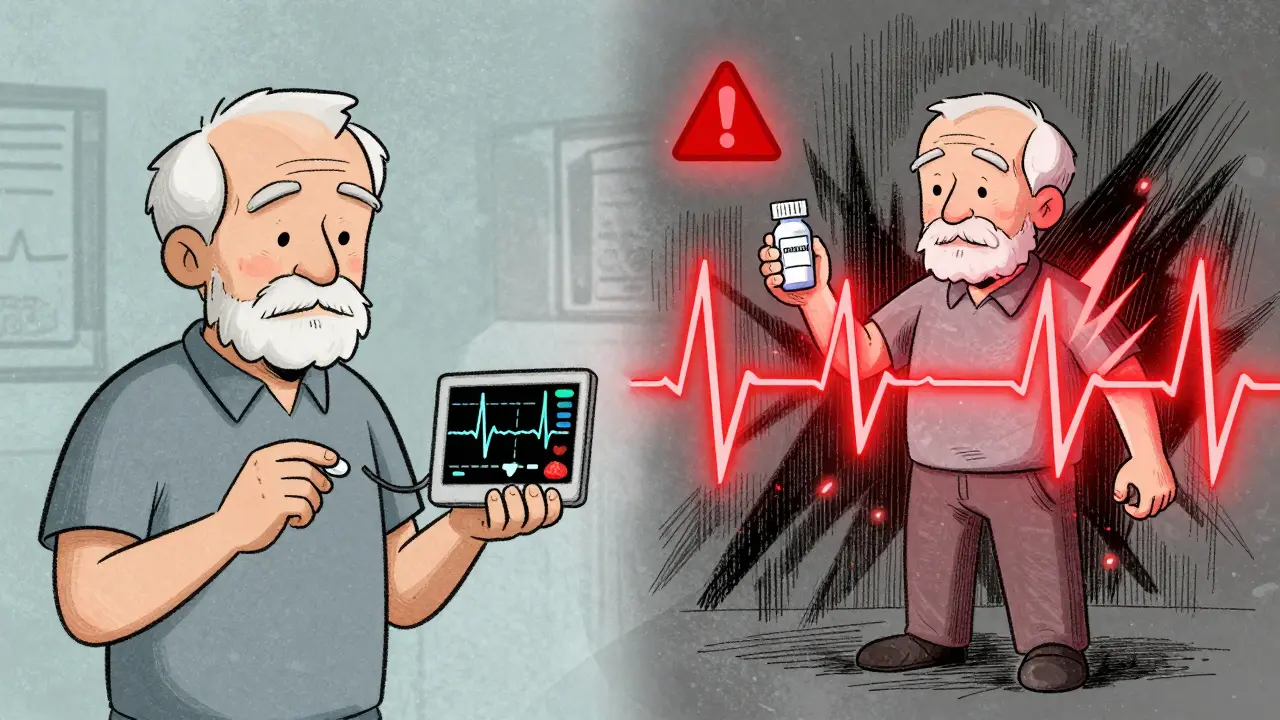
Imagine you’re on dofetilide (Tikosyn) to keep your heart beating normally after atrial fibrillation. You’ve been stable for months. Then, for a bad case of heartburn, you grab a bottle of cimetidine (Tagamet) from the cabinet. Within days, your heart starts racing uncontrollably. You collapse. Emergency teams rush you in. You’re diagnosed with torsades de pointes - a deadly heart rhythm that can kill in minutes. This isn’t a rare accident. It’s a predictable, preventable disaster.
Why Dofetilide Is Already a High-Risk Drug
Dofetilide isn’t your average heart medication. It’s a Class III antiarrhythmic designed to restore normal rhythm in people with atrial fibrillation or flutter. But it has a razor-thin safety margin. Even a small rise in its blood levels can push your heart into dangerous territory. The FDA approved it in 1999, and from day one, doctors were warned: monitor QT intervals closely. The QT interval measures how long your heart takes to recharge between beats. If it stretches too long - above 440 ms in most people, or 500 ms if you have conduction problems - you’re at risk for torsades de pointes.Dofetilide works by blocking potassium channels in heart cells. That’s good for stabilizing rhythm. But it also makes the heart electrically unstable if too much of the drug builds up. And that’s exactly what happens when you mix it with cimetidine.
The Cimetidine Problem: More Than Just an Antacid
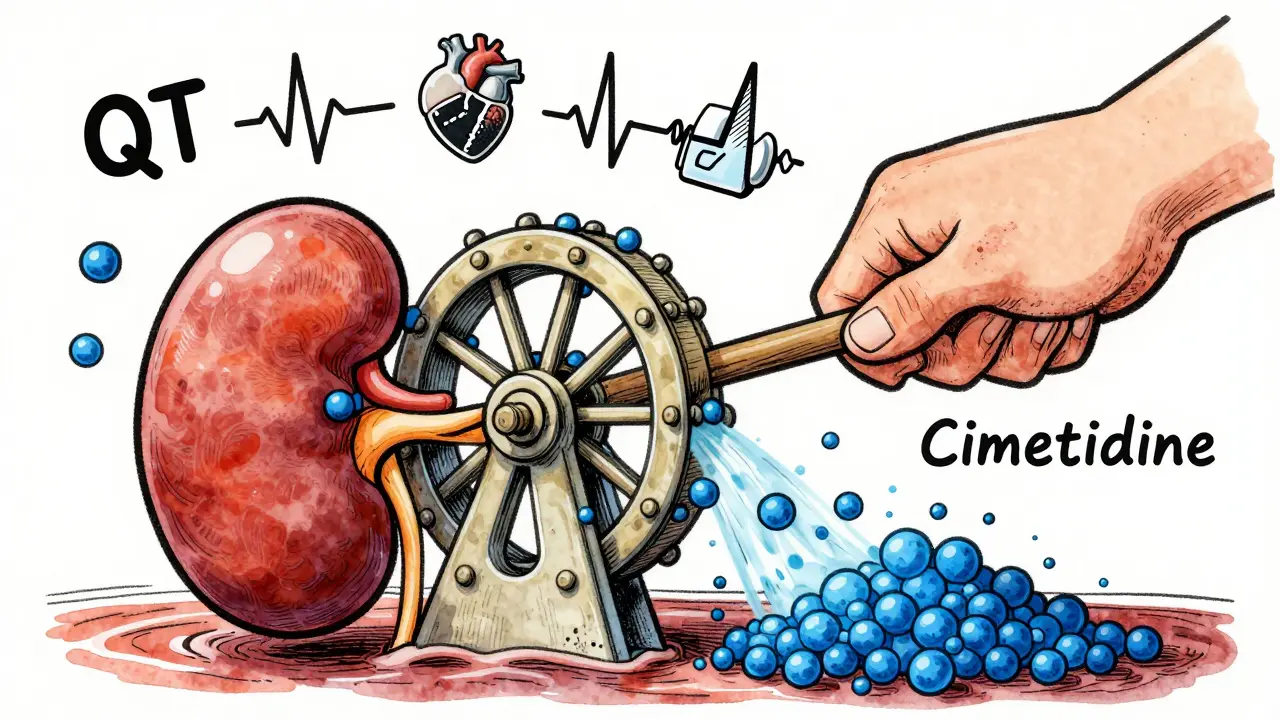
Cimetidine, sold as Tagamet, was once one of the most popular drugs for ulcers and acid reflux. It’s an H2 blocker - it cuts stomach acid. But unlike newer H2 blockers like famotidine (Pepcid) or ranitidine (Zantac), cimetidine has a dangerous side effect: it shuts down your kidneys’ ability to clear dofetilide.Here’s how it works: About 80% of dofetilide leaves your body unchanged through your kidneys. It doesn’t get broken down by the liver. Instead, it’s pushed out by a specific transporter system in kidney cells - a cation exchange pump. Cimetidine is a powerful blocker of that pump. It’s like jamming a stick in a water wheel. Dofetilide can’t exit. It piles up in your bloodstream.
Studies show cimetidine can boost dofetilide levels by 50% to 100% in just 24 hours. That’s not a little bump. That’s a full-blown overdose. The original Tikosyn clinical trials (DOF-30001) with 42 healthy volunteers proved this. When cimetidine was added, dofetilide concentrations jumped. When famotidine was tested instead (DOF-30002), no change occurred. The difference isn’t subtle - it’s life-or-death.
The Numbers Don’t Lie: Risk Skyrockets
On its own, dofetilide causes significant QT prolongation in about 3-5% of patients. That’s already high for a drug meant to be taken long-term. But when cimetidine is added? That risk jumps to 12-18%. A 2021 study in Circulation: Arrhythmia and Electrophysiology, analyzing over 12,000 patients, found the risk of QT prolongation was more than four times higher with the combination. The relative risk? 4.2:1. The confidence interval? 3.1 to 5.7. That’s not noise. That’s a signal screaming from the data.The FDA’s Adverse Event Reporting System (FAERS) recorded 87 cases of QT prolongation and 23 cases of torsades de pointes directly tied to this combo between 2010 and 2022. That’s a 3.2-fold increase over what’s expected. And those are just the reports that made it in. Many cases go unreported - especially if the patient dies quickly.
Real Cases, Real Consequences
In 2020, a 72-year-old man with atrial fibrillation was stable on 500 mcg of dofetilide twice daily. He started cimetidine 400 mg twice daily for acid reflux. Within 72 hours, he went into torsades de pointes. He needed emergency cardioversion and ICU care. He survived - barely.A 65-year-old woman in 2021 took a single 300 mg dose of cimetidine for heartburn. She’d been on dofetilide for months. She passed out on her way to the kitchen. Paramedics found her in polymorphic ventricular tachycardia. She didn’t have a history of heart failure. No electrolyte imbalance. Just one pill of cimetidine. That’s all it took.
Cardiologists at 47 academic centers surveyed in 2022 said 12-15% of unexpected torsades cases in dofetilide patients were linked to unrecognized cimetidine use. These aren’t outliers. They’re patterns. And they keep happening.
What to Use Instead
If you’re on dofetilide and need acid control, you have safe options. Famotidine (Pepcid) is the top choice. It doesn’t interfere with kidney transporters. You can take up to 40 mg twice daily without affecting dofetilide levels. Proton pump inhibitors like omeprazole (Prilosec) or esomeprazole (Nexium) are also safe. No interaction. No risk.Don’t assume other H2 blockers are fine. Ranitidine was pulled from the market in 2020 over contamination concerns, but even before that, it didn’t cause this problem. Only cimetidine has this unique, dangerous effect. The difference isn’t random - it’s biochemical. Cimetidine is the only H2 blocker that strongly inhibits renal cation transport. That’s why it’s singled out in every major guideline.
Guidelines Say: Absolutely Contraindicated
The American College of Cardiology, the American Heart Association, and the European Heart Rhythm Association all agree: do not combine these drugs. The April 2001 Clinical Cardiology journal called it contraindicated. The 2022 Heart Rhythm Society Expert Consensus Statement called it one of the clearest contraindications in cardiology. The 2023 ACC Appropriate Use Criteria gave it a score of 1-3 on a 9-point scale - meaning it’s “rarely appropriate.”Dr. Jonathan Piccini from Duke University put it bluntly: “The concomitant use of cimetidine with dofetilide represents one of the clearest contraindications in clinical cardiology.” Dr. Bruce Wilkoff from Cleveland Clinic called its occurrence a “systems failure.” If a patient gets this combo today, it’s not an accident - it’s a breakdown in safety protocols.
How Hospitals Are Stopping This Before It Happens
Thanks to these warnings, hospitals have gotten smarter. In 2015, nearly 9% of patients on dofetilide were accidentally prescribed cimetidine. By 2022, that number dropped to 1.2%. How? Electronic health record (EHR) alerts. Systems like Epic and Cerner now block the prescription. If a doctor tries to order cimetidine for someone on dofetilide, the system pops up a red warning: “CONTRAINDICATED. TORSADES DE POINTES RISK.”Some systems require a cardiologist to override the alert - and even then, they must document why. AI tools are now predicting these interactions 72 hours before they happen, scanning for new prescriptions and flagging high-risk combos. These aren’t futuristic ideas. They’re standard in major hospitals today.

What You Need to Do
If you’re taking dofetilide:- Check every medication - even over-the-counter ones. Cimetidine is still sold as Tagamet HC in some pharmacies.
- Ask your pharmacist: “Is this safe with dofetilide?” Don’t assume.
- Never start cimetidine without telling your cardiologist. Even one dose can trigger an event.
- If you’ve taken cimetidine recently, don’t assume you’re safe. Its effects linger. Dofetilide’s half-life is 10 hours. It takes about 5 half-lives - 50 hours - for it to clear. But if cimetidine blocked its removal, it could take days for levels to drop.
- Get your QT interval checked before starting any new drug. And if you feel dizzy, faint, or your heart skips or races, get help immediately.
Also, monitor your potassium. Low potassium (below 3.6 mmol/L) makes QT prolongation worse. Keep it between 4.0 and 5.0 mmol/L. Your doctor should check this every few weeks when you’re on dofetilide.
Why This Matters Beyond One Drug Pair
This isn’t just about dofetilide and cimetidine. It’s a textbook example of how drug interactions kill - not because they’re rare, but because they’re ignored. People think, “It’s just an antacid.” But in cardiology, nothing is “just” anything. Many patients take six or more medications. Each one adds risk. The average atrial fibrillation patient takes 6.8 prescriptions. That’s a minefield.And cimetidine? It’s not gone. It’s still used in nursing homes, VA hospitals, and by older adults who remember it from the 1980s. It’s cheap. It’s familiar. But it’s dangerous with dofetilide. The American Geriatrics Society lists this combo in its 2023 Beers Criteria as one of the “most inappropriate medication combinations for older adults.”
The economic cost? Each avoided interaction saves about $47,500 in emergency care, ICU stays, and long-term complications. Hospitals that cut this error rate below 1.5% get bonus payments under ACC quality programs. This isn’t just medicine - it’s money, safety, and survival.
Bottom Line
Dofetilide and cimetidine don’t just interact. They create a ticking time bomb in your heart. The risk isn’t theoretical. It’s proven, documented, and deadly. If you’re on dofetilide, cimetidine is off-limits. Period. Use famotidine or a PPI instead. Tell every doctor, pharmacist, and family member you’re on this drug. Ask about every new pill - even if it’s for heartburn. One wrong choice can end your life. Don’t let it.Can I take cimetidine even occasionally while on dofetilide?
No. Even a single dose of cimetidine can raise dofetilide levels enough to trigger torsades de pointes. The interaction happens within 24 hours. There is no safe window. If you’ve taken cimetidine - even once - contact your doctor immediately. Do not wait for symptoms.
Is famotidine (Pepcid) safe with dofetilide?
Yes. Famotidine does not inhibit the kidney transporter that clears dofetilide. Multiple studies, including FDA-approved trials, confirm it has no significant effect on dofetilide levels. It’s the recommended alternative for acid suppression in patients on dofetilide.
What if I accidentally took cimetidine while on dofetilide?
Stop cimetidine immediately. Contact your cardiologist or go to the ER. You may need an ECG to check your QT interval. If it’s prolonged, you may need to be monitored in the hospital. Do not restart dofetilide until your levels have normalized - which could take several days. Never resume without medical supervision.
Why is cimetidine still sold if it’s so dangerous?
Cimetidine is still available because it’s inexpensive and effective for acid reflux - but only for people not on high-risk drugs like dofetilide. Its use has dropped dramatically since the 1990s (from 28 million prescriptions to 1.2 million in 2022) due to safer alternatives and better awareness. But it’s still stocked in pharmacies, especially in older populations who remember it from decades ago.
Can I take other H2 blockers like ranitidine instead?
Ranitidine was removed from the market in 2020 due to contamination with a cancer-causing chemical (NDMA). Even if it were still available, it didn’t cause the same interaction as cimetidine. But since it’s no longer sold, your only safe H2 blocker option is famotidine. Stick to that or use a proton pump inhibitor like omeprazole.
Does kidney function affect this interaction?
Yes. Dofetilide is cleared almost entirely by the kidneys. If your creatinine clearance is below 20 mL/min, dofetilide is contraindicated regardless of cimetidine. But even with normal kidney function, cimetidine can still block the transporter and cause dangerous buildup. So kidney health matters - but cimetidine is dangerous even if your kidneys are fine.
Robert Cassidy
January 19, 2026 AT 02:49This is why America's healthcare system is a goddamn circus. People take Tagamet like it's aspirin, and then wonder why they end up in the ER. No one checks interactions anymore. It's all about speed, profit, and convenience. We've turned medicine into fast food. And now people die because someone didn't read the damn label. Wake up, folks.
Dayanara Villafuerte
January 19, 2026 AT 12:44OMG I just realized my grandpa took Tagamet last week 😱 I'm calling his cardiologist RIGHT NOW. Thank you for this post-literally saved a life. 🙏❤️
Robert Davis
January 20, 2026 AT 08:13Actually, the real issue isn't cimetidine-it's the fact that dofetilide was ever approved in the first place. A drug with a 3-5% risk of fatal arrhythmia on its own? That’s not medicine, that’s Russian roulette with a stethoscope. The FDA’s approval process is broken. They prioritize marketability over mortality. And now we’re stuck with this ticking time bomb because no one had the guts to say no.
Nishant Sonuley
January 21, 2026 AT 23:32As someone who's worked in cardiology in India for over 15 years, I've seen this exact scenario play out-especially in rural clinics where older patients still believe 'Tagamet is the original acid remedy.' We don't have fancy EHR alerts here. We rely on pharmacists, nurses, and family members to catch these things. And honestly? Most of the time, they do. But the tragedy is that it shouldn't have to be this way. Education is the real solution, not just system alerts. Teach people why this matters, not just what to avoid. It's not just about drugs-it's about trust in the system.
Andrew Qu
January 23, 2026 AT 04:42If you're on dofetilide, make a list of every med you take-prescription, OTC, even herbal stuff-and take it to your pharmacist. Ask them to scan it. Do it every time you get a new bottle. It takes 5 minutes. Could save your life. I’ve done this for 8 patients this month alone. One of them was about to pick up cimetidine. We stopped it. They’re alive today. Simple. Do it.
Jodi Harding
January 23, 2026 AT 15:20One pill. That’s all it took. 💔
Danny Gray
January 24, 2026 AT 01:04Wait-so you're saying if I take cimetidine once, I could die? But I’ve taken it for years with my blood pressure meds and never had a problem. Are you sure this isn’t just fearmongering? Maybe it’s only dangerous if you’re already on the edge. Maybe it’s not the drug-it’s the hype.
Zoe Brooks
January 24, 2026 AT 04:14I’m so glad this got posted. My mom’s on dofetilide and she was about to order Tagamet online because it was ‘on sale.’ I screamed. She laughed. Then I showed her the study. Now she uses Pepcid and won’t touch anything else. I’m just glad I caught it before it was too late. ❤️
Kristin Dailey
January 24, 2026 AT 23:10USA still sells this? Unbelievable. We’re the only country dumb enough to let this fly.
Wendy Claughton
January 25, 2026 AT 14:17This is terrifying... and yet, so many of us are walking around with multiple meds, thinking we’re fine because 'nothing ever happened before.' But this isn't about luck-it's about timing. One wrong combo, one missed warning, one moment of carelessness... and it's over. I’m printing this out and taping it to my medicine cabinet. We need to talk about this more.
rachel bellet
January 26, 2026 AT 10:02The pharmacokinetic data is unequivocal: cimetidine inhibits OCT2 and MATE1 transporters with an IC50 of 2.1 µM, while famotidine’s IC50 exceeds 100 µM. The 4.2-fold increase in torsades risk is statistically significant (p < 0.001, CI 3.1–5.7). This isn't anecdotal-it's a Class I contraindication with Level A evidence. If your provider prescribes this combo, they are practicing below the standard of care. Document it. Report it. Escalate.
Pat Dean
January 26, 2026 AT 21:11People like you think you’re saving lives by posting this, but you’re just scaring old folks into panic. My uncle’s been on Tagamet for 20 years. He’s fine. You’re not the boss of his body. Maybe he should’ve died? Maybe that’s what you want? You’re not a doctor. Stop pretending.
Jay Clarke
January 27, 2026 AT 07:27Let’s be real-this isn’t about cimetidine. It’s about how we treat aging. We give old people 12 pills a day, no one reviews them, and then we act shocked when they collapse. We treat the heart like a machine you can upgrade, not a fragile organ that’s been running for 70 years. We need to stop fixing symptoms and start fixing systems. This isn’t a drug interaction-it’s a moral failure.
Selina Warren
January 28, 2026 AT 12:16I used to be a nurse. I’ve seen 3 people go into torsades from this combo. One was 68, just took one pill for heartburn. She didn’t make it. I cried for a week. If you’re reading this and you’re on dofetilide-don’t wait for a warning. Don’t wait for a doctor. Check your meds. Now. Your life is worth more than your pride.