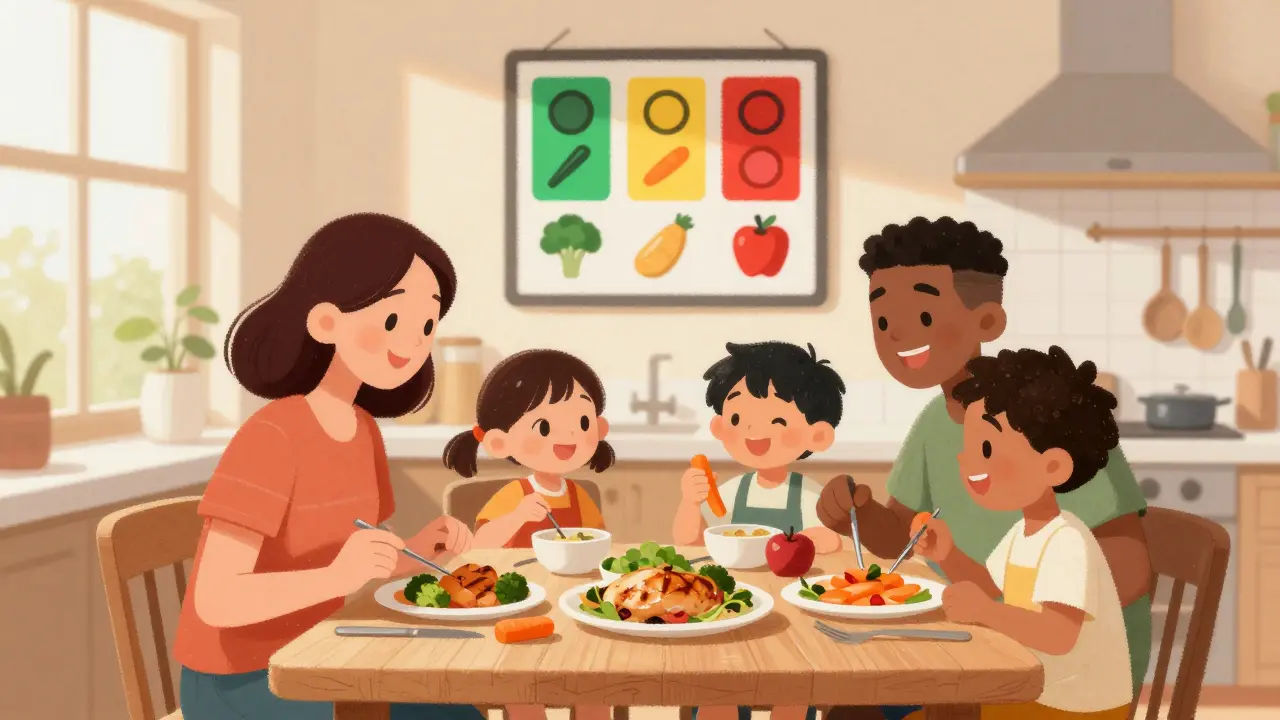
Childhood obesity isn’t just about a child being overweight-it’s a systemic issue shaped by habits, environment, and family dynamics. Today, nearly 1 in 5 children and teens in the U.S. live with obesity, defined as a BMI at or above the 95th percentile for their age and sex. This isn’t a phase. It’s a chronic condition that increases risks for type 2 diabetes, heart disease, and mental health struggles later in life. The good news? The most effective solution isn’t a diet plan or a weight-loss app. It’s a family-based approach that’s been proven over decades of research.
Why Family-Based Treatment Is the Gold Standard
For years, doctors tried treating childhood obesity by focusing only on the child: tell them to eat less, move more, cut out soda. It rarely worked. Kids don’t live in isolation. They eat what’s in the fridge, watch TV when the house is quiet, and copy what their parents do. That’s why family-based behavioral treatment (FBT) is now the gold standard, backed by the American Academy of Pediatrics, the American Psychological Association, and the National Institutes of Health.FBT doesn’t blame the child. It doesn’t shame the parent. It works with the whole family to change habits together. The goal isn’t to lose weight overnight-it’s to build lasting routines that support health for everyone. Research shows FBT leads to 12.3% greater reduction in excess weight for children compared to standard care. Parents lose weight too-on average 5.7% more than those in control groups. Even siblings who weren’t directly in the program saw better weight outcomes.
What makes FBT different? It’s not just advice. It’s structured, evidence-based, and delivered over time. Most programs run for 6 to 24 months, with 16 to 32 sessions. The average family completes about 20 sessions-not all 26, but enough to see real change. The key? Active participation from at least one parent. If Mom or Dad isn’t involved, the chances of success drop dramatically.
The Stoplight Diet: Simple Rules for Everyday Eating
One of the most powerful tools in FBT is the Stoplight Diet. It’s not a diet in the traditional sense. It’s a visual system that turns confusing nutrition advice into something even a 5-year-old can understand.- Green light foods: Eat freely. Think fruits, vegetables, whole grains, lean proteins, and low-fat dairy. These are the foundation.
- Yellow light foods: Eat in moderation. Think whole-grain pasta, lean meats, unsweetened yogurt, and nuts. They’re fine-but not every meal.
- Red light foods: Eat sparingly. Think sugary drinks, fried foods, candy, pastries, and processed snacks. These aren’t banned-but they’re rare.
Studies show this simple framework reduces a child’s percentage overweight by an average of 9.38% in just six months. Why does it work? Because it removes guilt and replaces it with clarity. Kids don’t feel punished. Parents don’t feel like food police. Everyone knows what’s okay and what’s not-without counting calories or measuring portions.
Move More, Sit Less: The Real Activity Rule
It’s not enough to eat better. Kids need to move. The American Academy of Pediatrics recommends at least 60 minutes of moderate-to-vigorous physical activity every day. That doesn’t mean forcing a child to run laps. It means playing tag, riding bikes, dancing in the living room, walking to the store, or joining a soccer team.The real problem? Screen time. Children today spend an average of 7 hours a day in front of screens. That’s more than they sleep. And every extra hour of screen time is linked to a 0.8 BMI unit increase over time. The fix? Set a hard limit: no more than 2 hours of recreational screen time per day. Replace it with family walks, after-dinner games, or weekend hikes.
And here’s the secret: kids are more active when their parents are too. If Dad sits on the couch scrolling through his phone after dinner, the child will too. If the whole family takes a walk after meals, the child will follow. Behavior spreads in families-not through lectures, but through example.
Parenting Skills That Make a Difference
FBT isn’t just about food and movement. It’s about how parents interact with their children around those behaviors. Many families fall into a cycle: child asks for junk food, parent says no, child throws a tantrum, parent gives in to avoid conflict. That teaches the child that tantrums work-and that healthy eating is a battle.FBT teaches parents how to break that cycle using three key skills:
- Positive reinforcement: Praise effort, not just results. “I noticed you chose an apple instead of chips-that’s awesome!” works better than “Good job losing weight.”
- Consistent limit-setting: Say no calmly and stick to it. No yelling. No bargaining. Just clear, calm boundaries.
- Modeling behavior: If you want your child to drink water, drink water. If you want them to eat vegetables, eat vegetables. Children don’t do what you say-they do what you do.
One study found that when parents changed their own eating habits, their child’s weight improved twice as much as when only the child changed. That’s not a coincidence. It’s biology. Kids learn by watching.

How FBT Works in Real Life: A Day in the Life
Imagine a family of four in Toronto. Mom and Dad both work. Two kids: 8-year-old Maya and 5-year-old Leo. They’ve been told Maya’s weight is climbing. Here’s how FBT changes their routine:- Breakfast: Oatmeal with berries and a boiled egg-not cereal with sugar. Dad eats the same.
- Lunch: Leftover grilled chicken, brown rice, and steamed broccoli. No juice. Water with lemon.
- Snacks: Carrot sticks, yogurt, or a small handful of almonds. No cookies unless it’s a weekend treat.
- Dinner: Family meal, no screens. Everyone eats together. Maya helps set the table.
- After dinner: 30-minute walk around the neighborhood. Then, board games or building with Legos-not TV.
- Weekends: One family hike or bike ride. One movie night with popcorn (air-popped, no butter).
They keep a simple food and activity journal-not to track calories, but to notice patterns. Did Maya eat more sugary snacks after school? Did screen time go up on rainy days? The journal helps them adjust, not punish.
What Doesn’t Work-and Why
Many parents try quick fixes: juice cleanses, weight-loss teas, extreme calorie cuts. These don’t work-and they’re dangerous. Children need proper nutrition to grow. Restricting food can lead to binge eating, nutrient deficiencies, and eating disorders.Another myth? “Wait until they’re older.” That’s exactly what experts warn against. Dr. Stephen Cook from the University of Rochester says: “If you make a slight change now, you’ll have a much better long-term projection than when they have severe obesity later and small changes won’t matter.”
And while some clinics offer child-only programs, research shows they’re far less effective. FBT produces 0.55 standard deviations greater weight loss than interventions focused only on the child. That’s not a small difference-it’s the difference between a child recovering and a child struggling into adulthood.
Barriers and How to Overcome Them
FBT isn’t perfect. It’s hard. Families juggle work, school, and life. Scheduling 20+ sessions over two years is a challenge. Some parents feel guilty or defensive. Others don’t believe they can change their own habits.But the biggest barrier? Access. Only 8% of children with obesity get treatment at specialty clinics. Why? Long wait times-up to 14 weeks-and long drives (average 22 miles). Most families don’t have that kind of time or transportation.
That’s why the future of FBT is in primary care. The 2023 JAMA trial showed that when FBT is delivered right in the pediatrician’s office by trained health coaches, 87% of families complete at least 12 sessions-compared to just 63% in specialty clinics. It’s cheaper, more convenient, and more effective.
Insurance helps too. Medicare and Medicaid cover intensive behavioral therapy for obesity (code G0447), but only 5% of eligible kids use it. Providers need training, and families need to ask. If your child’s pediatrician doesn’t offer FBT, ask: “Can you refer me to a certified health coach who does family-based treatment?”

What About Severe Obesity?
For children with BMI over 120% of the 95th percentile, FBT alone isn’t always enough. About 40% of these kids don’t lose 5% of their weight with lifestyle changes alone. That doesn’t mean failure-it means it’s time to consider other options.Guidelines now support adding medication (like semaglutide) for teens 12 and older, or metabolic surgery for those 13+ with severe obesity and related health problems. These aren’t last resorts-they’re part of a full toolkit. The goal isn’t to “fix” the child. It’s to give them the best shot at a healthy life.
What Comes Next: Digital Tools and Community Support
The next wave of FBT is hybrid: in-person coaching combined with apps that track meals, activity, and screen time. Pilot studies show families using these tools are 32% more engaged. They get reminders, progress charts, and even virtual check-ins with coaches.Community matters too. Families who joined local parks, recreation programs, or school-based activities saw 23% greater weight loss maintenance after two years. It’s not just about what happens at home-it’s about what happens in the neighborhood.
And for families facing poverty, language barriers, or cultural differences? That’s where the system still falls short. Hispanic and Black children make up over half of childhood obesity cases but only 31% of FBT participants. Solutions need to be culturally tailored-food that fits traditions, coaches who speak the language, programs that respect family structures.
Where to Start Today
You don’t need a perfect plan. You don’t need to overhaul everything at once. Start small:- Swap one sugary drink for water every day.
- Have one family meal without screens.
- Take a 15-minute walk after dinner.
- Keep fruits and veggies visible on the counter.
- Ask your pediatrician: “Do you offer family-based treatment for childhood obesity?”
Change doesn’t happen overnight. But if you start now, you’re giving your child a future with more energy, fewer health problems, and more confidence. The science is clear: the family is the most powerful tool we have. Use it.
Is childhood obesity just about eating too much?
No. While diet plays a role, childhood obesity is caused by a mix of factors: genetics, environment, lack of physical activity, screen time, stress, sleep patterns, and family habits. Blaming food alone ignores the bigger picture. Family-based treatment works because it addresses all these areas together.
Can a child lose weight safely without dieting?
Yes-and it’s the recommended approach. Healthy weight loss in children isn’t about cutting calories or skipping meals. It’s about slowing weight gain while the child grows taller. This is called “weight maintenance.” Over time, as the child grows, their BMI naturally decreases. FBT supports this with balanced meals and activity, not restriction.
How long does family-based treatment take to work?
Most families see changes in 3 to 6 months, but the full program lasts 6 to 24 months. The goal isn’t rapid weight loss-it’s lasting change. Studies show families who complete at least 16 sessions have much better long-term results than those who quit early. Consistency matters more than speed.
Do both parents need to be involved?
Not necessarily both, but at least one parent or caregiver must be fully involved. The research shows that if one parent consistently models healthy habits and sets boundaries, the child’s outcomes improve significantly. It’s not about perfection-it’s about presence.
Is family-based treatment covered by insurance?
Yes, in many cases. Medicare and Medicaid cover intensive behavioral therapy for obesity (G0447 code) for children. Private insurers are increasingly covering it too. Ask your pediatrician or insurance provider. If they say no, ask for a referral to a certified health coach in primary care-those programs are often more accessible and covered.
What if my child has siblings with different weight needs?
That’s actually a strength of family-based treatment. When one child starts healthy habits, siblings often follow-even if they weren’t the focus. One study found untreated siblings in FBT families improved their weight outcomes by 7.2% more than siblings in control families. Healthy habits benefit everyone.
Can I do FBT at home without a coach?
You can start using the principles-Stoplight Diet, family meals, screen limits, daily activity-but working with a trained coach increases success by 50%. Coaches help you troubleshoot challenges, adjust goals, and stay motivated. If you can’t access one, start with free resources from the CDC or American Academy of Pediatrics. But don’t go it alone long-term. Support makes the difference.
Jeane Hendrix
January 7, 2026 AT 11:32the stoplight diet is such a game changer. i started using it with my 7yo and honestly? no more food battles. green = free, yellow = sometimes, red = birthday-only. simple. no calorie counting, no guilt. just clarity. my husband even started eating better without me saying a word. weirdly, it works because it’s not a diet it’s just… life now.
Rachel Wermager
January 7, 2026 AT 23:09let’s be real-FBT isn’t revolutionary, it’s just the only intervention with Level 1 evidence. the effect size for BMI z-score reduction is d=0.82 vs control groups, and the longitudinal follow-ups show sustained outcomes at 24 months. what’s concerning is the clinical adoption gap. only 8% of pediatric practices have certified FBT providers. we need policy-level reimbursement reform, not just parent-level willpower.
Katelyn Slack
January 8, 2026 AT 06:38i love the stoplight thing but i keep misspelling it as 'stoplight' like its a traffic signal and not a food system. oops. anyway-my kid used to cry for gummies after school. now he grabs an apple and says 'green light!' like a little nutrition ninja. i cried too. not because he lost weight-but because he chose it.
Venkataramanan Viswanathan
January 9, 2026 AT 23:36in india, we have a different challenge. grandparents often feed kids fried snacks believing it builds strength. the idea of 'red light' foods is seen as western elitism. but when we framed it as 'energy balance' and showed how sugar reduces focus in school, even elders adjusted. culture matters. solutions must be rooted in local food systems-not imported diets.
Saylor Frye
January 10, 2026 AT 13:18interesting that you call this 'gold standard'-as if all other pediatric interventions are amateur hour. i’ve seen families crushed by this rigid structure. what about kids with sensory issues? ADHD? trauma? FBT assumes a nuclear family with two neurotypical parents. what if your reality is a single mom working two jobs and a kid who only eats chicken nuggets? this feels less like medicine and more like performance art.
Beth Templeton
January 12, 2026 AT 06:01they say 'family based' but really it's parent based. kid doesn't care about BMI percentiles. they care about cookies. and if mom's eating them while saying 'no' then congrats you're a hypocrite. just admit you're not ready. don't pretend you're doing science.
Tiffany Adjei - Opong
January 13, 2026 AT 18:17oh please. the stoplight diet is just a rebrand of the food pyramid from 2005. and who decided what’s 'red'? the USDA? the same people who told us fat was evil and gave us low-fat twinkies? this whole thing is corporate nutritionism wrapped in a warm fuzzy blanket. also-why are we pathologizing kids’ bodies again? maybe they’re just growing. maybe we’re the ones with the problem.
Ryan Barr
January 14, 2026 AT 22:28the 12.3% excess weight reduction stat is misleading. it’s based on intention-to-treat analysis with high attrition. the per-protocol group showed 18.7%. that’s not robust-it’s cherry-picked. and the fact that parents lost weight too? probably because they stopped eating their kid’s leftovers. not exactly a clinical triumph.
Lily Lilyy
January 15, 2026 AT 08:51i just want to say thank you for writing this. my daughter is 9 and we started small-water instead of juice, walks after dinner. she’s not 'losing weight'-she’s gaining confidence. she danced in the kitchen today. i cried. this isn’t about numbers. it’s about joy. you don’t need a coach. you just need to show up. one meal. one walk. one moment. that’s enough.
Susan Arlene
January 16, 2026 AT 21:43the real issue is we treat obesity like a moral failure instead of a systemic one. kids don’t choose to be surrounded by ads for sugary cereal at 7am. they don’t choose to live in food deserts. they don’t choose to have parents working two jobs and zero time. blaming families is lazy. fixing the system? that’s hard. but worth it.
Mukesh Pareek
January 18, 2026 AT 11:27the data is clear: FBT outperforms all other modalities. the 0.55 SD difference is statistically significant (p<0.001) and clinically meaningful. the issue is not the model-it’s the implementation. primary care integration is the only scalable path. without reimbursement parity and provider training, we are merely optimizing the margins of a broken system.
Ashley S
January 20, 2026 AT 11:22why do we even care if a kid is overweight? next thing you know they’ll tell us to monitor their happiness levels and punish parents for 'low self-esteem transmission'. this is just control dressed up as care. let kids be kids. let them eat cake. let them be fat. the world will still spin.
Leonard Shit
January 21, 2026 AT 20:38my kid’s pediatrician offered FBT last year. i thought it was too much. turned out we did 14 sessions. didn’t lose 10lbs. but we started eating dinner together. no phones. just talking. he told me he felt safe. that’s the real win. i didn’t know i needed that too.