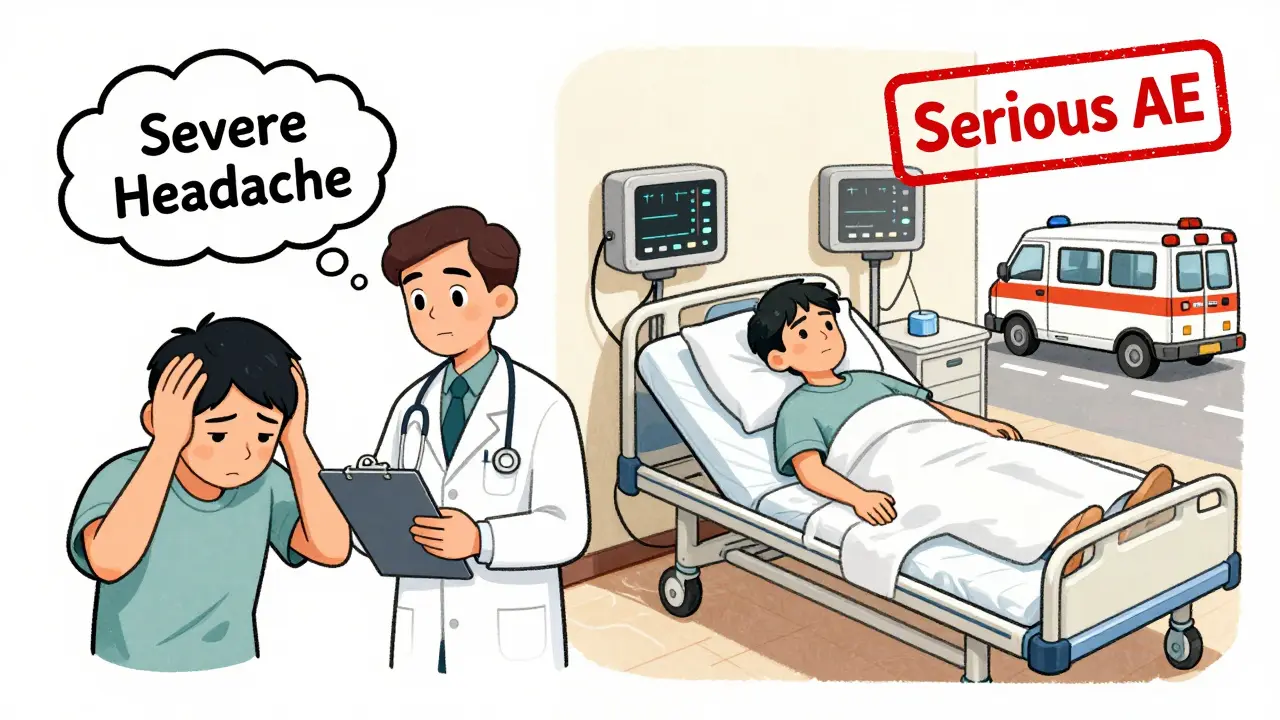
When you're running a clinical trial, every patient reaction matters-but not every reaction needs to be reported the same way. Confusing a serious adverse event with a non-serious one can delay real safety signals, waste staff time, and even put patients at risk. The difference isn’t about how bad the symptom feels. It’s about what happened to the person.
What Makes an Adverse Event 'Serious'?
An adverse event (AE) is any unwanted medical occurrence during a clinical trial, whether or not it’s linked to the drug or device being tested. But only some of these are serious. The FDA and global regulators define serious adverse events (SAEs) by six specific outcomes-not by how intense the symptoms are. A serious adverse event is one that:- Results in death
- Is life-threatening (meaning the patient was at immediate risk of death at the time of the event)
- Requires hospitalization or extends an existing hospital stay
- Causes persistent or significant disability or incapacity
- Leads to a congenital anomaly or birth defect
- Requires medical or surgical intervention to prevent permanent harm
That’s it. No more, no less.
Let’s say a patient on a new diabetes drug gets a bad headache. It’s pounding. They can’t focus. They take two painkillers and rest for a day. That’s a severe headache-but not a serious one. No hospitalization. No risk of death. No lasting damage. It’s non-serious.
Now imagine the same patient has a seizure. They’re rushed to the ER. They spend two nights in the hospital. That’s a serious adverse event-even if the headache before it was mild. The outcome changed everything.
The confusion between severity and seriousness is the #1 mistake in clinical safety reporting. A 2020 report from the Clinical Trials Transformation Initiative found that nearly 37% of events reported as serious didn’t actually meet the criteria. That’s thousands of reports every year that flood systems, distract reviewers, and hide real dangers.
When You Must Report a Serious Event
If an event meets any of the six seriousness criteria, it’s not just important-it’s urgent. Investigators must report it to the sponsor within 24 hours of learning about it. That clock starts the moment they know the details, not when they finish paperwork or consult the protocol.And it doesn’t matter if the event seems unrelated to the study drug. Even if you think it’s just bad luck, you still report it. The sponsor will decide later whether it’s connected.
For the Institutional Review Board (IRB), the timeline is slightly longer: serious events must be reported within 7 days. But if the event is unexpected and serious-meaning it wasn’t listed in the study’s safety profile-the sponsor must report it to the FDA within 7 days for life-threatening cases, and 15 days for others.
Non-serious events? They’re handled differently. These go into the Case Report Form (CRF) and are reported in routine summaries-monthly or quarterly-depending on the study’s Data and Safety Monitoring Plan. You don’t call anyone. You don’t rush. You just log it. That’s by design. It keeps the system from being drowned in noise.
Why This Distinction Exists
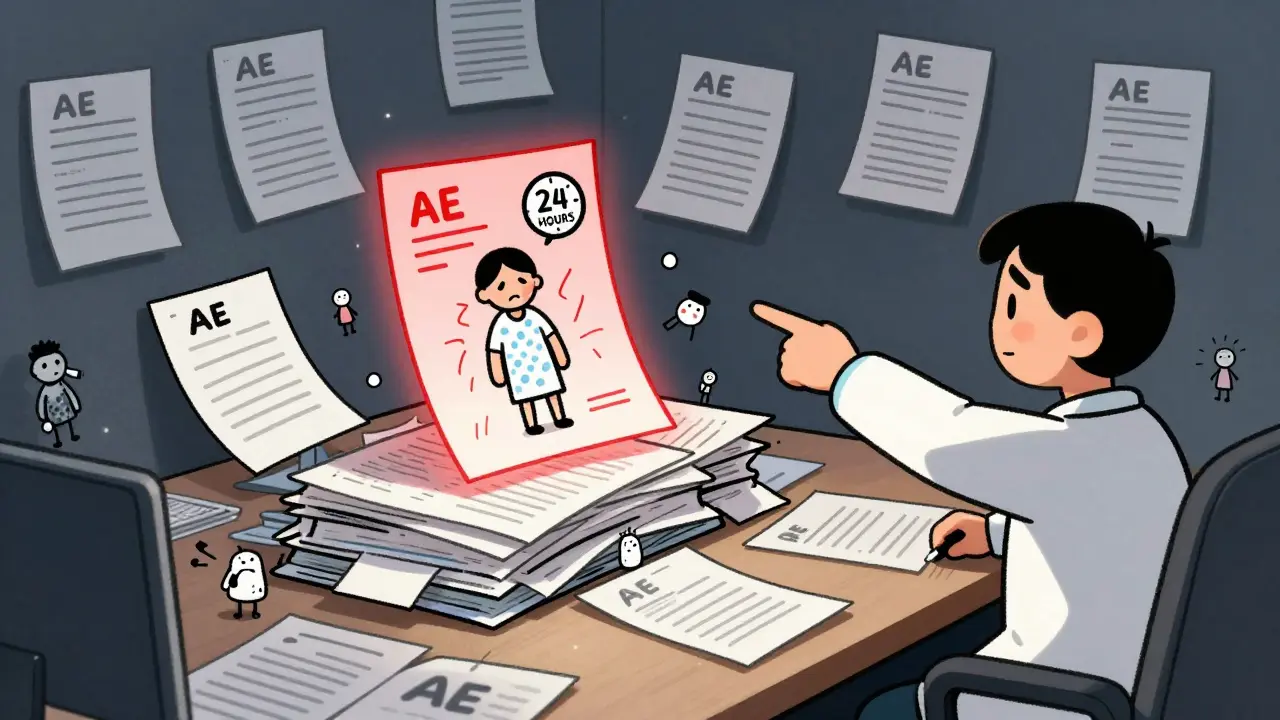
Imagine you’re a safety officer at a drug company. Every day, your team gets hundreds of AE reports. Most are colds, bruises, nausea that goes away. But buried in there could be the first sign of a new heart rhythm problem linked to your drug. If every mild symptom triggers an emergency alert, you’ll miss the real signal.That’s exactly what’s happening. The FDA’s Sentinel Initiative has processed over 14 million adverse event reports since 2008. Only 18% of them were serious. That means 82% were noise. In 2020, nearly 29% of expedited reports sent to the European Medicines Agency didn’t meet seriousness criteria. That’s tens of thousands of hours wasted reviewing events that didn’t need urgent review.
It’s not just inefficient-it’s dangerous. When people get used to false alarms, they start ignoring them. And when a real safety signal comes in, it might get lost in the pile.
Dr. Janet Woodcock, former director of the FDA’s drug center, said it plainly: “The current system is overwhelmed by non-serious events reported as serious.”
How to Get It Right
The good news? There are clear tools to help.The NIH’s 2018 guidelines offer a simple four-question decision tree:
- Did the event cause death?
- Was it life-threatening?
- Did it require hospitalization or extend a stay?
- Did it cause lasting disability or birth defects?
If the answer is “yes” to any one of these, it’s serious. Report it immediately.
For severity-how bad the symptom feels-use the Common Terminology Criteria for Adverse Events (CTCAE). That’s separate. CTCAE grades symptoms from 1 (mild) to 5 (death). But severity doesn’t trigger reporting timelines. Outcome does.
Most major research sites now train staff annually on this distinction. A 2023 report showed 98.7% of top institutions require this training. Still, mistakes happen.
At UCSF, over 40% of AE reports submitted in 2022 needed clarification. In oncology trials, where patients are often already sick, inconsistency hit 78%. One patient with low platelets after chemo? That’s expected. But if those platelets drop so low they bleed uncontrollably? That’s serious-even if the patient didn’t die.
What’s Changing Now
Regulators are fixing the system.In 2022, the European Union rolled out a new Clinical Trials Regulation that standardized seriousness definitions across all 27 member states. The result? A 34.8% drop in cross-border reporting errors.
The FDA’s 2023 draft guidance proposes tiered reporting: not just “serious” vs “non-serious,” but also faster reporting for serious events that are more severe-even if they don’t cause death or hospitalization.
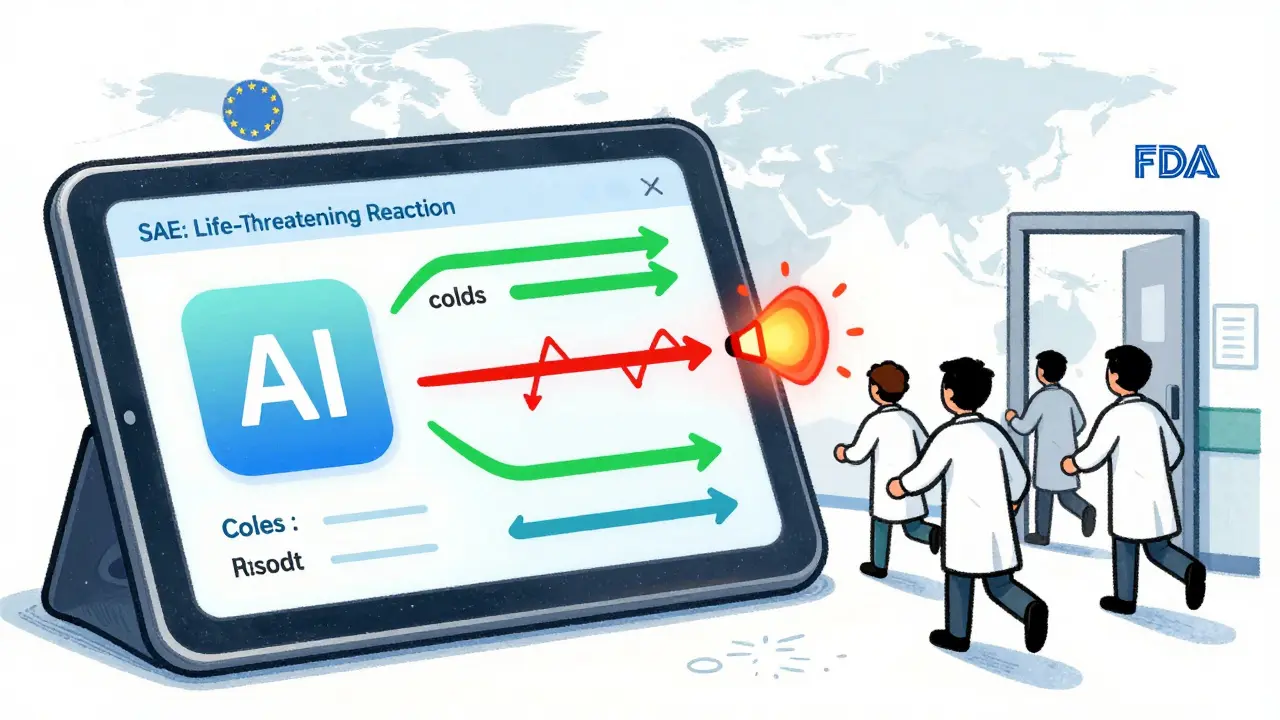
And technology is stepping in. AI tools now correctly classify seriousness in 89.7% of cases, compared to 76.3% for humans. But they’re not replacing people-they’re helping them. These tools flag events for human review, reducing delays and cutting down misclassification.
By 2025, the ICH’s new E2B(R4) system will make all adverse event reports electronic and standardized worldwide. That means less paperwork, fewer translation errors, and faster detection of real risks.
Bottom Line
Don’t report based on how bad it feels. Report based on what happened.Death? Hospitalization? Permanent harm? Report it now.
Headache, nausea, fatigue that goes away? Log it, but don’t panic. Save the emergency alerts for the real emergencies.
Getting this right isn’t just about compliance. It’s about protecting patients. It’s about making sure when something truly dangerous happens, someone sees it-before it happens again.
And in clinical research, that’s the whole point.
Is a severe headache always a serious adverse event?
No. A severe headache is not automatically serious. Seriousness depends on outcome, not intensity. If the headache doesn’t lead to hospitalization, life-threatening complications, disability, or death, it’s non-serious-even if it’s the worst headache the patient has ever had.
Do I report an adverse event if I think it’s unrelated to the study drug?
Yes. You must report all serious adverse events to the sponsor within 24 hours, regardless of whether you believe they’re related to the investigational product. The sponsor, not the investigator, determines the causal relationship.
What’s the difference between severity and seriousness?
Severity describes how intense a symptom is-mild, moderate, or severe. Seriousness describes the outcome-did it cause death, hospitalization, disability, or other defined harms? A mild rash can be serious if it leads to toxic epidermal necrolysis. A severe cough can be non-serious if it resolves without intervention.
Can an event be serious even if the patient doesn’t go to the hospital?
Yes. If an event is life-threatening, causes permanent disability, or requires intervention to prevent lasting harm, it’s serious-even without hospitalization. For example, a severe allergic reaction treated with epinephrine in an ER but discharged the same day still qualifies as serious.
What happens if I misclassify a non-serious event as serious?
Misclassifying non-serious events as serious wastes resources, delays real safety signals, and can trigger unnecessary regulatory scrutiny. Studies show up to 37% of reported SAEs don’t meet criteria. Repeated errors can lead to audit findings, training requirements, or protocol amendments.
Are there tools to help determine if an event is serious?
Yes. The FDA’s MedWatch Form 3500A includes checkboxes for each seriousness criterion. Many institutions use decision trees based on NIH guidelines. AI-assisted tools are now used by 73% of pharmaceutical sponsors to flag potential SAEs, but final determination always requires human review.
Manish Kumar
January 8, 2026 AT 11:39Look, I get it-people wanna panic over a headache like it’s the end of the world. But you know what’s wild? We treat every little twinge like it’s a plague. I’ve seen interns report a sneeze as an SAE because ‘the patient looked annoyed.’ The system’s drowning in noise. We’re not fixing safety-we’re just making paperwork more fun. Seriously, if we kept this up, we’d need a whole department just to sort through ‘mild nausea’ reports. Let’s not turn clinical trials into a bureaucratic sitcom.
Aubrey Mallory
January 10, 2026 AT 03:36Stop. Just stop. This isn’t about paperwork-it’s about people. If you’re minimizing a patient’s experience because it didn’t land them in the hospital, you’re missing the point. A severe headache can be the first sign of a brain bleed. A ‘mild’ rash could be the start of Stevens-Johnson. We don’t wait for death to act. We act on warning signs. The FDA criteria are a floor, not a ceiling. And if you’re treating patients like data points, you’ve already lost.
Dave Old-Wolf
January 12, 2026 AT 01:50Wait, so if someone gets a bad headache but doesn’t go to the hospital, it’s not serious? But what if they’re a 70-year-old with high blood pressure? Or pregnant? Or on blood thinners? Context matters. The rules are clear, but real life isn’t a checklist. I’ve seen patients lie about symptoms because they’re scared of being ‘wrong.’ We need to train people to think, not just click boxes.
Prakash Sharma
January 12, 2026 AT 20:25This whole thing is a Western overcomplication. In India, we’ve been doing trials for decades without all this fancy reporting. If a man gets sick, he gets treated. If he dies, we investigate. No 24-hour forms, no AI flags. We trust doctors. Not algorithms. You think your FDA rules are the only way? Look at how many trials get delayed because of paperwork. We need less bureaucracy, not more.
Donny Airlangga
January 13, 2026 AT 19:49I’ve been on both sides-researcher and patient. I’ve had the headache. I’ve also been the one who missed a real SAE because I was buried in 200 non-serious reports. It’s not about being cold. It’s about not missing the forest for the trees. The system’s broken, but the fix isn’t to ignore the rules-it’s to fix how we apply them. Training matters. More than tech.
Molly Silvernale
January 15, 2026 AT 19:21Let’s be real: seriousness is a social construct wrapped in bureaucratic legalese. Death? Hospitalization? Disability? These are outcomes-but what about suffering? What about the quiet terror of a seizure in the middle of the night, alone, with no one to call? The system doesn’t measure that. It measures outcomes, not experiences. And maybe… maybe that’s the real tragedy. We’re trying to quantify humanity with checkboxes. We’re not saving lives-we’re just organizing death reports.
Kristina Felixita
January 16, 2026 AT 00:04okay so i just read this and honestly? mind blown. i work in a clinic and we had this one lady who had a headache so bad she cried but didn’t go to the er bc she didn’t want to be ‘a bother’-and then she had a mini-stroke 3 days later. the doc said if we’d known about the headache, we might’ve caught it. so yeah-severity matters. even if it’s not ‘serious’ by the book. just sayin’. we gotta listen better. also-why is everyone so obsessed with rules instead of people??
Joanna Brancewicz
January 16, 2026 AT 10:15SAE criteria are operationalized for signal detection, not clinical judgment. Severity (CTCAE) and seriousness (ICH E2A) are orthogonal dimensions. Misclassification inflates false positive rates, degrades signal-to-noise ratio, and undermines pharmacovigilance. Training reduces error by 42%-per J Clin Oncol 2023. Prioritize decision trees over intuition.
Evan Smith
January 16, 2026 AT 18:49So let me get this straight-we’re spending millions on AI to tell us if a headache is serious… but we still don’t trust a nurse who’s been doing this for 15 years? I mean, come on. The real problem isn’t the rules-it’s that we treat people like robots and then wonder why the system breaks. Also, why does everything have to be so… corporate? Can’t we just say ‘if something feels wrong, report it’? Simple. Human. Works.
Lois Li
January 17, 2026 AT 09:21I appreciate the clarity here, but I worry this kind of rigid definition makes people afraid to speak up. What if a patient says ‘I feel weird’ but can’t articulate why? We’ve lost so many signals because someone didn’t want to be ‘wrong.’ Maybe we need a ‘gray zone’ reporting option-not for formal SAEs, but for ‘concerns worth watching.’ Just a thought.
christy lianto
January 18, 2026 AT 01:17Every single time I see someone downplay a symptom because ‘it’s not serious’-I want to scream. This isn’t just about paperwork. It’s about trust. Patients need to know their pain is seen. Even if it doesn’t meet a checklist, even if it doesn’t land them in the hospital-it matters. And if we keep teaching staff to ignore the ‘minor’ stuff, we’re teaching them to ignore people. And that’s dangerous.
Ken Porter
January 20, 2026 AT 00:31Ugh. More American overregulation. In my day, we just called the doctor. No forms. No AI. No 24-hour deadlines. You report death. You report hospitalization. Everything else? Grow up. This system is a joke. Costs billions. Saves nothing. We’re turning medicine into a spreadsheet.
swati Thounaojam
January 21, 2026 AT 20:10headache = not serious. got it. but what if its a woman and shes 8 weeks preggo? still not serious? just saying… maybe the rules need a little more nuance. not every case fits the box.
Annette Robinson
January 22, 2026 AT 09:48This is such an important distinction. I’ve seen so many patients dismissed because their symptoms didn’t ‘qualify.’ But the truth is, early intervention saves lives. Even if it’s not a hospital-level event, if it’s new, unusual, or worsening-it deserves attention. We don’t need more rules. We need better listening.
Luke Crump
January 23, 2026 AT 12:44Let’s be honest-this whole ‘serious vs non-serious’ thing is a lie. It’s not about outcomes. It’s about liability. If you report too much, you get sued. If you report too little, you get sued. So we make up rules to cover our asses. The real problem? The system is designed to protect corporations, not patients. The FDA doesn’t care if you have a headache. They care if the CEO gets fined. Wake up.