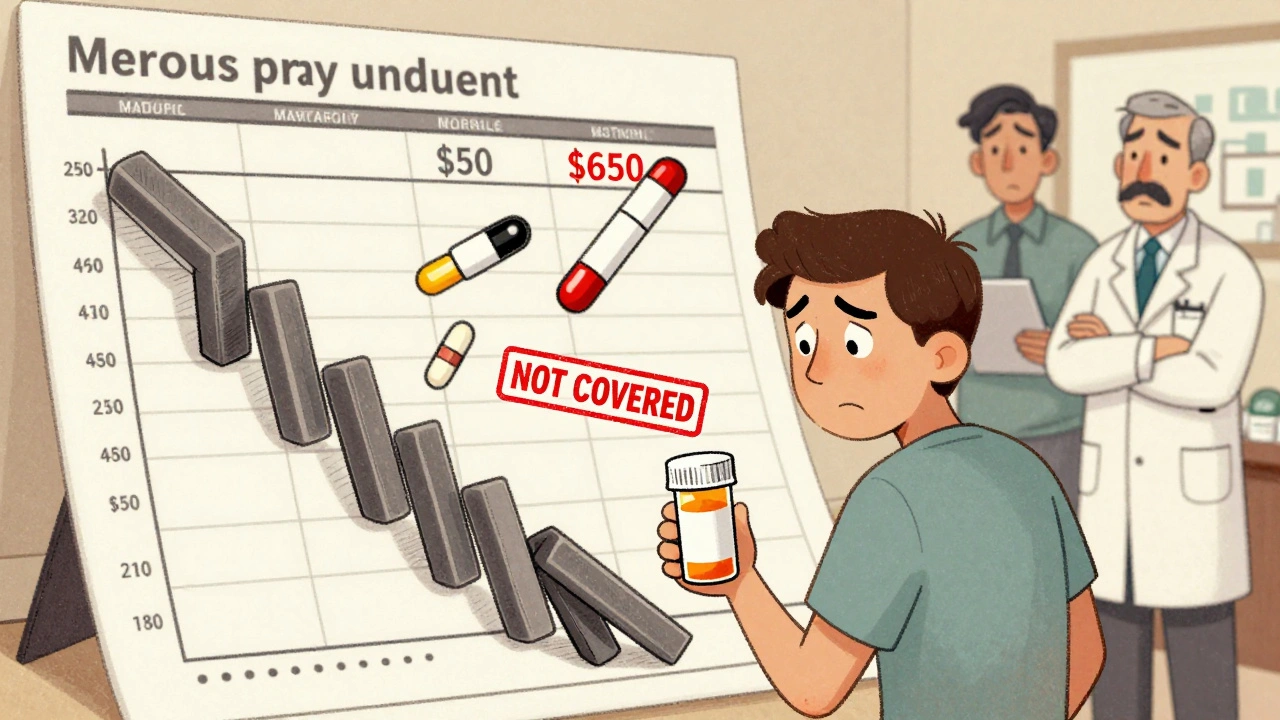
When your insurance plan suddenly stops covering your medication, it’s not just a paperwork issue-it’s a health crisis. For millions of people on chronic medications, a formulary change can mean switching drugs mid-treatment, facing a 10x price jump, or going without treatment entirely. In 2024, formulary changes affected over 34% of Medicare beneficiaries and caused 47% of patients to abandon their prescriptions when drugs moved from tier 2 to tier 3. These aren’t random decisions. They’re calculated moves by insurers to control costs, but the human cost is real.
What Is a Formulary, Really?
A formulary is a list of drugs your insurance plan will pay for. It’s not just a catalog-it’s a ranking system. Most plans use a tiered structure: Tier 1 is cheap generics, Tier 2 is preferred brand-name drugs, Tier 3 is non-preferred brands, and Tier 4 or 5 are specialty drugs with high out-of-pocket costs. Medicare Part D plans typically have six tiers, with specialty drugs sometimes costing 33% coinsurance. Commercial plans vary, but the principle is the same: the higher the tier, the more you pay. Around 92% of Medicare Part D plans and 87% of commercial plans use tiered formularies. These systems help insurers save money-studies show formulary management cuts pharmacy spending by 12-18% compared to plans without them. But that savings doesn’t come free. When a drug you’ve been taking for years gets bumped from Tier 2 to Tier 4, your monthly cost can jump from $50 to $650 overnight.Why Do Formularies Change?
Formularies aren’t static. They’re reviewed quarterly by Pharmacy and Therapeutics (P&T) committees-groups of doctors, pharmacists, and sometimes patient advocates-who decide which drugs stay, go, or move tiers. Their decisions are based on three things: clinical effectiveness, cost, and rebates from drug manufacturers. If a new generic version of your drug hits the market, your insurer might drop the brand-name version to save money. If a drug’s price spikes and the manufacturer won’t offer a big enough rebate, it might get moved to a higher tier. Or, if a competing drug proves more effective in real-world studies, the old one gets phased out. In 2024, 78% of large pharmacy benefit managers (PBMs) conducted quarterly formulary reviews. That means your medication could be pulled from coverage at any time, even mid-year. And while Medicare plans must give you 60 days’ notice, commercial plans often give as little as 22 days. Many patients don’t even know their drug is at risk until they go to fill their prescription and get denied.How Formulary Changes Hit Patients
The impact isn’t theoretical. On Reddit, a user named ChronicCareWarrior shared how their Humira-used for Crohn’s disease-was moved to a non-preferred specialty tier. Their monthly cost went from $50 to $650. They spent three weeks fighting for temporary coverage and had to rely on manufacturer assistance just to keep taking it. That’s not rare. A 2023 Scripta Insights report found that 22% of patients stop taking their meds because of formulary changes. For diabetes medications, the abandonment rate jumps to 58%. When patients can’t afford their drugs, they end up in the ER. Dr. Aaron Kesselheim from Harvard found that excessive formulary restrictions led to a 12% increase in emergency visits among low-income Medicare patients. The problem gets worse with specialty drugs. Over 73% of rare disease medications require prior authorization, and 57% of patients report getting no clear notice before their coverage changes. Even when insurers send notices, they’re often buried in fine print or written in confusing jargon. Only 22% of patients understand how formulary decisions are made.
What You Can Do When Your Drug Is Removed
If your medication is taken off the formulary, you’re not out of options. Here’s what to do next:- Check your plan’s formulary lookup tool. Most insurers have an online formulary search. Enter your drug name and see if it’s still covered-and at what tier.
- Ask for a formulary exception. This is a formal request to your insurer to cover your drug anyway. You’ll need a letter from your doctor explaining why the alternative drugs won’t work for you. In 2023, 64% of medically justified exceptions were approved.
- Request a 30- to 60-day transition supply. If your drug is being removed, Medicare and many commercial plans must let you get a short-term refill so you don’t go without. Don’t assume this is automatic-call your pharmacy and ask.
- Explore manufacturer assistance programs. Drugmakers often have patient support programs that cover copays or even give free medication. In 2024, these programs helped patients save $6.2 billion.
- Switch to a therapeutic alternative. If your drug has a generic or similar brand, ask your doctor if switching is safe. For conditions like high blood pressure, there are often 8+ generic options. But for complex conditions like multiple sclerosis or rheumatoid arthritis, alternatives are limited.
How Providers Can Help
Doctors and pharmacists are on the front lines. Large medical groups with 76% of their staff using e-prescribing systems now check formulary status in real time before sending a prescription. That means if a drug is about to be dropped, the system flags it before the patient even leaves the office. The best providers don’t wait for problems to happen. They monitor formulary updates 60 days in advance. One clinic in Toronto started using a subscription service that alerts them when any of their patients’ insurers make changes. They then schedule follow-up visits to switch medications during routine checkups-no panic, no disruption. If you’re a patient, ask your doctor: “Do you check my drug’s coverage before writing the prescription?” If they say no, it’s time to find a provider who does.
What’s Changing in 2025 and Beyond
The rules are shifting. Starting in 2025, the Inflation Reduction Act caps out-of-pocket drug costs for Medicare beneficiaries at $2,000 per year. That’s a game-changer. Insurers can’t just push expensive drugs to the highest tier anymore-they’ll need to find other ways to control costs, like negotiating better rebates or using value-based formularies. Value-based formularies are growing fast. Instead of just picking the cheapest drug, these plans pick the one that works best and keeps patients out of the hospital. They’re used by 25% of large employers today, but that number is expected to hit 45% by 2027. AI is also entering the mix. Some PBMs now use algorithms that predict how a formulary change will affect patient adherence-with 89% accuracy. That means insurers might avoid dropping a drug not because it’s cheap, but because patients will stop taking it and end up in the ER. Still, transparency remains a huge issue. Patients still don’t know why drugs are removed. The system is built for cost control, not clarity.How to Protect Yourself
The best defense is preparation:- Check your formulary every year during open enrollment. Don’t wait until you run out of pills.
- Use tools like Medicare’s Plan Finder or your insurer’s online formulary tool. Save a screenshot of your drug’s current tier.
- Keep a list of your medications, dosages, and why you take them. If you need to file an exception, you’ll need this.
- Sign up for email alerts from your insurer. Many send formulary change notices-but only if you’re subscribed.
- If you’re on a specialty drug, contact the manufacturer’s patient support program now. Don’t wait until you’re denied.
Ollie Newland
December 5, 2025 AT 09:18Man, I’ve seen this play out in my clinic. One day, a patient’s insulin gets bumped to Tier 4, and suddenly they’re skipping doses to make it last. No drama, no panic-just silent suffering. We’ve started running formulary checks before we even write the script. If your doc doesn’t do this, find one who does. It’s not rocket science, just basic harm reduction.
Rebecca Braatz
December 5, 2025 AT 20:01YOU ARE NOT ALONE. I’ve been there-Humira from $40 to $700 overnight. I called my pharmacist, my doctor, the manufacturer, and my state’s SHIP office. Within 10 days, I had a 30-day transition supply AND a manufacturer coupon. It’s a grind, but you CAN fight back. Don’t accept ‘no’ as the final answer. Your life is worth more than a spreadsheet.
jagdish kumar
December 7, 2025 AT 14:27Capitalism is a disease. We treat pills like stocks. The body is a balance sheet. The soul? A deductible.
zac grant
December 8, 2025 AT 00:25Big Pharma and PBMs are in a dance where the patient is the floor. But here’s the thing-value-based formularies are starting to win. More insurers are realizing that keeping people out of the ER saves more than pushing them to cheaper drugs. AI-driven adherence models? That’s the future. It’s not perfect, but it’s moving toward outcomes, not just cost-cutting.
Benjamin Sedler
December 9, 2025 AT 15:43Wait, so you’re telling me the system isn’t broken-it’s working exactly as designed? That’s not a flaw, that’s a feature. If you’re not rich, you’re just a data point in a spreadsheet. Maybe we should all just stop taking meds and let the market sort it out. 🤷♂️
Carolyn Ford
December 10, 2025 AT 21:13Everyone’s so focused on ‘what you can do’-but nobody’s holding the insurers accountable. You think a 22-day notice is legal? It’s predatory. And those ‘manufacturer assistance programs’? They’re a Band-Aid on a gunshot wound. The real solution is national drug price control-not ‘here’s a coupon, good luck.’
Bill Wolfe
December 11, 2025 AT 14:39Look, I get it-you’re upset. But let’s be real: if insurers didn’t manage formularies, premiums would skyrocket, and everyone-including you-would pay more. The system is designed to incentivize cost-effective care. Yes, it’s brutal for some. But that’s the price of a market-based system. If you want universal coverage, move to Canada. Or better yet, stop complaining and learn how to navigate the system like an adult. 🙄
Heidi Thomas
December 12, 2025 AT 14:48Formulary changes are not a crisis they’re a reality. If you can’t afford your drug, you shouldn’t be on it. Your doctor prescribed it, not your insurance. Stop blaming the system and start taking responsibility. There are generics. There are alternatives. If you’re too lazy to research, that’s on you.
Michael Feldstein
December 13, 2025 AT 16:29Rebecca’s story is everything. I had a patient last month who got her MS med pulled-she cried in the exam room. We called the manufacturer, got her on a free 90-day trial, and switched her to a similar drug that’s still on formulary. It took three weeks, but she’s stable now. The system’s broken, but people can still make it work. You just gotta be relentless. And yes, your doc should be checking coverage before they write the script. If they’re not, ask why.
Alex Piddington
December 14, 2025 AT 08:46As a healthcare administrator, I can confirm: the 2025 $2,000 cap will force PBMs to rethink tiering entirely. We’re already piloting value-based formularies in our network. The goal isn’t to cut costs-it’s to cut hospitalizations. And yes, we’re using AI to predict adherence drops before they happen. It’s not perfect, but it’s progress. Patients deserve transparency. Providers deserve tools. And insurers? They need to stop treating people like line items.