EPO & Medication Interaction Checker
Select the medications you are currently taking to see potential interactions with Evening Primrose Oil (EPO). Note: This is an educational tool, not a medical diagnosis.
If you are managing epilepsy or schizophrenia, or if you are taking medications that affect your brain chemistry, the stakes are high. You aren't just looking for a "yes" or "no" answer; you need to know why experts disagree and how this supplement actually behaves in your body. This guide breaks down the conflicting evidence and the specific risks associated with combining this oil with psychiatric medications.
The Great Debate: Does EPO Actually Cause Seizures?
The medical community is currently split into two very different camps regarding the safety of Evening Primrose Oil (EPO). On one side, you have institutional guidelines from places like the Mayo Clinic, which explicitly advise against taking the supplement if you have epilepsy or schizophrenia. Their stance is that EPO might raise your risk of seizures. This position is shared by many pharmacy guides, including those from Walgreens, which warn that the oil can interact with various seizure and antipsychotic medications.
On the other side is the research coming out of Imperial College London. A significant re-examination of the data by BK Puri concluded that the association between EPO and seizures is "spurious." Puri's work suggests that the original reports from the 1980s weren't backed by strong evidence. In fact, some animal studies showed that a specific mixture of linoleic acid and alpha-linolenic acid-both found in the oil-actually had a protective effect against seizures. This creates a confusing landscape for patients: one authority says "danger," while another says "it's actually helpful."
To make sense of this, it helps to look at what is actually inside the bottle. The core active component is Gamma-Linolenic Acid (or GLA), an omega-6 fatty acid that the body converts into prostaglandin E1, a compound with known anti-inflammatory properties. From a biological standpoint, prostaglandin E1 is believed to have anticonvulsant activity, which would theoretically *raise* the seizure threshold rather than lower it.
Interactions with Antipsychotics and Other Drugs
While the general risk of EPO causing a seizure is debated, the risk becomes more concrete when you combine it with specific drugs. The interaction isn't necessarily with the oil itself, but how the oil influences the brain's excitability while other drugs are trying to stabilize it.
Certain antipsychotics are noted as being particularly problematic when paired with EPO. For instance, medications like Chlorpromazine (often known by the brand name Largactil) and Flupentixol (Fluanxol) have been linked to an increased incidence of seizures when taken alongside this supplement. The concern is that the combination might lower the epileptic threshold more than either substance would on its own.
It isn't just antipsychotics. There are specific interactions with other neurological drugs. For example, combining EPO with Amifampridine is documented to increase the severity or risk of seizures. Even newer antipsychotics like brexpiprazole, lumateperone, and pimavanserin are now being monitored for similar interactions. If your medication changes your GABA levels or affects sodium ion currents in the brain, adding a potent fatty acid supplement like EPO could potentially disrupt that delicate balance.
| Authority/Source | Position | Key Reasoning | Evidence Level |
|---|---|---|---|
| Mayo Clinic | Contraindicated | May increase seizure risk | Institutional Guideline |
| BK Puri (Imperial College) | Safe / Protective | Sodium channel inhibition | Peer-Reviewed Review |
| Epilepsy Foundation | Cautionary | Theoretical GABA modulation | Limited Clinical Evidence |
| American Academy of Neurology | Cautionary | Mechanistic plausibility | Class IV (Lowest) |

How EPO Affects the Brain's Electrical Activity
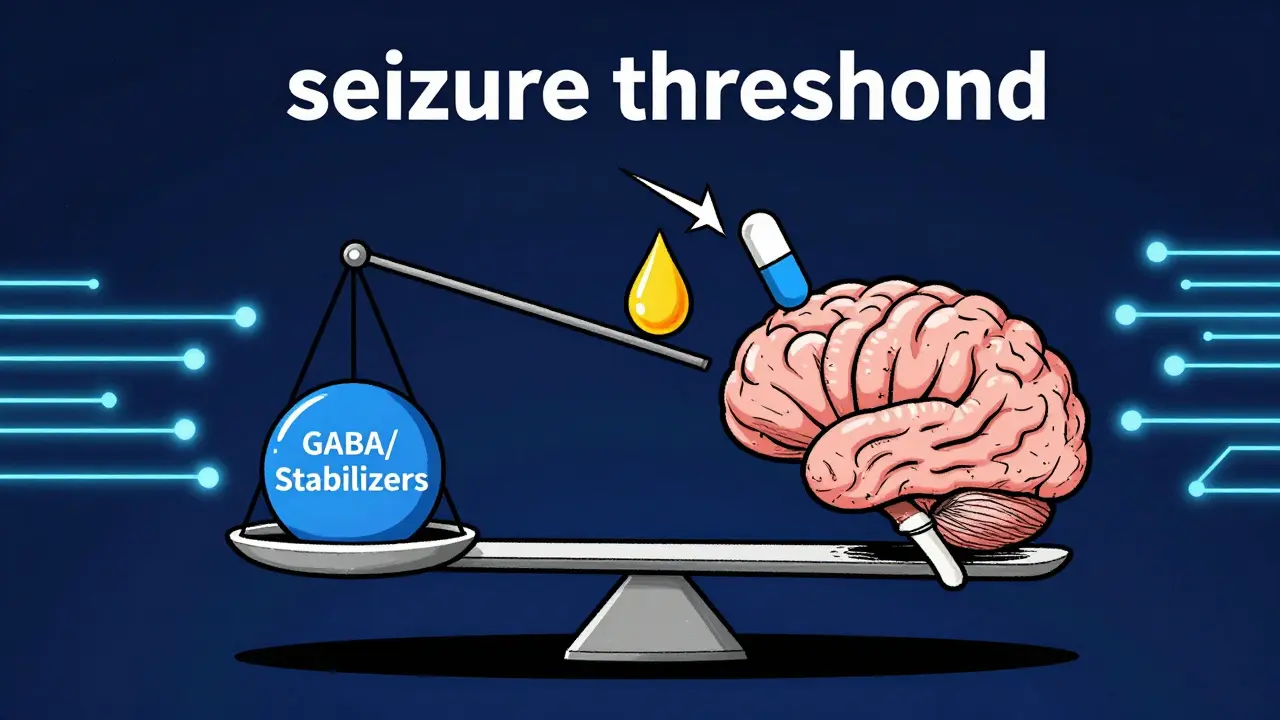
To understand why this interaction happens, we have to look at the "seizure threshold." Think of this as the tipping point at which your brain's electrical activity becomes unstable and triggers a seizure. Anything that lowers this threshold makes a seizure more likely.
The mechanism behind EPO's potential effect is twofold. First, the arachidonic acid derived from the oil is thought to inhibit sodium ion currents. In some contexts, this is protective. However, the Epilepsy Foundation has pointed toward theoretical concerns regarding GABA, the primary inhibitory neurotransmitter in the brain that prevents over-excitation of neurons. If a supplement interferes with how GABA works, it can remove the "brakes" from the brain's electrical system.
The timing of the dose also matters. Pharmacokinetic data shows that GLA reaches its peak plasma concentration about 2.7 hours after an evening dose and 4.4 hours after a morning dose. If you are taking an antipsychotic that also peaks at a specific time, you may create a window of increased vulnerability where the combined effect on your neurons is strongest.
Real-World Experiences: What Patients Report
When you look at patient forums and review sites, the data is all over the place. This is a classic example of how individual biochemistry varies. On platforms like Reddit and HealthUnlocked, many people with epilepsy report taking EPO for years to treat eczema or PMS without a single increase in seizure activity. In one community thread, over half of the respondents claimed no issues.
However, a significant minority-about a third in some polls-report a genuine increase in seizure frequency. Some users specifically mentioned that these issues cropped up only when they were also taking quetiapine, an antipsychotic. This suggests that the risk isn't universal but is highly dependent on the specific medication you are using and your unique brain chemistry. This is why a "one size fits all" warning from a clinic may not match your personal experience, but it's also why ignoring the warning can be dangerous.
Practical Steps for Safe Supplement Use
If you are considering using EPO while on antipsychotics or anti-epileptics, you shouldn't just guess. Because the evidence is so contradictory, the best approach is a personalized risk assessment with your doctor.
- Review your medication list: Check if you are taking high-risk combinations like chlorpromazine or amifampridine.
- Start low and slow: If your doctor clears you, starting with a lower dose (e.g., 500mg instead of 1300mg) can help you monitor your reaction.
- Keep a seizure diary: Track the timing of your supplement dose and any unusual neurological symptoms or auras.
- Verify the label: Be aware that different brands have different concentrations of GLA, which can change the potency of the interaction.
The most important thing to remember is that "natural" does not always mean "safe." The very properties that make EPO great for reducing inflammation in the joints can potentially interfere with the electrical stability of the brain.
Can I take Evening Primrose Oil if I have epilepsy?
It depends on who you ask. Major institutions like the Mayo Clinic advise against it due to potential seizure risks. However, some researchers argue that the risk is minimal or even that the oil is protective. Because there is no consensus, you must consult your neurologist to weigh the risks against the benefits for your specific condition.
Which antipsychotics interact most with EPO?
Reports highlight medications like Chlorpromazine (Largactil) and Flupentixol (Fluanxol) as particularly problematic. Newer medications like brexpiprazole and lumateperone have also been added to interaction lists in pharmacological databases like DrugBank.
Does EPO actually lower the seizure threshold?
The evidence is conflicting. Some believe it interferes with GABA modulation or sodium channels, lowering the threshold. Others argue that its conversion to prostaglandin E1 actually provides an anticonvulsant effect, which would raise the threshold.
What is the safest way to introduce EPO into my routine?
The safest method is to get a medical clearance from your prescribing physician. If approved, introduce the supplement at the lowest possible dose and monitor your neurological symptoms closely for several weeks before increasing the dosage.
Is there a difference between EPO and other omega oils?
Yes. EPO is specifically rich in gamma-linolenic acid (GLA). While other omega oils (like fish oil) have different effects on the brain, the specific conversion of GLA to prostaglandin E1 is what drives the specific debate around seizure thresholds.
Nigel Gosling
April 27, 2026 AT 13:21Absolutely tragic that we live in an era where the most basic medical guidelines are basically a coin flip!
It's a philosophical crisis, really. We trust these 'institutions' with our very consciousness, yet they can't even agree if a plant oil is a trigger or a shield. The sheer audacity of the medical establishment to leave patients in this state of existential dread is just breathtaking.
Aubrey Johnson
April 27, 2026 AT 21:43The lack of a unified consensus is simply a reflection of the poor quality of the data.
Steve Grayson
April 28, 2026 AT 02:06I think it's a good point that biochemistry varies so much from person to person. Some of us just react differently to these things, and that's why the doctor's visit is non-negotiable.
Trish Perry
April 28, 2026 AT 08:16It makes you wonder about the nature of 'natural' health. We tend to categorize things as safe just because they grow from the ground, but chemistry is chemistry regardless of the source. The brain is such a complex web of electrical signals that adding anything, even a fatty acid, is basically like throwing a pebble into a pond and hoping the ripples don't hit something important. I've always felt that the middle ground-monitoring and slow introduction-is the only logical way to handle these gray areas of medicine.
Kali Murray
April 28, 2026 AT 16:20just glad there's info out there for this 🌸 stay safe everyone ✨
Abhishek Charan
April 28, 2026 AT 23:44Actually... the Mayo Clinic is probably just playing it safe to avoid lawsuits!!! 🙄 Why do we always assume the institutional giants are the gold standard when peer-reviewed research from London is literally telling us the opposite??? It's a joke!!! 🤡
Betty Kawira
April 29, 2026 AT 06:45I've worked with a lot of patients on these combos, and the biggest mistake people make is ignoring the timing. If your antipsychotic peaks at the same time as that GLA concentration, you're basically asking for a flare-up. Definitely stick to the 'low and slow' method mentioned here. Also, don't forget that different brands use different extraction methods, so a 'natural' oil isn't always a standard dose. Always double-check the actual GLA percentage on the back of the bottle before you start your diary!
Ryan Wilson
April 29, 2026 AT 20:41Typical bureaucratic nonsense. The medical industrial complex loves to keep us in this state of bewildered submission while they pedal contradictory warnings. It's a total clusterfuck of 'maybe this, maybe that.' If you've got the guts to actually read the research instead of blindly following a brochure from a pharmacy chain, you'll see the 'danger' is mostly a ghost story designed to keep the lawyers happy. Absolute madness.
Stephen Johnson
May 1, 2026 AT 07:44It's a reminder to be kind to ourselves when navigating these health journeys. We're all just trying to find a balance that works for our unique minds. Taking a step back to observe how our bodies react is a form of mindfulness in itself. No one should feel rushed into a decision when it comes to brain chemistry.