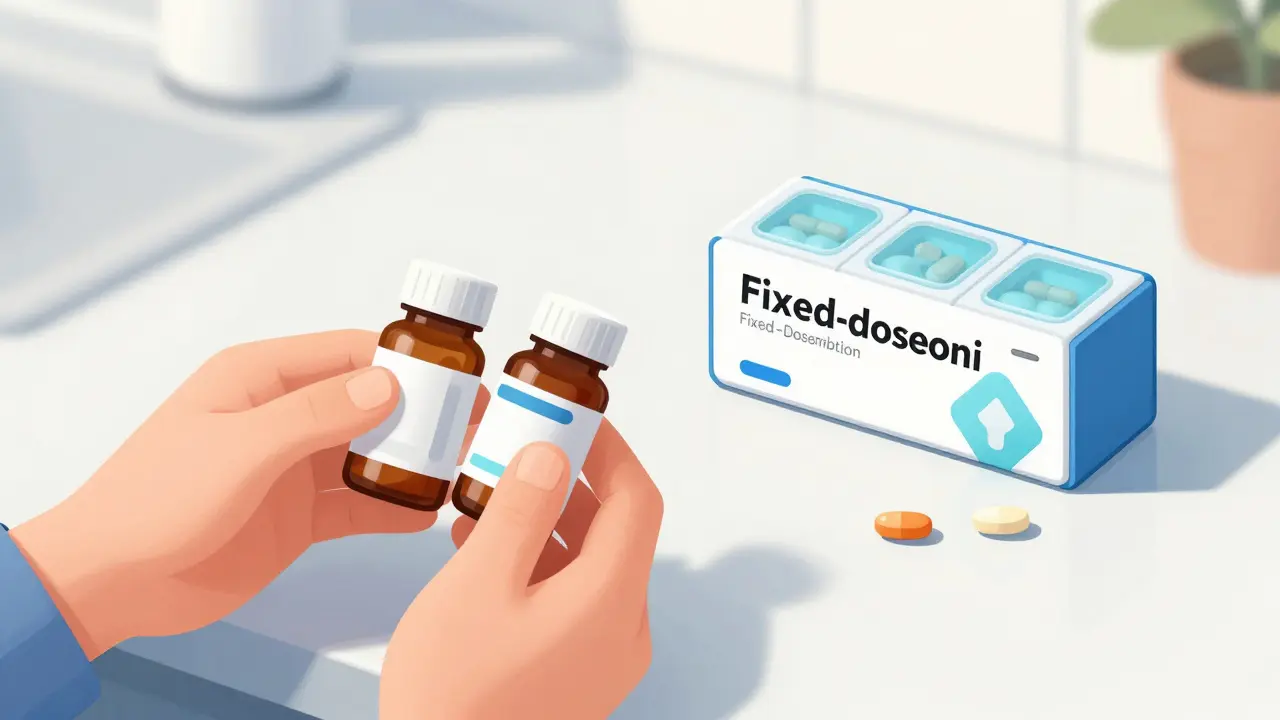
You might be holding two small bottles in your hand instead of one. One contains a generic for blood pressure; the other, a generic for cholesterol. Your doctor prescribed them separately to save you money or to fine-tune your dosage. This is known as a de facto combination, defined as the clinical practice where patients take multiple separate generic medications instead of a single Fixed-Dose Combination (FDC) product that would contain the same active pharmaceutical ingredients in a fixed ratio within one dosage form. It’s an "unofficial" therapy regimen that has become increasingly common, especially in conditions like hypertension and diabetes. But while this approach offers flexibility and potential cost savings, it comes with hidden risks that many patients-and even some prescribers-overlook.
The rise of de facto combinations isn't accidental. As patents on branded drugs expire, generic versions flood the market. Sometimes, these generics are cheaper individually than the combined pill. Other times, the available Fixed-Dose Combination doesn't match your specific medical needs. For example, if you need 5mg of amlodipine but the only FDC offers 10mg paired with valsartan, your doctor has no choice but to prescribe them separately. This creates a complex web of benefits and drawbacks that affects how well your treatment works.
Understanding the Core Difference: FDC vs. De Facto
To grasp why this matters, we first need to look at what a Fixed-Dose Combination (FDC) is. An FDC is a medicinal product containing two or more active substances combined in a fixed ratio in a single dosage form, as defined by the European Medicines Agency (EMA). These aren't just random pills stuck together. They undergo rigorous testing for compatibility, stability, and bioequivalence. The FDA and EMA require proof that both drugs contribute to the therapeutic effect and that the combination is safer or more effective than taking them alone.
De facto combinations bypass this regulatory scrutiny. When you take separate generics, you are essentially creating your own experimental cocktail. There is no systematic evaluation of how those specific generic formulations interact in your stomach or bloodstream. While each individual generic is approved, their combined effect in that specific pairing hasn't necessarily been studied for safety or efficacy in the way an FDC has. This lack of pharmaceutical optimization can lead to unexpected issues with absorption or stability.
| Feature | De Facto Combinations (Separate Generics) | Approved Fixed-Dose Combinations (FDCs) |
|---|---|---|
| Dosing Flexibility | High - Each dose can be adjusted independently | Low - Fixed ratios limit titration options |
| Patient Adherence | Lower - Multiple pills increase burden | Higher - Single pill reduces complexity |
| Safety Testing | None - Interactions not systematically evaluated | Rigorous - Tested for compatibility and stability |
| Cost | Variable - Often cheaper, but not always | Predictable - May be higher due to branding |
| Regulatory Oversight | Minimal - Prescriber discretion | Strict - Requires EMA/FDA approval |
The Case for Flexibility: Why Doctors Choose Separates
Why would a healthcare provider choose the riskier path? The answer often lies in precision medicine. Not every patient fits the standard mold. In chronic conditions like type 2 diabetes or heart failure, kidney or liver function can change over time. A study noted that 67.3% of patients with type 2 diabetes require individualized dosing adjustments that simply don’t align with the rigid structures of most FDCs.
Consider a patient with mild renal impairment. They might need a full dose of metformin but only half the standard dose of sitagliptin. If an FDC exists only in a 1:1 ratio, prescribing it could lead to toxicity or under-treatment. By using separate generics, the doctor can dial in the exact milligrams needed for each organ system. This level of customization is invaluable for complex cases, elderly patients, or those with multiple comorbidities.
Cost is another major driver. In markets with robust generic competition, buying two separate off-patent drugs can sometimes be cheaper than a branded FDC. A parliamentary report in India highlighted that many FDCs offered no advantage over individual drugs and were often more expensive. For patients paying out-of-pocket or with high deductibles, saving $15 a month can mean the difference between staying on treatment and skipping doses entirely.

The Hidden Cost: Adherence and Safety Risks
However, there is a steep price for this flexibility: adherence. Human beings are bad at remembering things. Every additional pill in your daily routine increases the cognitive load. Research published in PubMed found that each extra pill reduces adherence by approximately 16%. In contrast, FDCs showed a 22% higher adherence rate compared to equivalent separate medications. That’s a significant gap when you’re managing a life-threatening condition.
Patients on PatientsLikeMe reported that 63% of those on separate generics struggled with remembering which pills to take when, compared to just 31% of those on FDCs. One Reddit user shared their frustration: "My doctor switched me from a single Amlodipine/Benazepril FDC to separate generics to save money, but I've missed doses twice already because I forget which blue pill is which." Missed doses lead to uncontrolled blood pressure, hospitalizations, and ultimately, higher healthcare costs.
Then there’s the safety issue. Dr. Kenneth H. Fye from the University of Pennsylvania called unapproved combinations a "therapeutic Wild West." Without stability studies, you don’t know if the chemical properties of one generic interfere with the absorption of the other. The FDA’s Division of Bioequivalence found that 12.7% of generic products show clinically significant differences in bioavailability. When you combine two such variables, the outcome becomes unpredictable. You might be getting less of Drug A because Drug B is altering your stomach’s pH levels, a scenario never tested in clinical trials.
Navigating the System: Practical Steps for Patients
If you are currently on a de facto combination, you’re not powerless. Here’s how to manage the risks effectively:
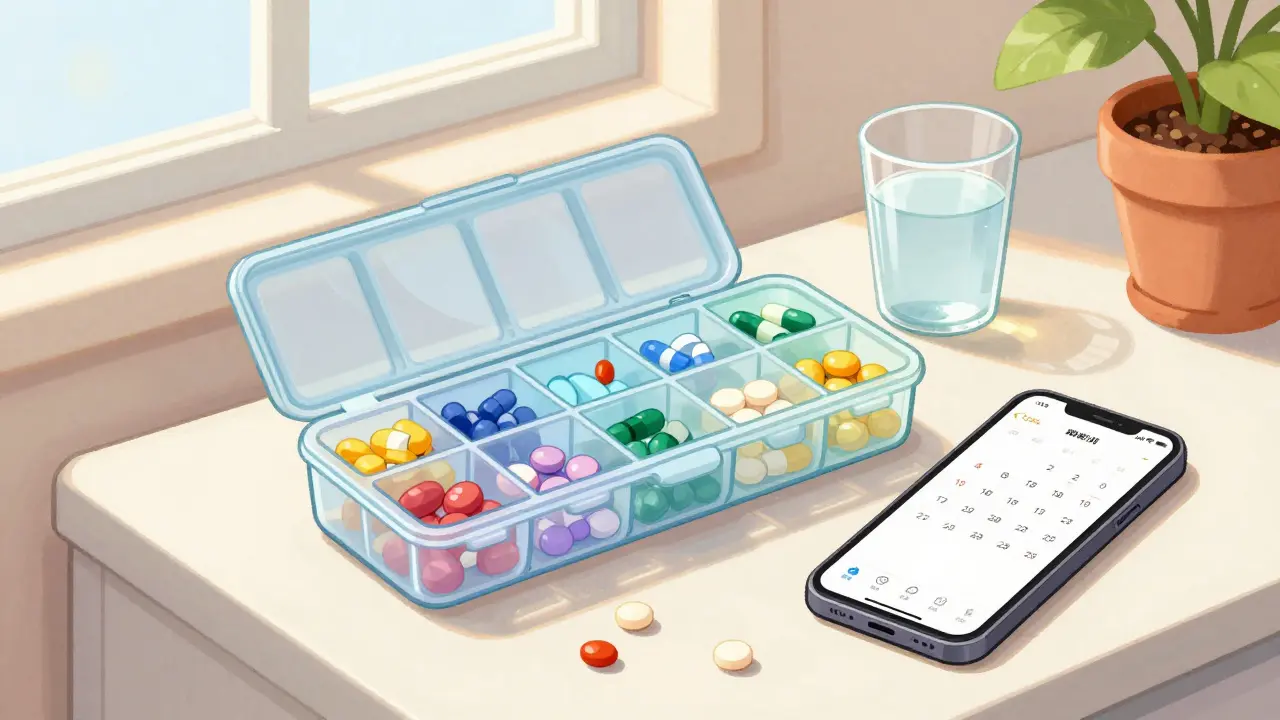
- Create a Visual Schedule: Use a pill organizer with days and times labeled clearly. Color-coding helps distinguish between different medications. The Institute for Safe Medication Practices recommends this as a primary defense against errors.
- Synchronize Refills: Ask your pharmacy to align refill dates so you pick up all medications at once. This prevents gaps in supply and simplifies logistics.
- Track Side Effects: Keep a simple journal. Note any new symptoms after starting the separate regimen. Since interactions aren't fully mapped, your body’s feedback is critical data.
- Consult a Pharmacist: Pharmacists are experts in drug interactions. Ask them specifically: "Are there known absorption issues between these two specific generic brands?" They can check databases that doctors might not have time to access during a quick visit.
- Review Regularly: Set a reminder to ask your doctor every six months: "Is there now an FDC option that matches my current doses?" As your health stabilizes, you might qualify for a simplified regimen.
The Future of Combination Therapy
The landscape is shifting. Regulators are paying closer attention. The FDA issued a safety communication in January 2023 warning about unintended consequences of untested drug combinations. Meanwhile, technology is bridging the gap. AI-driven platforms like Delta4 AI are identifying optimal combinations with precise dosing, potentially leading to next-generation FDCs that offer both flexibility and safety.
Innovations like AstraZeneca’s modular FDC systems aim to allow dose adjustment while maintaining the benefits of a single pill. The World Health Organization updated its Essential Medicines List in 2023 to include guidance on when separate components are preferable, acknowledging that de facto combinations have a place-but only when evidence-based.
Within the next decade, electronic prescribing systems will likely flag inappropriate de facto combinations automatically, reducing their use by up to 60%, according to Health Affairs projections. Until then, the choice remains yours and your doctor’s. It’s a balance between precision and simplicity, cost and compliance.
What exactly is a de facto combination?
A de facto combination occurs when a patient takes two or more separate generic medications that serve the same purpose as a Fixed-Dose Combination (FDC), but without being packaged together. It is an unofficial therapy created by prescribing individual drugs rather than an approved multi-ingredient pill.
Are de facto combinations safe?
They can be safe, but they carry higher risks than approved FDCs. Because they haven't undergone rigorous compatibility and stability testing, there may be unknown drug interactions or bioavailability issues. Always consult your pharmacist about potential interactions between separate generics.
Why would my doctor prescribe separate generics instead of an FDC?
Doctors often choose separate generics for dosing flexibility. If your required dose doesn't match the fixed ratio in an FDC, or if you have kidney/liver issues requiring adjusted amounts, separate pills allow for precise titration. Cost savings can also be a factor.
Do de facto combinations affect medication adherence?
Yes, significantly. Studies show that each additional pill reduces adherence by about 16%. Patients on separate generics report more difficulty remembering schedules compared to those on single-pill FDCs, which can lead to missed doses and poorer health outcomes.
Can I switch from separate generics to an FDC later?
In many cases, yes. Once your dosage stabilizes and matches the fixed ratio of an available FDC, your doctor may recommend switching. This can simplify your routine and improve adherence. Discuss this option during regular check-ups.
How do I manage the complexity of taking multiple separate pills?
Use tools like color-coded pill organizers, synchronized pharmacy refills, and medication apps. The Institute for Safe Medication Practices recommends comprehensive counseling and visual aids to prevent errors and ensure consistent intake.