When your child gets sick, you want the fastest, safest relief possible. Many parents assume generic drugs are just as safe and effective as brand-name ones - and for adults, that’s often true. But for kids, especially those under 2, that assumption can be dangerous. Generic drugs for children aren’t just cheaper versions of the same medicine. They can carry hidden risks that most people never think about.
Why Kids Aren’t Small Adults
Children’s bodies don’t process medicine the same way adults do. Their liver and kidneys are still developing, their stomachs absorb drugs differently, and their brains are more sensitive to certain chemicals. This isn’t just theory - it’s backed by years of clinical data. For example, acetaminophen is less likely to cause liver damage in young children than in adults because their bodies produce more glutathione, a natural detoxifier. But that doesn’t mean they can handle any dose. Too much, and even this common pain reliever can still cause harm.Some drugs are outright unsafe for kids. Aspirin, for instance, is banned for children under 19 because it can trigger Reye’s syndrome - a rare but deadly condition that causes swelling in the brain and liver. Lamotrigine, used for seizures, carries a higher risk of life-threatening skin reactions in children. Verapamil, a heart medication, can cause dangerous drops in blood pressure in infants. These risks don’t disappear just because the drug is generic. The active ingredient is the same, but the body’s reaction to it isn’t.
The Hidden Dangers in Inactive Ingredients
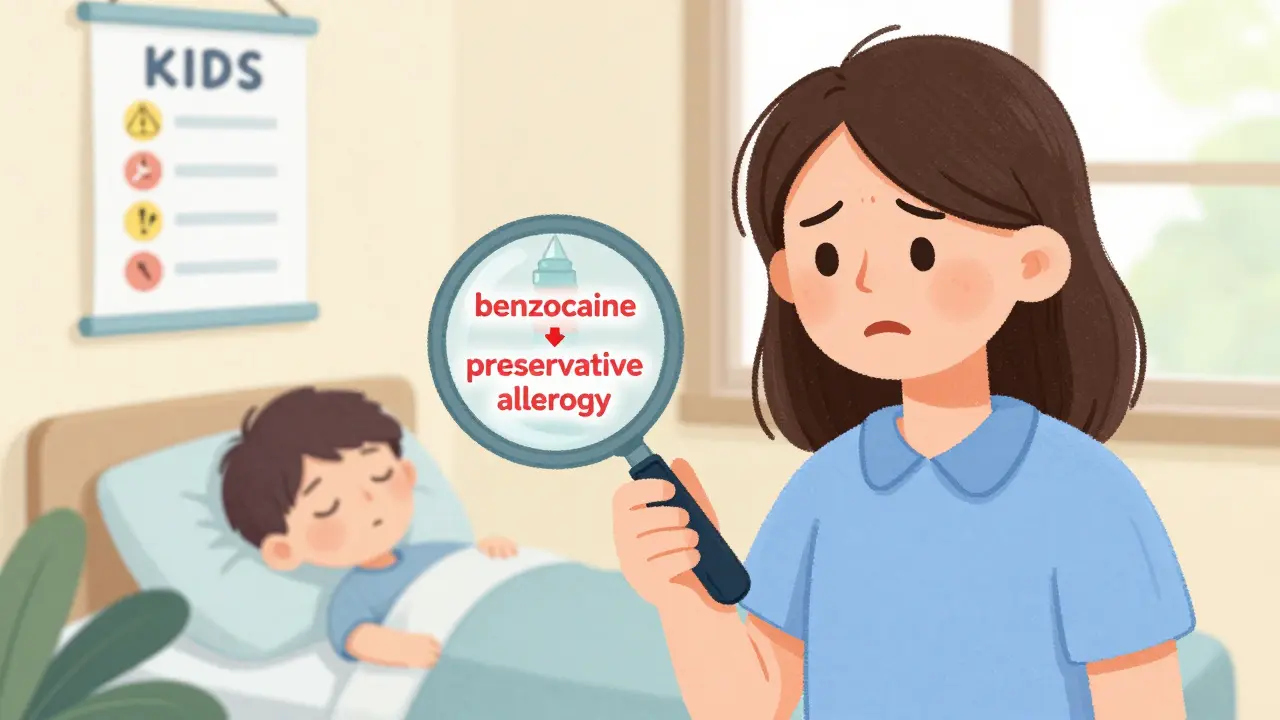
Generic drugs must contain the same active ingredient as the brand-name version. But they can have completely different fillers, dyes, preservatives, and flavorings. For most adults, this doesn’t matter. For kids, it can be a big problem.Take benzocaine, a common numbing agent in teething gels. The FDA warns against using it in children under 2 because it can cause methemoglobinemia - a rare but serious blood disorder that reduces oxygen in the bloodstream. The same chemical is in both brand-name and generic versions. But some generics use different preservatives that can trigger allergic reactions in sensitive kids. One parent on Reddit reported her 5-month-old developed a full-body rash after switching from brand-name cetirizine to a generic version. The active ingredient was identical, but the preservative changed. That’s all it took.
Topical steroids like betamethasone are another concern. Generic versions vary in strength - medium, high, very high. Using a high-potency version on a baby’s diaper area can cause Cushing syndrome or adrenal suppression, even with short-term use. Brand-name products often come with clearer warnings. Generic labels? Not always.
The KIDs List: A Lifesaver You’ve Probably Never Heard Of
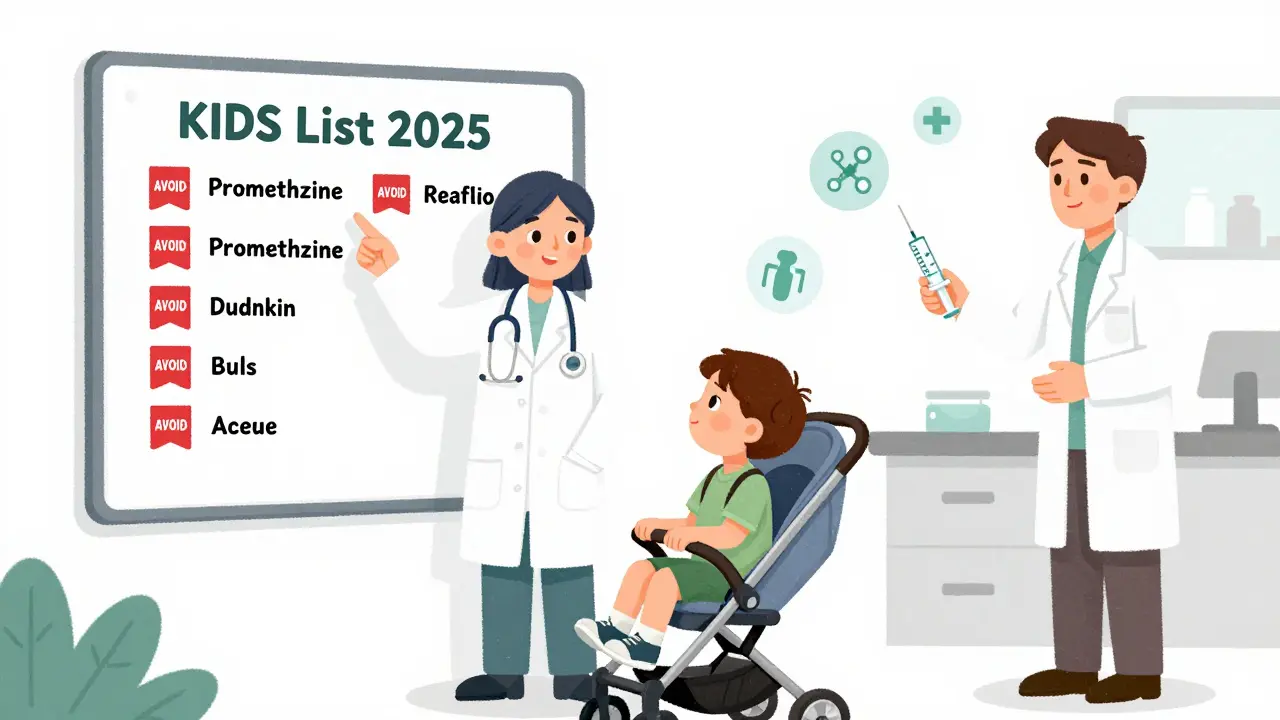
The Pediatric Pharmacy Association created the KIDs List - a living document that flags drugs with known or suspected dangers in children. The 2025 update includes over 4,100 medications, with clear recommendations: avoid or use with caution.Some entries are shocking. Promethazine, a generic antihistamine often used for nausea or sleep, carries a strong avoid warning for children under 2. Why? It’s been linked to respiratory failure and death. Even in older kids, it can cause dangerous sedation. Trimethobenzamide, a generic anti-nausea drug, is flagged for all patients under 18 because it can trigger acute dystonic reactions - violent muscle spasms that look like seizures. And yes, these warnings apply to generic versions too.
Even common OTC meds are on the list. Guaifenesin, found in many cough syrups, should be avoided in children under 4. Linaclotide, used for constipation, has a new caution for kids under 2 due to reports of death from dehydration. These aren’t obscure drugs. They’re in medicine cabinets across the country.
Off-Label Use Is the Norm - and It’s Risky
About 40% of all pediatric prescriptions are off-label - meaning the drug isn’t officially approved for that age, condition, or dose. And 90% of those prescriptions are for generics. Why? Because manufacturers rarely test their drugs on kids. It’s expensive. It’s slow. And until recently, there was little legal pressure to do it.The FDA’s Best Pharmaceuticals for Children Act and Pediatric Research Equity Act helped, but progress is slow. Sixty percent of generic drugs still lack pediatric dosing info, compared to just 35% of brand-name drugs. That means doctors are often guessing. They use adult doses and adjust by weight - but weight isn’t the only factor. Age, organ maturity, and metabolism matter just as much.
One study found that dosing errors in children are three times more common than in adults. Many of those errors happen because the generic label doesn’t say, “For children 6 months to 2 years: 5 mg/kg.” Instead, it says, “Adult dose: 10 mg.” The doctor has to calculate it - and sometimes, they miss.
How Medication Errors Happen - And How to Stop Them
Most pediatric medication errors aren’t caused by doctors. They happen at home. Parents give the wrong dose because:- They use a kitchen spoon instead of an oral syringe
- They confuse milligrams with milliliters
- They don’t realize the new bottle looks different
- They switch brands without checking
A 2023 survey by the American Society of Health-System Pharmacists found that 32% of medication errors intercepted by pharmacy staff involved inappropriate generic substitutions. The most common? Wrong concentration, wrong device, and wrong formulation.
Here’s what works:
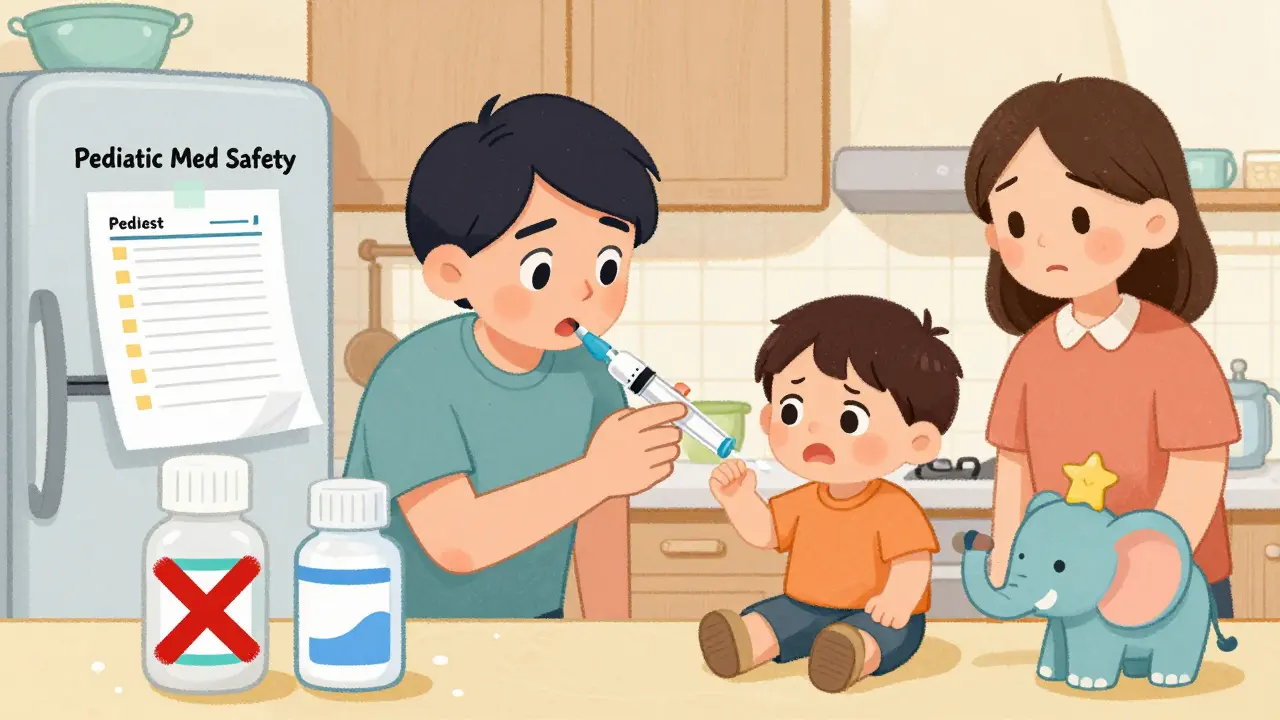
- Always use an oral syringe - never a teaspoon or tablespoon. Household spoons vary wildly in size.
- Never write “1.0 mg.” Write “1 mg.” A trailing zero can lead to a 10-fold overdose.
- Check the concentration. Liquid ibuprofen for infants is 50 mg/mL. For children, it’s 100 mg/mL. Using the wrong one can be fatal.
- Keep a current list of all meds - including vitamins and OTC drugs - and bring it to every appointment.
- Ask: “Is this the right version for my child’s age?”
When to Say No to the Generic
You don’t have to accept every generic substitution. If your child has had a reaction before, or if they’re on a narrow-therapeutic-index drug like levothyroxine or phenytoin, you can ask your doctor to write “Dispense as written” on the prescription. That tells the pharmacist: don’t switch it out.Some drugs are just too unpredictable in generic form. Levothyroxine, for example, has tiny variations in absorption between brands. For a baby with congenital hypothyroidism, even a 5% change can affect brain development. The same goes for seizure medications. Stability matters.
And yes - taste matters too. A 2024 Reddit poll of 1,247 parents found that 42% said their child refused to take a generic because it tasted awful. That leads to missed doses, which can be just as dangerous as the wrong dose.
What’s Changing - And What Still Needs to Change
The FDA now requires generic manufacturers to include pediatric dosing info when available - and full compliance is due by December 2025. That’s progress. But it’s not enough. Only 42% of U.S. generic makers comply with pediatric study requests. In Europe, it’s 78%.Health systems that use pediatric-specific safety protocols - like standardized dosing charts, pharmacist-led reviews, and parent education - have cut adverse events by nearly half. The American Academy of Pediatrics is rolling out a mobile app this year that will give doctors instant access to the KIDs List and dosing calculators. That’s a game-changer.
But the real solution? More testing. More labeling. More accountability. Until every generic drug for children is tested for safety in pediatric populations - not just assumed safe - the risk remains.
What You Can Do Right Now
You don’t need to be a doctor to keep your child safe. Here’s your checklist:- Always ask: “Is this approved for my child’s age?”
- Use only children’s formulations - never adult pills cut in half.
- Measure with an oral syringe - never a spoon.
- Write doses without decimals (1 mg, not 1.0 mg).
- Check the KIDs List at pediatricpharmacy.org (free to view).
- Report any reaction - even if you think it’s minor.
- Keep a written list of all meds, including doses and reasons.
Generic drugs save money. But when it comes to kids, safety shouldn’t be a trade-off. The right medicine - at the right dose, in the right form - matters more than price. Don’t assume. Ask. Verify. Protect.
Are generic drugs always safe for children?
No. While generics have the same active ingredient as brand-name drugs, they can contain different inactive ingredients that may cause allergic reactions, taste issues, or absorption problems in children. Some drugs, like promethazine and benzocaine, are outright unsafe for young kids - regardless of whether they’re generic or brand-name.
What is the KIDs List and why should I care?
The KIDs List is a regularly updated guide from the Pediatric Pharmacy Association that identifies drugs with known safety risks for children. It flags medications as "avoid" or "use with caution" based on evidence. If your child’s prescription is on the list, you need to talk to your doctor before giving it. It’s free to access online and should be part of every parent’s safety checklist.
Can I switch between brand-name and generic drugs for my child?
Sometimes, yes - but not always. For drugs like levothyroxine, phenytoin, or seizure medications, even small changes in formulation can affect how the body absorbs the drug. Always check with your pediatrician before switching. If your child had a reaction to a generic before, ask for "Dispense as written" on the prescription to prevent automatic substitution.
How do I measure liquid medicine correctly for my child?
Always use an oral syringe - never a kitchen spoon. Household spoons vary in size and can lead to dangerous overdoses or underdoses. Most liquid medications come with a syringe. If not, ask your pharmacist for one. Also, make sure you’re using the right concentration - infant and children’s versions often differ. Double-check the label.
What should I do if my child has a reaction to a generic drug?
Stop giving the medication immediately and contact your pediatrician. Take a photo of the pill or bottle, including the label and lot number. Report the reaction to the FDA’s MedWatch program. Even mild reactions like rashes or diarrhea can signal a serious problem. Never assume it’s just a coincidence - especially if it happened after switching generics.
Next steps: Talk to your child’s doctor about every new prescription. Ask if the drug is on the KIDs List. Confirm the dose and formulation. Keep a written log. And never hesitate to say no - your child’s safety is worth the extra step.
Lance Long
January 28, 2026 AT 07:33My 14-month-old broke out in hives after we switched to a generic cetirizine. Same active ingredient, different preservative. We went back to the brand and it vanished overnight. No one warned us this could happen. Parents need to know this isn’t just about price - it’s about your kid’s skin, lungs, and brain.
I didn’t even know inactive ingredients could cause this. Now I read every label like a detective. And I always ask the pharmacist: 'Is this the same version as last time?'
Amber Daugs
January 29, 2026 AT 08:45Of course generics are dangerous for kids. You think Big Pharma cares about your child? They care about profit margins. The FDA lets them slide because they’re too cozy with the drug companies. This isn’t an accident - it’s systemic neglect. And now you’re supposed to trust a label printed by a company that doesn’t even test on children?
My niece had a seizure after a generic anticonvulsant. The doctor said it was 'just a coincidence.' Coincidence my ass. They don’t test. They don’t warn. They just profit.
Linda O'neil
January 30, 2026 AT 03:34Just wanted to say thank you for sharing the KIDs List - I had no idea it existed. I printed it out and taped it to my fridge next to the emergency numbers. I’ve already caught two dangerous substitutions at the pharmacy because of it.
Pro tip: When the pharmacist tries to swap your kid’s levothyroxine, say 'I need the exact brand.' If they push back, ask to speak to the pharmacy director. Most will back down. Your child’s thyroid doesn’t negotiate.
And yes - the taste matters. If your kid refuses it, they’re not being picky. They’re sensing something’s off. Trust them.
Robert Cardoso
January 30, 2026 AT 10:13The entire premise here is emotionally manipulative. You’re conflating anecdotal reactions with systemic risk. Yes, some kids react to fillers. So do adults. That’s why we have pharmacovigilance systems. The fact that you’re treating every generic like a ticking bomb is irresponsible.
90% of pediatric prescriptions are generics because they’re safe, effective, and accessible. If you’re going to panic over preservatives, you might as well stop feeding your kid anything processed. Even water has additives.
Also, the FDA doesn’t 'let' manufacturers skip testing - they’re legally exempt because pediatric trials are ethically and logistically complex. Blaming the system without proposing alternatives is just noise.
James Dwyer
January 30, 2026 AT 12:46This is exactly the kind of info every parent needs to hear. I used to think generics were just 'cheaper brand names.' Now I know they’re a gamble with my kid’s health. I’ve started keeping a meds journal - drug name, dose, lot number, reaction. It’s a pain, but it’s worth it.
Also, oral syringes are a game-changer. I bought five of them. One for each room. No more guessing with spoons. My daughter’s asthma inhaler? I measure the dose before every use now. Small steps, big difference.
Chris Urdilas
February 1, 2026 AT 11:57Let’s be real - if you’re not checking the KIDs List, you’re playing Russian roulette with your kid’s liver. I used to think this was overkill until my son got hospitalized after a 'safe' generic cough syrup. Guaifenesin. Under 4. Totally legal. Totally deadly.
And yes, taste matters. I’ve had my 3-year-old throw up three times in a row because the generic version tasted like burnt plastic. He refused it for weeks. No dose = no treatment = bigger risk.
Doctors don’t know this stuff. Pharmacists don’t know it. So you have to. And that’s not paranoia - that’s parenting in 2025.
Jeffrey Carroll
February 2, 2026 AT 11:01While the concerns raised are valid, the tone of this article may inadvertently foster unnecessary fear around generic medications. The vast majority of pediatric generic prescriptions are administered safely and effectively. The focus should be on improving labeling, increasing pediatric pharmacovigilance, and educating providers - not on demonizing cost-effective therapeutics.
That said, the KIDs List is an invaluable resource, and its dissemination should be prioritized across all pediatric care settings. Thank you for highlighting this critical gap in public awareness.
SRI GUNTORO
February 3, 2026 AT 11:35India has been using generics for decades and our kids are fine. Why do Americans always assume the worst? Maybe you should focus on clean water and sanitation instead of obsessing over pill fillers.
Also, your doctor knows best. If they prescribe it, it’s safe. Don’t go reading random blogs and panic. Your child doesn’t need you to be a pharmacist. Just trust the system.
Kevin Kennett
February 4, 2026 AT 18:35Listen - I get it. You’re scared. I was too. But you’re not alone. I used to be the guy who just grabbed the cheapest bottle off the shelf. Then my daughter had a reaction. Now I’m the guy who shows up to the pharmacy with a printed copy of the KIDs List and a list of questions.
And guess what? Pharmacists respect that. They’ll slow down. They’ll double-check. They’ll even call the doctor for you. You just have to ask. You have to show up. Your child’s life isn’t a cost-saving exercise.
And if you’re tired of being the only one who cares? You’re not. There are thousands of us. We’re just quiet until we have to speak up.
Jess Bevis
February 4, 2026 AT 22:29Generic = cheaper. Brand = tested on kids. That’s the bottom line.
My kid’s seizure med? Brand only. No debate.
Rose Palmer
February 6, 2026 AT 20:46It is imperative that caregivers exercise due diligence when administering pharmacological agents to pediatric populations. The variance in excipient composition among generic formulations may precipitate idiosyncratic adverse reactions, particularly in neonates and infants with immature metabolic pathways.
Furthermore, the absence of standardized pediatric labeling in a significant proportion of generic products necessitates a heightened level of clinical vigilance. The KIDs List represents a critical, evidence-based framework for mitigating these risks and should be integrated into routine pediatric care protocols.
Howard Esakov
February 7, 2026 AT 13:16Of course generics are risky. You think the FDA approves these without corporate lobbying? I’ve seen the documents. They don’t test on kids because they don’t have to. The system is rigged. And you? You’re just a pawn in a game where your child’s health is the currency.
Next time you see a $2 generic, ask yourself: Who benefits? Not you. Not your kid. The shareholders do.
And don’t even get me started on the flavorings. They’re not there for taste. They’re there to mask the chemical aftertaste so kids don’t spit it out. That’s not medicine. That’s manipulation.
Kathy Scaman
February 9, 2026 AT 11:45My daughter had a rash after a generic amoxicillin. We switched back. Gone in 12 hours. I didn’t think it was the meds until I read this.
Now I keep a photo of every bottle. I screenshot the label. I write down the lot number. I know it sounds crazy. But I’d rather look like a weirdo than lose my kid to a preservative I didn’t know existed.
Mindee Coulter
February 10, 2026 AT 14:29My kid refused the generic cough syrup so I mixed it with applesauce and he still gagged. Switched back to brand. He drank it like juice. No joke. Taste is a real thing. And if your kid won’t take it, it doesn’t matter how safe it is.
Also - oral syringes. Buy them. Use them. Stop using spoons. I’m not even mad anymore. Just tired of seeing parents wing it.
Rhiannon Bosse
February 11, 2026 AT 18:51Okay but what if the KIDs List is a scam? What if it’s funded by brand-name drug companies to scare parents into paying more? What if the FDA is in on it? I read somewhere that the same people who regulate drugs also own stock in pharma.
My cousin’s friend’s neighbor’s kid had a seizure after a generic - and the hospital covered it up. They said it was 'idiopathic.' Idiopathic my foot.
They’re hiding the truth. And you’re just giving them your trust. Don’t you see? Everything is a lie. Even the syringes. They’re measuring wrong on purpose. To sell more bottles.
…I’m just saying. Think about it.