
Generic Drug Savings Calculator
This calculator estimates potential savings from switching to generic medications while highlighting safety considerations based on medication type and patient stability. As the article explains, for drugs with a narrow therapeutic index, switching between generic brands can be dangerous.
Medication costs are rising fast. In 2025, the average Canadian household spends over $1,200 a year on prescriptions, and hospital drug budgets are growing at more than 10% annually. But cutting corners on meds isn’t an option-wrong dosages, missed refills, or unsafe substitutions can land patients back in the hospital, costing far more than the original savings. The real challenge? Saving money without risking safety. And the good news? It’s possible. Hospitals, clinics, and even individual patients are doing it every day-with proven strategies that cut waste, prevent errors, and keep people healthy.
Pharmacists Are the Secret Weapon
Most people think of pharmacists as people who hand out pills. But in top-performing hospitals, they’re clinical decision-makers sitting right beside doctors and nurses. A pharmacist reviewing a patient’s full medication list before discharge can catch dangerous interactions, duplicate prescriptions, or unnecessary drugs. One study in a 390-bed community hospital found that daily pharmacist reviews for heart failure patients cut 30-day readmissions by nearly half-and saved $5,652 per patient. That’s not luck. It’s expertise.These aren’t just busywork checks. Board-certified pharmacists (BCPS) use clinical judgment to swap expensive brand-name drugs for equally effective generics, adjust doses based on kidney or liver function, and stop meds that no longer help. A Walter Reed Army Medical Center study from the 1990s showed every dollar spent on pharmacist-led care returned $6.03 in savings. That ratio still holds today. Hospitals that embed pharmacists into daily rounds see 28% fewer medication errors than those that don’t. And nurses? 78% say having a pharmacist on the team reduces mistakes and cuts down on risky "workarounds" they used to do just to get meds given faster.
Generic Drugs Work-When Used Right
Generic medications are the easiest win. About 82% of patients in the U.S. already use them. In Canada, generics cost 30-80% less than brand names and are required by law to meet the same purity and effectiveness standards. But here’s the catch: not all generics are created equal when it comes to safety.For drugs with a narrow therapeutic index-like warfarin, lithium, or levothyroxine-even tiny differences in absorption can cause harm. That’s why switching patients between different generic brands without monitoring isn’t safe. The solution? Stick with one generic manufacturer unless there’s a clear clinical reason to switch. Pharmacists track which brand a patient responds to and keep them on it. If cost is the goal, use generics-but don’t treat them like interchangeable commodities. A 2021 NEJM article warned that early push for "cheapest possible" generics led to therapeutic failures in some epilepsy and heart patients. Smart cost-saving means knowing when to hold the line.
Standardize Communication to Prevent Mistakes
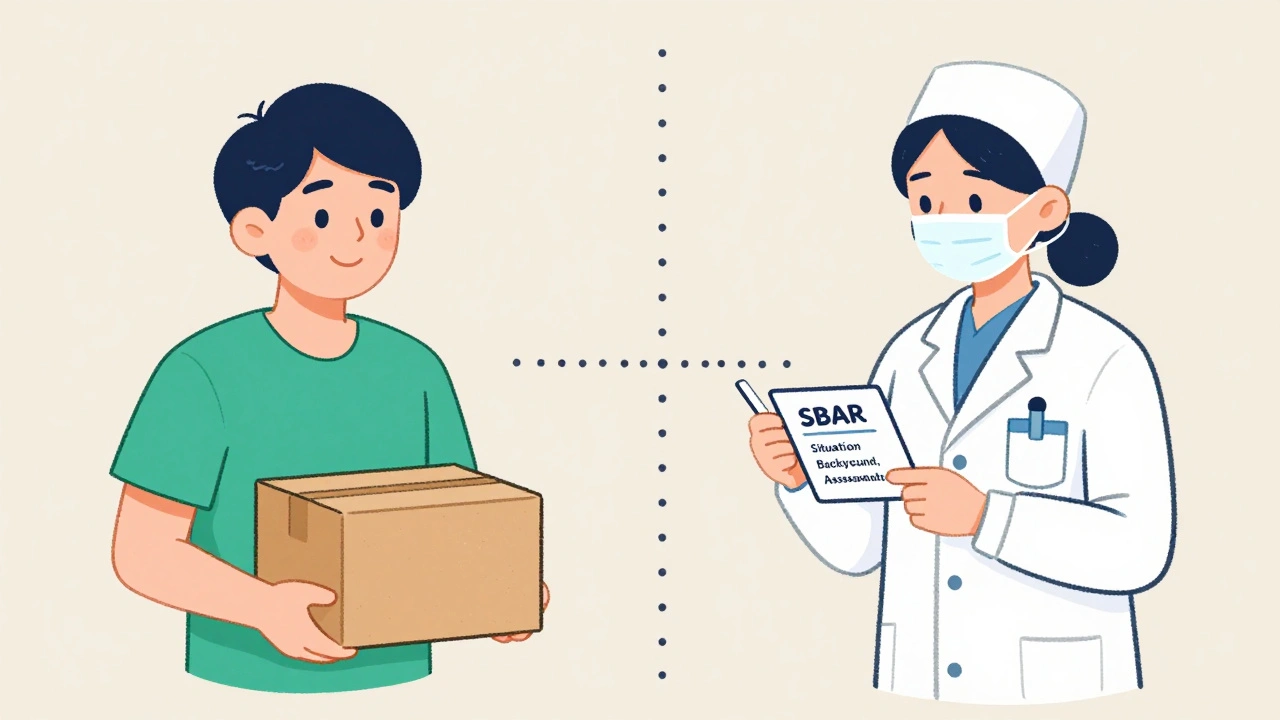
One of the biggest causes of medication errors? Poor handoffs. A patient moves from ER to floor, from hospital to home, and details get lost. That’s where SBAR-Situation, Background, Assessment, Recommendation-comes in. It’s a simple, structured way for nurses, doctors, and pharmacists to communicate critical info. One large hospital system cut adverse drug events by 50% after training staff to use SBAR. No new software. No big budget. Just better talk.Same goes for medication reconciliation. The Joint Commission requires it, and for good reason. Up to 70% of medication errors happen during transitions of care. A pharmacist sitting down with a patient at discharge, comparing their home meds to what’s being prescribed in the hospital, can catch missing drugs, wrong doses, or conflicting prescriptions. That single step reduces readmissions by up to 30%. It’s low-tech, high-impact, and costs almost nothing except time.
Ready-to-Administer Meds Save Time and Errors
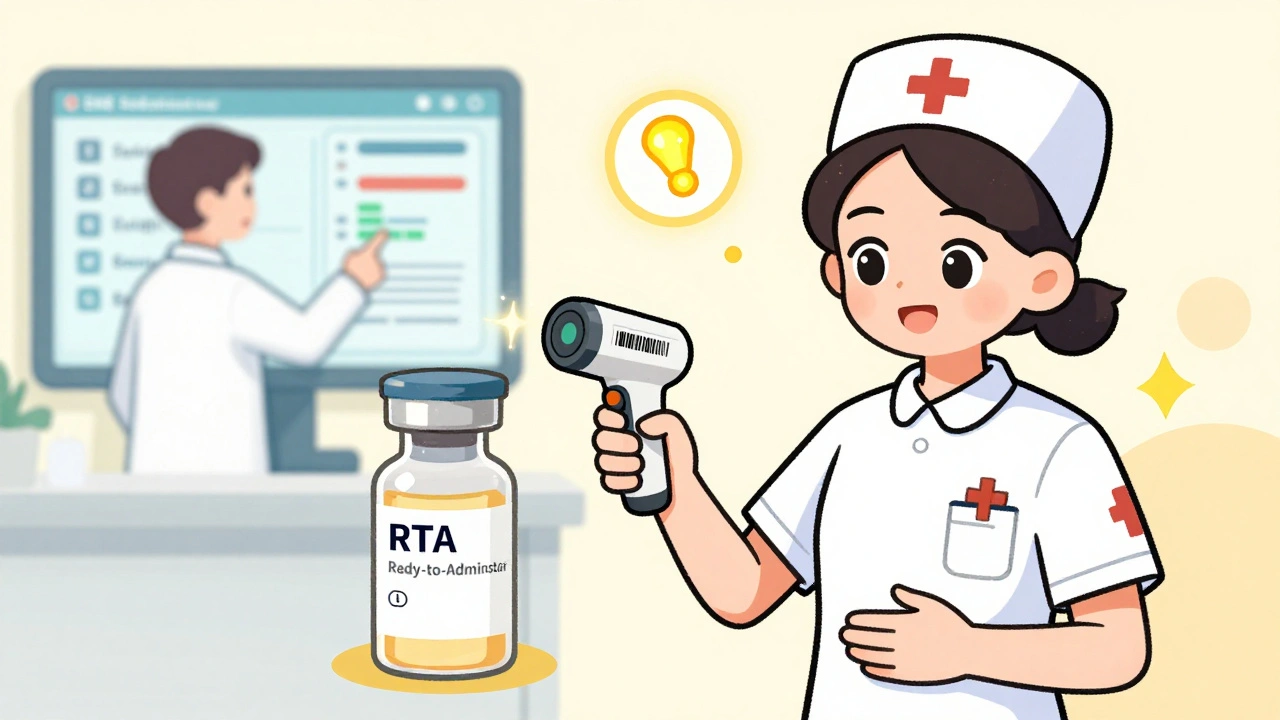
In busy units, nurses often have to open, measure, and mix medications themselves. That’s where mistakes creep in-wrong dose, wrong dilution, wrong patient. Ready-to-Administer (RTA) products come pre-measured, pre-labeled, and ready to give. They’re common in ICUs and oncology units, and they’re spreading.RTA cuts preparation time by 30%, reduces waste from spilled or expired meds, and slashes administration errors. The downside? They cost 15-20% more than bulk powder or vials. But when you factor in reduced errors, fewer patient complications, and staff time saved, the math often works out. One hospital reported saving $180,000 in one year after switching to RTA for high-risk antibiotics-mostly from avoiding one ICU admission caused by a dosing error.
Use Technology Wisely
Electronic prescribing cuts errors by 55%, and barcode scanning at the bedside reduces administration mistakes by 41%. These aren’t optional anymore-they’re baseline tools. But tech alone doesn’t fix everything. A system can’t tell if a 90-year-old patient really needs five blood pressure pills. Only a pharmacist can.Big EHRs like Epic and Cerner help, but they’re only as good as the people using them. The best results come when tech supports people-not replaces them. A 2023 Leapfrog Group report found that 89% of top-performing hospitals had pharmacists on every care unit. The ones relying only on software? They saw only half the error reduction.
Patients Can Help Too
Patients aren’t just passive recipients-they’re key players in safety and savings. Nearly 40% use at least one cost-saving strategy: generics, mail-order pharmacies, free samples, or splitting pills (with approval). Mail-order pharmacies often offer 90-day supplies at lower copays, reducing trips to the pharmacy and improving adherence.But patients need guidance. A 2023 study showed that when pharmacists proactively offered to switch a patient to mail-order for chronic meds, refill rates jumped from 62% to 89%. That’s not just savings-it’s safety. Missed doses are a leading cause of ER visits for heart failure, diabetes, and hypertension.
Don’t assume patients know how to ask. Teach them: "Ask your pharmacist if there’s a cheaper version." "Can I get a 90-day supply?" "Should I still take this pill if I feel fine?" Simple questions prevent big problems.
What Doesn’t Work
Cutting pharmacy staff to save money is a classic trap. One hospital director on LinkedIn admitted reducing tech positions led to a 22% spike in medication errors within three months-and $1.2 million in extra costs from extended stays and lawsuits. Another tried cutting drug inventory to "reduce waste," only to run out of critical antibiotics during a flu surge, forcing emergency purchases at triple the price.Same goes for blindly switching to the cheapest generic without clinical oversight. Or skipping medication reconciliation because "the patient seems fine." These aren’t savings-they’re financial and clinical risks disguised as efficiency.
Where to Start
You don’t need a $5 million tech upgrade to make a difference. Start here:- Identify your top 3 most expensive or most error-prone medications (e.g., insulin, anticoagulants, antibiotics).
- Assign a pharmacist to review those cases weekly.
- Train staff on SBAR for handoffs.
- Offer mail-order for chronic conditions.
- Track readmissions and medication errors monthly.
Small steps, done consistently, add up. Hospitals that followed this path saw 15-20% lower drug costs per admission by 2025-and 18.7% higher patient satisfaction scores. Safety and savings aren’t opposites. They’re two sides of the same coin.
What’s Next
The future is clear: pharmacists are moving from the back room to the front line. By 2027, 75% of health systems in North America will have pharmacists embedded in care teams, according to ASHP. The CMS is investing $500 million in pilot programs to test pharmacist-led cost-saving models. And the FDA’s Safer Technologies Program is fast-tracking new safety tools.The goal isn’t to spend less. It’s to spend smarter. Every dollar saved on a drug should be reinvested in safety-whether that’s more pharmacist hours, better training, or smarter systems. Because when medication safety slips, the cost isn’t just financial. It’s human.
Can switching to generic drugs really save money without risking safety?
Yes-when done correctly. Generic drugs must meet the same FDA and Health Canada standards as brand names. For most medications, they’re just as safe and effective. But for drugs with a narrow therapeutic index-like warfarin, lithium, or thyroid meds-switching between different generic brands can cause problems. The key is consistency: once a patient is stable on a specific generic, stick with it. Always consult a pharmacist before switching.
Do pharmacist-led programs actually save money?
Absolutely. Studies show every $1 spent on clinical pharmacist services returns $6.03 in savings by preventing hospital readmissions, reducing errors, and cutting unnecessary prescriptions. One program saved $1.8 million in 180 days for just 830 high-risk patients. These aren’t theoretical numbers-they’re real results from hospitals across North America.
What’s the biggest mistake hospitals make when trying to cut drug costs?
Reducing pharmacy staff or skipping clinical reviews to save money. One hospital cut pharmacy technician positions and saw a 22% rise in medication errors within three months. The resulting extended stays and lawsuits cost $1.2 million-far more than the initial savings. Safety isn’t an expense; it’s the foundation of cost control.
How can patients help reduce medication costs safely?
Patients can ask four simple questions: "Is there a generic version?" "Can I get a 90-day supply through mail-order?" "Are any of these meds no longer needed?" and "Can I split this pill safely?" Using generics, mail-order pharmacies, and free samples from doctors can cut costs by 30-80%. But always check with a pharmacist first-some meds shouldn’t be split or substituted.
Is technology enough to ensure medication safety?
No. Electronic prescribing and barcode systems reduce errors by 50-60%, but they can’t judge if a drug is appropriate for a specific patient. A computer won’t notice that a 92-year-old with kidney disease is on five blood pressure pills. Only a trained pharmacist can spot those risks. The best systems combine tech with human expertise-never one without the other.
Jack Arscott
December 2, 2025 AT 23:28Pharmacists are the real MVPs 😍 I had a friend who got switched between generic warfarin brands and ended up in the ER. One pharmacy used one filler, another used another-same pill, different body. Never again. Stick with one brand. Period. 🙌
Lydia Zhang
December 3, 2025 AT 16:12Generics work fine unless you’re on something like lithium
Lucinda Bresnehan
December 4, 2025 AT 15:45As someone who works in a community pharmacy, I see this every day. Patients think generics are all the same but they don’t realize how much absorption varies with fillers and coatings. I had a 78-year-old woman on levothyroxine who kept having palpitations-turned out she’d been switched three times in six months. We got her back on the original generic and her TSH stabilized in two weeks. It’s not about cost, it’s about consistency. Also, mail-order for chronic meds? Life-changing for seniors with mobility issues. Just make sure they have a pharmacist they trust to monitor it. And please, stop letting people split pills without checking the coating. Some meds are designed to release slowly and splitting them is dangerous. Just say no.
Shannon Gabrielle
December 6, 2025 AT 09:17Oh wow a whole article about how pharmacists are magic wizards who fix everything while we peasants just pay for it. Newsflash: the system is rigged. Big Pharma pays pharmacists to push certain generics. The FDA’s standards? Laughable. And don’t get me started on how ‘generic’ just means ‘not branded’-not ‘same quality.’ You think a pill made in India is the same as one made in Canada? LOL. You’re not saving money-you’re gambling with your life. And don’t even get me started on ‘mail-order pharmacies’-half of them ship expired meds in plastic bags. This whole post is corporate propaganda wrapped in a lab coat.
ANN JACOBS
December 8, 2025 AT 03:23It is truly remarkable, and indeed profoundly encouraging, to witness the growing recognition of the indispensable role that clinical pharmacists play in the modern healthcare ecosystem. Their integration into multidisciplinary care teams represents not merely a tactical adjustment, but a paradigmatic shift toward patient-centered, evidence-based, and economically sustainable medicine. The data presented-particularly the $6.03 return on every dollar invested-is not merely statistically significant; it is morally imperative. To reduce pharmacy staffing in the name of fiscal prudence is, in effect, to prioritize short-term accounting over long-term human dignity. One must also acknowledge the quiet heroism of patients who, armed with the right questions, become active agents in their own therapeutic outcomes. This is not just cost-saving-it is the reclamation of medical autonomy.
Priyam Tomar
December 8, 2025 AT 09:07Everyone here is acting like pharmacists are the only solution. Have you heard of India? They make 40% of the world’s generics. You think your $10 pill is the same as the $2 one from there? Nope. And your ‘clinical pharmacist’ is just a glorified clerk who follows algorithms. Real savings? Stop prescribing so many unnecessary drugs in the first place. My cousin’s doctor gave him 12 pills for high blood pressure-half of them were for side effects of the other half. Fix the prescribing culture, not the pill distribution. Also, why is everyone ignoring telehealth? You can get a pharmacist consult for $5 via app. Why pay for a whole team?
Kay Lam
December 8, 2025 AT 09:37I’ve been a nurse for 22 years and I’ve seen hospitals cut corners on everything-staff, supplies, time-and then wonder why patients keep coming back. The one thing we never cut? The pharmacist. Not because we’re sentimental, but because when you’re rushing to give meds to 12 patients and someone’s BP is sky-high and the chart says ‘hold’ but the doctor didn’t write it down, that pharmacist is the only person who says ‘wait, this doesn’t add up.’ I’ve watched them catch wrong doses, duplicate anticoagulants, even spot a patient who was allergic to a filler in a generic. It’s not glamorous. It’s not in the headlines. But it’s what keeps people alive. And if your hospital doesn’t have a pharmacist on rounds? You’re not saving money-you’re just betting on luck.
Adrian Barnes
December 9, 2025 AT 12:07Let’s be brutally honest: the entire narrative here is a smokescreen. The real issue is that the U.S. healthcare system is a for-profit casino where patients are the house edge. Pharmacists are not heroes-they’re cost-center managers under corporate directives. The $6.03 ROI? That’s calculated by excluding liability payouts, malpractice settlements, and the hidden cost of chronic disability from medication errors. And the ‘generic’ push? It’s a corporate strategy to offload risk onto vulnerable populations who can’t afford to switch brands. This isn’t innovation. It’s exploitation dressed in white coats. The only thing saving lives here is the fact that people still have enough sense to question the system.
Linda Migdal
December 10, 2025 AT 00:30RTA products are the future. Period. I work in oncology. We used to spend 45 minutes per chemo bag preparing infusions. Now? 12. Error rate dropped from 1 in 15 to 1 in 200. Yes, they cost 20% more. But we stopped having two patients per month get sepsis from contaminated infusions. The math isn’t hard: $180K saved in one year from one avoided ICU admission? That’s not a cost-it’s a win. And the nurses? They’re not fighting to get meds done anymore. They’re actually talking to patients. That’s the real ROI.
Tommy Walton
December 11, 2025 AT 21:48Medication safety isn’t about cost-it’s about consciousness. We’ve outsourced our health to algorithms and bureaucrats. The real revolution? Asking ‘why’ before swallowing. A pill is not a solution-it’s a conversation. The pharmacist is not a vendor. They’re a guide. And the system? It’s not broken. It’s just asleep. Wake it up. 🌿