
Have you ever looked at a bottle of pills and wondered why one label says take once daily while another looks almost identical but demands three doses a day? It’s easy to assume they work the same way, but for certain medications, that small difference is a matter of life and death.
Imagine crushing a tablet meant to slowly release medicine over 24 hours. Suddenly, your body gets the entire dose at once-potentially causing a severe overdose. That is exactly why reading the directions for extended-release medications requires more attention than your average pill bottle. As we move through 2026, new safety standards mean labels look slightly different, but the core risks remain the same. Misunderstanding these labels leads to hospital visits, wasted medication, and unnecessary side effects.
What You Need to Know Right Now
- Suffix Matters: Look for XR, ER, SR, or CD after the drug name-they change how long the medicine lasts.
- Never Crush: Breaking the tablet bypasses the time-release mechanism and dumps the full dose into your system immediately.
- Timing is Key: Some must be taken at bedtime to reduce side effects, regardless of how fast you feel better.
- Visual Warnings: Newer labels since 2024 often include high-contrast icons warning against splitting or chewing.
- Brand Differences: Even generic versions with the same name might use different release technologies.
Decoding the Abbreviations
The pharmaceutical industry uses short codes to tell you exactly how a medicine behaves inside your body. If you see a list of letters after your drug name, stop and read them carefully. The Food and Drug Administration (FDA) has mandated standardized labeling conventions for these products to prevent confusion between immediate and modified-release formulas.
You will most commonly encounter suffixes like ER (Extended Release) or XR (eXtended Release). These generally indicate that the drug is designed to last longer in your system, allowing you to take fewer doses per day. However, you might also see SR (Sustained Release) or CR (Controlled Release). While they sound similar, the technology behind them differs significantly.
For instance, sustained-release formulations specifically prolong the medication's release from a tablet or capsule, whereas controlled-release often involves a coating that regulates the speed based on stomach conditions. There are even proprietary names like CD (Continuous Delivery) found on heart medications like Cardizem CD. Knowing which letter code appears on your label helps you anticipate how long the effects should last. If you are prescribed Adderall XR, you know it’s a morning medication designed to help you through the school or workday, unlike an immediate-release version that wears off in four hours.
| Abbreviation | Meaning | Typical Duration |
|---|---|---|
| ER / XR | Extended Release | 8-24 hours |
| SR | Sustained Release | 12-24 hours |
| CR | Controlled Release | Varies by formulation |
| CD | Continuous Delivery | Usually 24 hours |
| LA | Long Acting | Similar to ER/SR |
The "Do Not Crush" Warning
This is arguably the most critical part of reading your label. Dr. Michael Cohen of the Institute for Safe Medication Practices (ISMP) warns that most modified-release dosage forms shouldn’t be crushed, split, or chewed. When you break the tablet, you destroy the special matrix or coating that controls the flow of the active ingredient. Instead of a steady stream of medicine over 24 hours, your body receives a massive spike-the equivalent of taking five or ten regular pills at once.
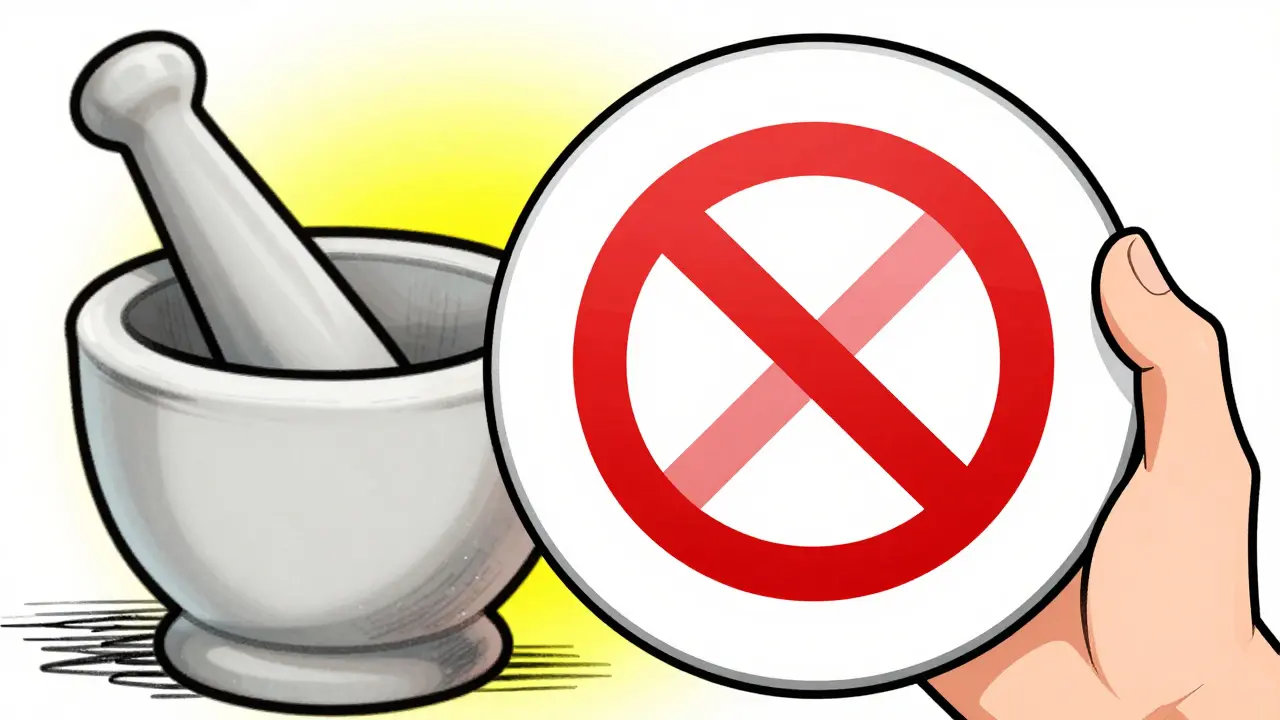
In 2024, the FDA updated regulations requiring enhanced visual indicators on extended-release medication labels. If your label is recent, look for bold, high-contrast warnings saying "DO NOT CRUSH" or "DO NOT CHEW." Sometimes this warning is accompanied by a symbol, such as a crossed-out mortar and pestle or a broken tablet icon. These aren't just suggestions; they are mandatory safety directives found in the Warnings section of the Drug Facts panel. Ignoring this can lead to serious adverse events, including respiratory failure with opioids or dangerous blood pressure drops with cardiovascular drugs.
Interpreting the Timing Instructions
Once you’ve confirmed the release type, you need to figure out when to take it. The directions section doesn't just say "take daily"; it provides specific timing cues because the absorption profile depends on your body's internal clock. For example, some extended-release niacin formulations cause flushing if taken during the day, so the label mandates bedtime dosing.
Pay close attention to whether the label specifies "morning," "evening," or "without regard to meals." If it says "once daily in the morning," taking it right before bed could keep you awake all night, as noted by many patient reviews regarding stimulant medications. Furthermore, some drugs require consistency in timing to maintain therapeutic blood levels. A 24-hour extended-release product like Diltiazem XT maintains stable levels only if you take it at the exact same time every day. If you delay a dose by six hours, your protection dips, potentially putting you at risk during those unprotected windows.
Technology Behind the Pill
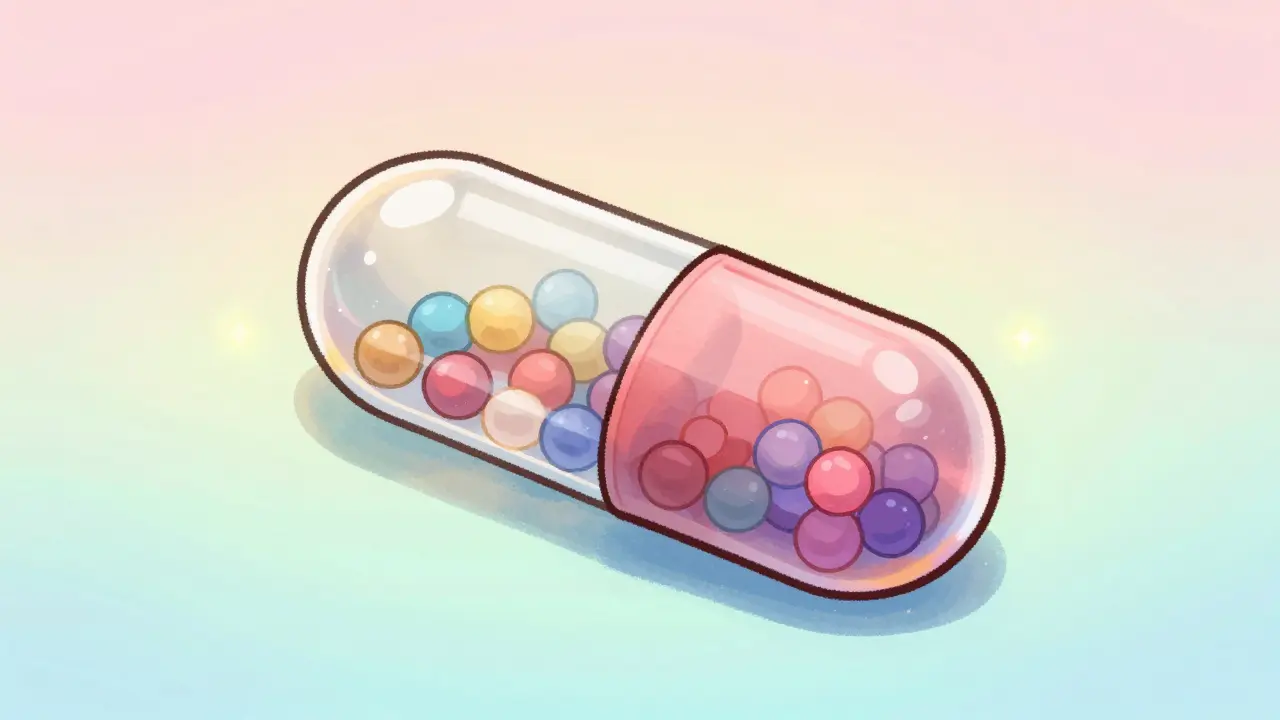
To fully understand the label, it helps to know what is happening inside the pill. There are three primary mechanisms used to create extended-release effects: matrix systems, coating techniques, and encapsulation methods. Matrix formulations mix the drug with a polymer matrix and compress it into a tablet that dissolves slowly as water penetrates it. Coating techniques involve applying a thin polymer layer to the drug particles, where the thickness determines how fast the drug releases.
Another sophisticated method is encapsulation, where tiny beads are enclosed within a capsule that dissolves at a controlled rate. One famous example is the OROS (Osmotic Release Oral System) technology used in Concerta. Unlike standard matrix tablets, this system uses osmotic pressure to push the medication out over 10 to 12 hours. Understanding this helps explain why some labels say "Swallow Whole" without exception-you cannot alter the geometry of an osmotic pump without ruining its function.
Common Pitfalls to Avoid
Patient experiences shared online reveal several recurring mistakes. A significant number of users confuse brand names with release times. For instance, Ritalin LA and Concerta both treat ADHD but utilize entirely different delivery systems. Confusion arises when patients expect the same effect duration when switching between brands. Always ask your pharmacist if two medications are truly interchangeable.
Another major error is assuming "Maximum Strength" means a higher dose rather than an optimized release profile. Over-the-counter pain relievers like Aleve PM often carry this claim, referring to the stability of the release rather than potency. Additionally, many patients ignore the Inactive Ingredients section, assuming all generics are identical. The FDA's Inactive Ingredient Database shows that excipients vary widely between manufacturers, affecting how well someone tolerates the drug, especially those with allergies to dyes or fillers.
Practical Checklist for Patients
Before you start a new regimen, run through this quick validation process to ensure you have read the label correctly:
- Check the Suffix: Confirm if it reads XR, ER, SR, or CR.
- Verify the Warning: Scan the top of the label for "Do Not Crush" in large text.
- Identify Frequency: Note if it requires once-daily, twice-daily, or specific clock-time administration.
- Food Interaction: Read the "Directions" section for instructions on eating before or after the dose.
- Check Expiration: Verify the bottle isn't nearing the end of its shelf life, as coatings degrade over time.
- Ask Questions: If you don't understand a term like "24-hour formulation," ask for clarification immediately.
Frequently Asked Questions
Can I cut an extended-release pill in half?
You should never split an extended-release tablet unless the manufacturer explicitly states it is scored for that purpose. Splitting usually breaks the release mechanism, causing the drug to dump into your system too quickly. Always consult your pharmacist before attempting to modify the form.
What happens if I crush my extended-release medication?
Crushing destroys the special coating or matrix, releasing the entire dose at once. This can cause an overdose, leading to severe side effects or toxic reactions depending on the drug class. For example, crushing opioid painkillers can be fatal.
Is ER the same as XR?
They are very similar, but not always identical. Both stand for extended release, but the specific technology varies by brand and company. While they usually last a similar amount of time, you should not assume interchangeability without checking with your healthcare provider.
Why does my label say "Take at Bedtime"?
Some medications release chemicals that interact poorly with alertness or digestion during the day. Taking them at night minimizes side effects like flushing or drowsiness, or ensures the drug reaches peak blood levels when you wake up, covering the longest part of your day.
What if I miss a dose of an extended-release medication?
If you miss a dose, take it as soon as you remember unless it is nearly time for your next scheduled dose. Never double up to catch up, as this increases the risk of accidental overdosing due to the lingering presence of the previous dose in your system.
Troubleshooting Your Medication Routine
Even with careful reading, issues can arise. If you notice the tablet looks different one month than the last, contact your pharmacy immediately. Generics can switch manufacturers, changing the shape or color without altering the active ingredient, though this causes anxiety for many patients.
If you experience sudden side effects after weeks of stability, suspect a timing change or a new interaction. Keep a log of when you take your meds versus when symptoms appear. Finally, trust the label over memory. Human memory fails, but a label remains constant. If you lose confidence in your ability to manage the complex labels, ask for a MedGuide or a printed Medication Action Plan from your local clinic. By staying informed, you turn a simple bottle label into a powerful tool for managing your health safely.
Carolyn Kask
March 30, 2026 AT 10:49People really ignore the labels until something goes wrong then they sue everyone.
emma ruth rodriguez
March 31, 2026 AT 18:15The distinction between sustained release and controlled release is fundamentally different regarding pharmacokinetics! It is imperative that patients understand these mechanisms before ingestion occurs! Safety protocols are established for reasons beyond simple convenience!
Katie Riston
April 2, 2026 AT 14:51We often forget the complexity hidden inside small tablets.
Medicine is not just chemistry but a contract with our biology.
When we swallow a pill we are trusting science with our immediate future.
The delay in action creates a buffer zone for safety margins.
If we break that buffer we expose ourselves to raw toxicity.
It feels like a violation of natural order to force rapid absorption.
Technology mimics nature by slowing down processes artificially.
Nature itself moves slowly through the digestive tract.
Our impatience to feel better fights against these biological rhythms.
Patience becomes a medical requirement in modern therapy protocols.
We see the warning signs as hurdles instead of protections.
Understanding the suffix codes helps us align with the medication flow.
Every letter represents hours of testing and design work.
Ignoring those letters shows a lack of respect for the engineering.
Respect keeps the therapeutic relationship balanced and safe.
Without that respect chaos reigns in the bloodstream.
Michael Kinkoph
April 3, 2026 AT 17:12One must acknowledge that common sense does not exist among the general population anymore!! Proper labeling adherence is a civic duty!!!
Beccy Smart
April 5, 2026 AT 04:04Took me 10 minutes to read this 😴📉
Jonathan Sanders
April 5, 2026 AT 19:02You seem exhausted by the very act of staying alive sometimes.
Ruth Wambui
April 7, 2026 AT 10:06They want you confused so you keep buying the expensive brand versions forever.
Rick Jackson
April 7, 2026 AT 19:30Possibly there is more to consider than just corporate greed alone.
Brian Yap
April 8, 2026 AT 08:13Fair dinkum advice for the bush folk out here.