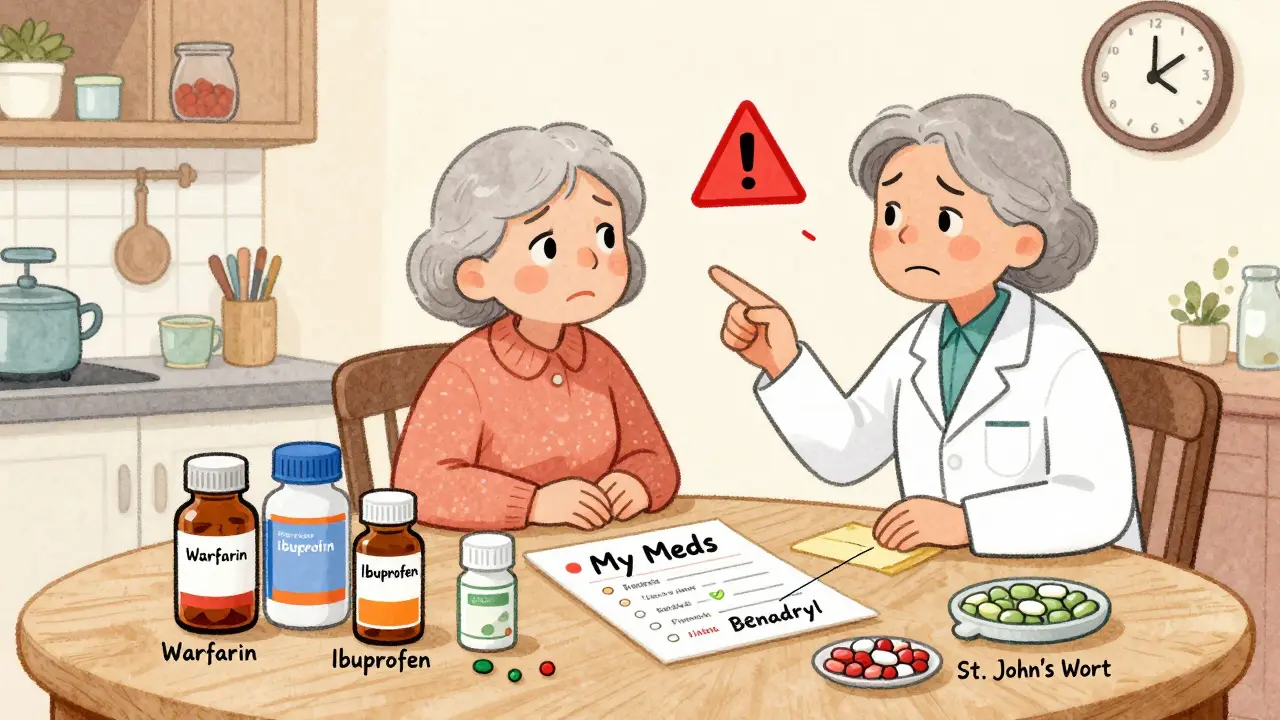
Every year, thousands of older adults end up in the hospital because of something that shouldn’t have happened: a bad reaction between their medications. It’s not rare. It’s not random. It’s predictable-and preventable.
People over 65 are the most likely group to take multiple medications. About 40% of them are on five or more drugs at once. That’s not because they’re overmedicated-it’s because they’re managing arthritis, high blood pressure, diabetes, heart disease, and maybe even depression or sleep issues. Each condition needs treatment. But when you stack those treatments together, the risks multiply.
Here’s the problem: aging changes how your body handles drugs. Your liver doesn’t break down medications as fast. Your kidneys don’t flush them out as efficiently. Your body has less water and more fat, so drugs stick around longer or build up in the wrong places. All of this makes seniors up to 50% more likely to have a serious reaction to a drug interaction than younger adults.
What Makes Drug Interactions So Dangerous in Older Adults?
Not all drug interactions are the same. Some are mild-a little dizziness, a dry mouth. Others can be deadly: a sudden drop in blood pressure, internal bleeding, kidney failure, or a dangerous heart rhythm.
The biggest troublemakers? Medications that affect the heart and the brain. Together, they make up nearly two-thirds of all serious drug interactions in seniors. Think blood thinners like warfarin mixing with common painkillers like ibuprofen. Or antidepressants combining with certain heart meds, causing a dangerous spike in serotonin levels. Even something as simple as taking a sleep aid with a blood pressure pill can send your blood pressure too low, increasing fall risk.
And it’s not just prescription drugs. Over-the-counter meds, herbal supplements, and even vitamins can cause problems. A 2023 Merck Manual survey found that 68% of older adults don’t tell their doctors about the supplements they take. St. John’s Wort, ginkgo biloba, garlic pills-these aren’t harmless. They can interfere with blood thinners, antidepressants, and even chemotherapy drugs.
The Role of the Beers Criteria and STOPP
Doctors don’t guess which drugs are risky for seniors. They use tools built on decades of research. Two of the most trusted are the Beers Criteria and the STOPP criteria.
The Beers Criteria, updated every two years by the American Geriatrics Society, lists 30 types of medications that should generally be avoided in older adults-and 40 others that need lower doses because of kidney or liver changes. For example, benzodiazepines like diazepam (Valium) are on the list because they increase fall risk and confusion. Anticholinergics like diphenhydramine (Benadryl) are also flagged-they can cause memory problems and urinary retention.
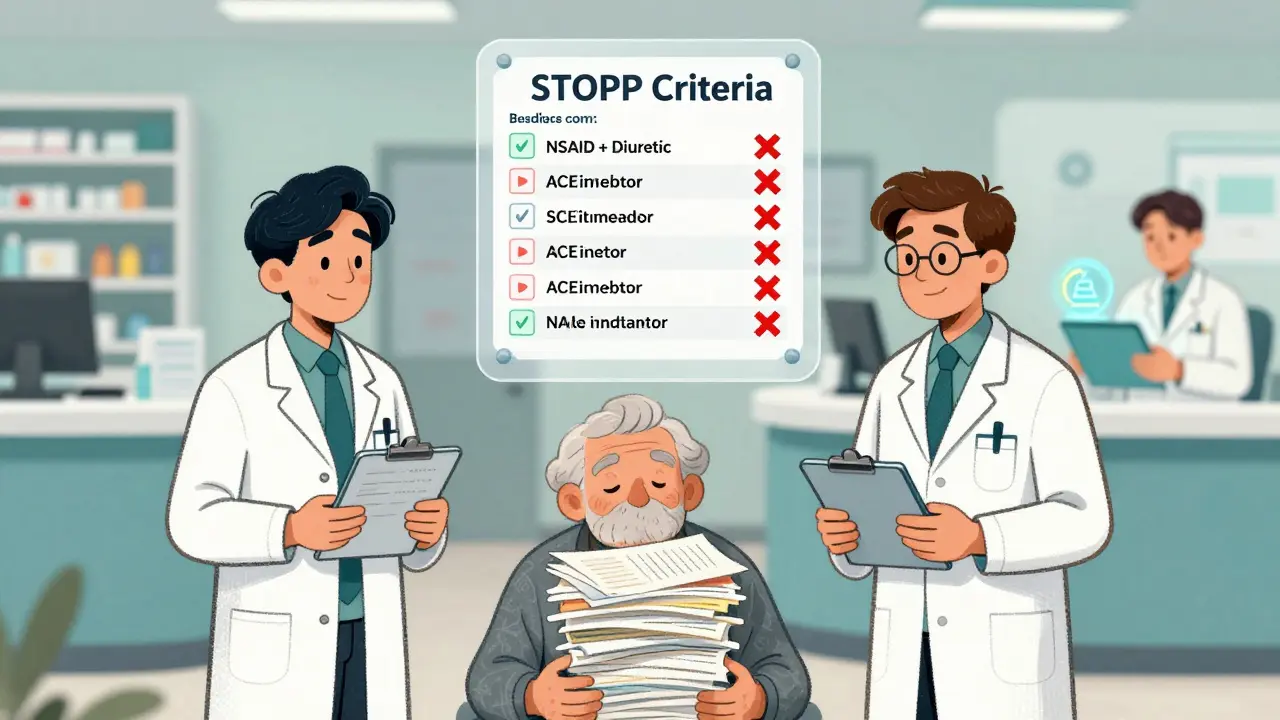
STOPP (Screening Tool of Older Persons’ Potentially Inappropriate Prescriptions) goes further. It’s not just about individual drugs-it’s about combinations. STOPP identifies 114 potentially harmful prescribing patterns. For instance: prescribing a proton pump inhibitor (like omeprazole) long-term with clopidogrel (a blood thinner), which reduces the effectiveness of the blood thinner. Or giving a nonsteroidal anti-inflammatory drug (NSAID) to someone already on a diuretic and ACE inhibitor-this combo can wreck kidney function.
Studies show that when hospitals use STOPP during discharge planning, potentially inappropriate prescribing drops by over 34%, and hospital readmissions fall by more than 22%.
Why Fragmented Care Makes Things Worse
One of the biggest hidden dangers? Multiple doctors. Over two-thirds of seniors see more than one specialist. One doctor prescribes a new blood pressure med. Another adds a sleep aid. A third prescribes an anti-anxiety drug. None of them know what the others have written.
And it’s not just doctors. Many seniors fill prescriptions at different pharmacies-sometimes because one is closer, or has a better price. Each pharmacy has its own system. Unless they’re linked, they can’t flag interactions.
This is why 67% of older adults see three or more physicians each year-and why 42% of preventable drug reactions happen during care transitions, like going from hospital to home. No one has the full picture.
The NO TEARS Framework: A Simple Way to Review Meds
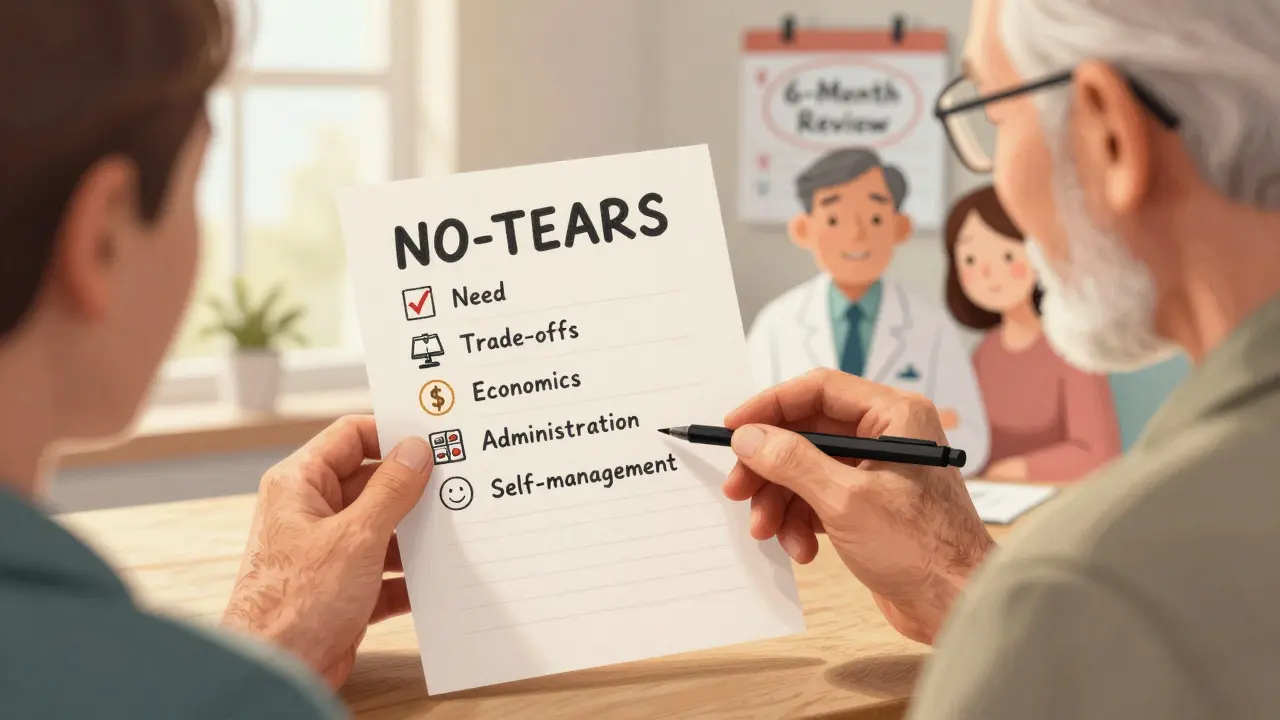
There’s a practical, step-by-step method that works in clinics and at home: NO TEARS. It’s not a high-tech tool. It’s a checklist anyone can use.
- Need: Is this medication still necessary? Could it have been stopped after the condition improved?
- Optimization: Is the dose right? Many seniors need lower doses than what’s listed on the label.
- Trade-offs: Do the benefits outweigh the risks? Is the extra pain relief worth the increased fall risk?
- Economics: Can the patient afford it? Skipping doses because of cost is a major hidden problem.
- Administration: Is the patient taking it correctly? Are the pills too big? Are there too many to remember?
- Reduction: Can we stop one or more? Sometimes, removing a drug makes everything better.
- Self-management: Does the patient understand why they’re taking each one? Can they explain it back?
Using NO TEARS during a 15-minute visit can uncover problems no software can catch. It’s not about cutting meds-it’s about making sure every pill has a purpose.
What’s Being Done to Fix the System?
There’s progress-but it’s slow.
The FDA now requires drug labels to include interaction info in Section 7 and geriatric data in Section 8.5. But a 2023 study found only 28% of labels actually give clear guidance for older adults. That’s a big gap.
Meanwhile, artificial intelligence is stepping in. Hospitals that use AI-powered clinical decision support systems now catch 40% more dangerous interactions than those that don’t. These tools scan all prescriptions at once, flagging conflicts based on real-world data. Adoption jumped from 22% of U.S. hospitals in 2020 to 47% in 2023.
The Centers for Medicare & Medicaid Services runs a Medication Therapy Management program that gives seniors free pharmacist consultations. In 2022, over 11 million people used it-and hospitalizations dropped by 15.3% among participants.
But here’s the catch: older adults are still left out of clinical trials. Less than 5% of participants in Phase 3 drug trials are over 65-even though seniors take 40% of all medications. That means we’re guessing how drugs interact in this population. New FDA guidelines aim to fix that by requiring pharmacokinetic data from older adults in drug development. But only 18% of new drug applications between 2018 and 2022 included that data.
What You Can Do Right Now
If you or a loved one is on multiple medications, here’s what to do:
- Make a complete list: Include every prescription, over-the-counter drug, vitamin, and supplement. Don’t leave anything out.
- Bring the list to every doctor visit-even if you’re seeing a new specialist.
- Ask: “Is this still needed?” and “Can we try stopping one?”
- Use one pharmacy if possible. Ask them to run an interaction check every time a new med is added.
- Ask for a medication review with a pharmacist. Many insurance plans cover this.
- Watch for new symptoms: confusion, dizziness, fatigue, falls, or stomach bleeding. These aren’t normal aging-they could be drug reactions.
Don’t assume your doctor knows everything. If you’re on seven or more medications, ask for at least 25% more time during your visit. That’s what experts recommend.
Why This Matters More Than Ever
By 2030, one in five Americans will be over 65. That means millions more people at risk for dangerous drug interactions. The cost? An estimated $177 billion a year in preventable hospitalizations and emergency care.
The tools to prevent this exist. The data is clear. The solutions are practical. What’s missing is consistent action.
Every pill you take should be intentional. Every interaction should be checked. Every question should be answered. Because for older adults, the right medication isn’t just about treating disease-it’s about staying safe, independent, and alive.
What are the most dangerous drug combinations for elderly patients?
The most dangerous combinations involve drugs that affect the heart and brain. Examples include blood thinners like warfarin combined with NSAIDs like ibuprofen (increased bleeding risk), antidepressants mixed with certain heart medications (risk of serotonin syndrome), and benzodiazepines paired with opioids (dangerous respiratory depression). The Beers Criteria and STOPP guidelines specifically flag these combinations as high-risk for seniors.
Can over-the-counter meds cause dangerous interactions?
Yes. Common OTC products like diphenhydramine (Benadryl), ibuprofen, and even some sleep aids and antacids can interact badly with prescription drugs. For example, diphenhydramine is an anticholinergic and can worsen confusion and urinary problems in seniors. Ibuprofen can reduce the effectiveness of blood pressure meds and increase kidney damage risk when taken with diuretics or ACE inhibitors. Always check with a pharmacist before taking anything new.
How often should elderly patients review their medications?
At least once a year, but ideally every time they see a new doctor or after a hospital stay. For those on five or more medications, a full review every 6 months is recommended. The NO TEARS framework can be used during these reviews to systematically assess each drug’s necessity, dose, and risk.
What is the role of pharmacists in preventing drug interactions?
Pharmacists are critical. They can screen for interactions across all medications, including OTCs and supplements. Many insurance plans now cover Medication Therapy Management (MTM), where a pharmacist meets with the patient to review all meds, simplify the regimen, and communicate with doctors. Studies show MTM reduces hospitalizations by 15% or more in older adults.
Are there apps or tools that help track drug interactions?
Yes. Apps like Medisafe, MyTherapy, and PillPack help track medications and send alerts. But the most powerful tools are in hospitals and clinics-AI-driven clinical decision support systems that scan prescriptions in real time. These systems are now used in nearly half of U.S. hospitals. For home use, a printed list reviewed with a pharmacist is still the most reliable method.
Why aren’t older adults included more in drug trials?
Historically, clinical trials excluded older adults due to complex health conditions, multiple medications, and concerns about safety. But this means we’re prescribing drugs based on data from younger, healthier people. The FDA now recommends including older adults in trials and collecting pharmacokinetic data, but only 18% of new drug applications between 2018-2022 did so. This gap is slowly closing, but it’s still a major blind spot.
What should caregivers do if they suspect a drug interaction?
If you notice new confusion, dizziness, falls, nausea, unusual bruising, or sudden fatigue, don’t wait. Write down when symptoms started and what medications were changed around that time. Bring the full list to the doctor or pharmacist immediately. Never stop a medication without professional advice-some drugs need to be tapered. But do ask: “Could this be a drug interaction?”
jesse chen
December 27, 2025 AT 03:02I’ve seen this firsthand with my dad-he was on eight meds, and no one ever sat down with him to ask if he really needed them all. One day he started falling, and it turned out the new sleep aid was mixing with his blood pressure pill. We didn’t even know to ask about interactions until his pharmacist flagged it. I’m so glad someone wrote this out clearly.
Joanne Smith
December 28, 2025 AT 07:34Oh wow, another ‘oh btw your grandma’s Benadryl is basically a cognitive demolition derby’ post. 🙄 Let me guess-the solution is ‘just talk to your pharmacist’? Newsflash: most seniors can’t afford the time, let alone the Uber ride to get there. And don’t even get me started on how ‘medication therapy management’ sounds like a corporate buzzword designed to make insurers feel better while charging $200 for a 10-minute chat. 💅
Prasanthi Kontemukkala
December 28, 2025 AT 15:58Thank you for sharing this. In India, many elderly patients are on 5–7 medicines, but often without proper follow-up. Families assume the doctor knows everything. But when I helped my aunt review her meds with a local pharmacist, we found she’d been taking two different versions of the same blood pressure pill for years. Simple fix. Life-changing result. The NO TEARS framework is brilliant-easy to remember, even for non-medical people. Let’s spread this!
Alex Ragen
December 29, 2025 AT 03:56Ah, yes-the noble quest to ‘optimize’ pharmacological entropy in geriatric populations. But let us not confuse bureaucratic compliance (Beers Criteria, STOPP) with genuine epistemic humility. The very notion that we can ‘manage’ polypharmacy through checklists betrays a profound ontological error: we are not engineers of biology. We are, at best, clumsy interpreters of a system that evolved without our intervention. And yet… we persist. With spreadsheets. And algorithms. And… *sigh*… pharmacists.
Jeanette Jeffrey
December 29, 2025 AT 10:40Let’s be real-this post is just a fancy brochure for Big Pharma’s ‘we care’ PR campaign. The FDA doesn’t require geriatric data? Of course not. They’re too busy approving new antidepressants that cost $800 a month. And you think a pharmacist is gonna fix this? Nah. They’re overworked, underpaid, and legally shielded from liability. Meanwhile, grandmas are popping pills like Skittles because they don’t wanna ‘be a burden.’ This isn’t a medical problem. It’s a societal failure wrapped in bullet points.
Shreyash Gupta
December 30, 2025 AT 05:19bro why is everyone so scared of meds?? 😅 i mean my grandpa takes 12 pills and he’s fine!! 🤷♂️ maybe we just need more chai and less fear?? 🫖❤️
Jay Ara
January 1, 2026 AT 03:25my mom took 7 meds and started feeling dizzy. we went to the pharmacist and they found she was on two drugs that did the same thing. one was removed. she’s been better since. no fancy app needed. just a list and a chat. simple. but no one ever asks. just trust the doctor. bad idea.
Michael Bond
January 1, 2026 AT 07:49One pharmacy. One list. One conversation. That’s all it takes.
Kuldipsinh Rathod
January 1, 2026 AT 12:06My uncle died last year from a bleed caused by warfarin and ibuprofen. No one knew he was taking Advil for his back. He thought it was ‘just a painkiller.’ This post? It’s not just helpful. It’s life-saving. Please share it with everyone you know who’s over 60. Even if they say they’re fine. They’re not.