
Walk into any pharmacy or open a prescription bottle, and you see a name. But that name is just the tip of the iceberg. Behind every generic drug lies a complex web of classifications that determine how it’s prescribed, priced, regulated, and even named. If you’ve ever wondered why one generic costs less than another, or why your doctor calls a medication by a different class than your pharmacist does, you’re not alone. The truth is, there isn’t just one way to classify drugs-there are several, each serving a distinct purpose in healthcare.
Understanding these systems isn’t just for medical professionals. As patients, we interact with them daily through prescriptions, insurance copays, and safety warnings. Knowing how generic drug classifications work can help you navigate conversations with your provider, understand your coverage, and make informed decisions about your health. Let’s break down the main frameworks used today, how they differ, and what they mean for you.
Therapeutic Classification: Treating the Condition
The most common way doctors and hospitals organize medications is by what they treat. This is called therapeutic classification. Instead of focusing on chemical structure, this system groups drugs based on their intended medical use. For example, all medications used to lower blood pressure fall under cardiovascular agents, while those managing diabetes are grouped as endocrine agents.
This approach is championed by organizations like the FDA and the United States Pharmacopeia (USP). According to the FDA’s USP Therapeutic Categories Model Guidelines updated in 2023, this method remains the most clinically relevant because it aligns directly with patient care goals. When a physician treats hypertension, they look for antihypertensives-not necessarily for a specific molecular mechanism.
| Category | Purpose | Common Generic Examples |
|---|---|---|
| Analgesics | Pain relief | Ibuprofen, acetaminophen, morphine |
| Antibiotics | Fight bacterial infections | Amoxicillin, ciprofloxacin, azithromycin |
| Antidepressants | Treat depression/anxiety | Fluoxetine, sertraline, duloxetine |
| Cardiovascular Agents | Manage heart/blood pressure | Lisinopril, metoprolol, atorvastatin |
| Endocrine Agents | Hormone regulation | Metformin, levothyroxine, insulin |
The American Hospital Formulary Service (AHFS) recognizes over 300 such categories, creating a precise hierarchy that helps clinicians quickly identify appropriate treatments. In fact, 92% of U.S. hospitals rely on this system for formulary management, according to data from the American Society of Health-System Pharmacists (ASHP) in 2022.
However, this system has limitations. Some drugs serve multiple purposes. Take aspirin: it’s an analgesic for pain but also an anticoagulant for stroke prevention. Placing it in only one category can create confusion. That’s where other classification methods come in.
Pharmacological Classification: How Drugs Work
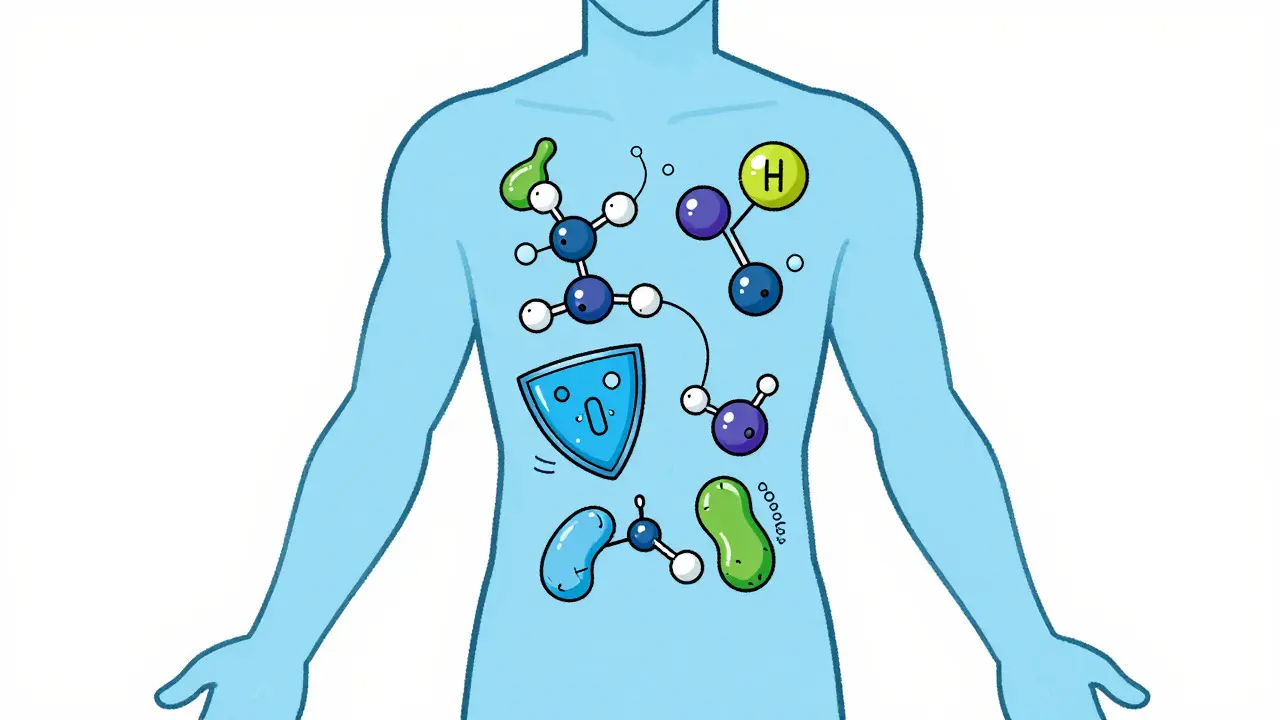
If therapeutic classification asks “What does this drug do?” pharmacological classification asks “How does it do it?” This system groups medications by their mechanism of action-the biological process they target in the body.
For instance, beta-blockers like propranolol work by blocking adrenaline receptors, while proton pump inhibitors like omeprazole reduce stomach acid by inhibiting a specific enzyme. These mechanisms define their pharmacologic classes, regardless of the condition they treat.
This approach is heavily used in research and advanced clinical settings. The National Center for Biotechnology Information (NCBI) documents approximately 1,200 distinct pharmacologic classes in current medical literature. It’s particularly useful for understanding drug interactions and side effects, since drugs with similar mechanisms often behave similarly in the body.
But here’s the catch: this level of detail requires specialized knowledge. A primary care physician doesn’t need to know the exact kinase pathway inhibited by a cancer drug to prescribe it appropriately. As Dr. John Beckner of the American Pharmacists Association noted in a 2023 white paper, pharmacologic classification is scientifically rigorous but demands significant education to implement broadly in everyday practice.
DEA Schedules: Legal Control and Abuse Potential
Not all drug classifications are about treatment. Some are about control. The Drug Enforcement Administration (DEA) uses a five-schedule system to categorize substances based on their potential for abuse and accepted medical use. This legal framework impacts everything from prescribing rules to storage requirements.
| Schedule | Abuse Potential | Medical Use | Examples |
|---|---|---|---|
| Schedule I | High | No accepted use | Heroin, LSD, marijuana* |
| Schedule II | High | Accepted, strict limits | Oxycodone, fentanyl, Adderall |
| Schedule III | Moderate | Accepted | Buprenorphine, testosterone |
| Schedule IV | Low | Accepted | Xanax, Ambien |
| Schedule V | Lowest | Accepted | Cough syrups with codeine |
*Marijuana remains Schedule I federally despite medical legalization in 38 states as of November 2023, highlighting ongoing controversy in this system.
This scheduling affects patient access significantly. Schedule II drugs require written prescriptions and cannot be refilled without a new order. They also trigger stricter monitoring in prescription drug programs. While essential for public safety, critics argue the system lags behind scientific evidence. Dr. Nora Volkow, director of the National Institute on Drug Abuse, pointed out in JAMA (2021) that Schedule I status for marijuana impedes research despite proven therapeutic benefits for conditions like chronic pain.
Insurance Tiers: Cost and Coverage Realities
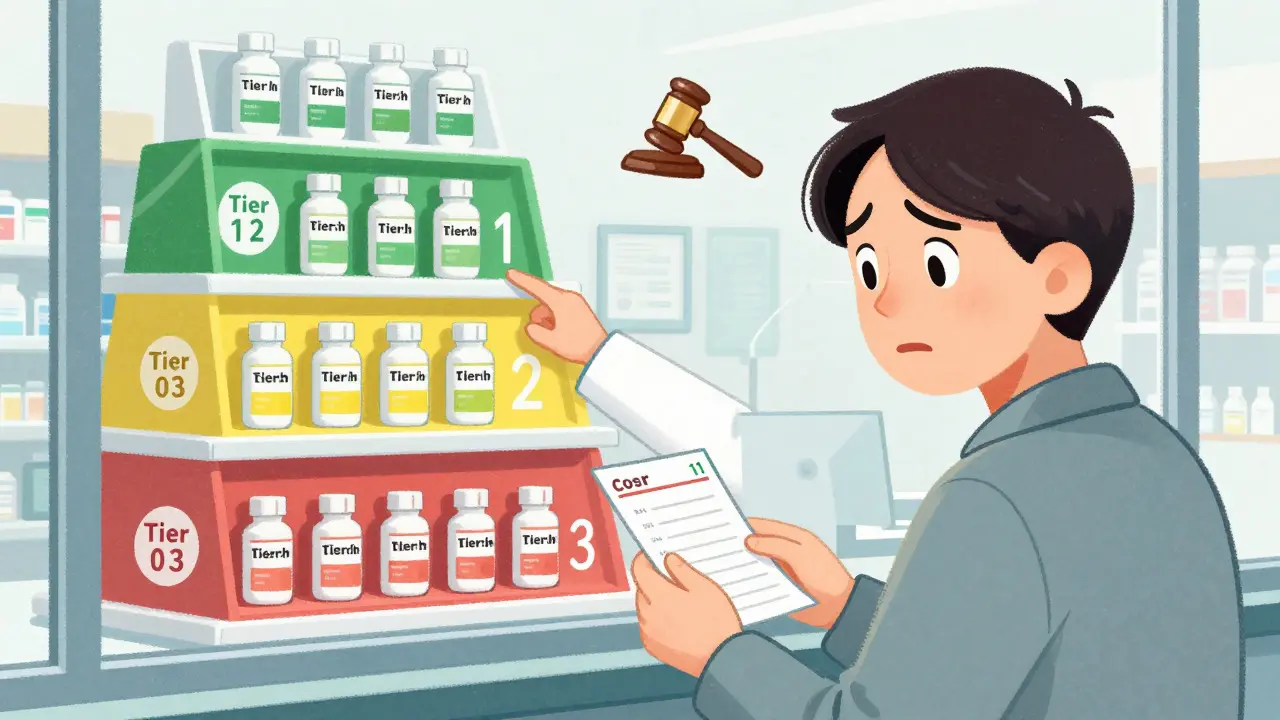
When you pick up a generic at the pharmacy, its cost isn’t determined solely by manufacturing expenses-it’s shaped by insurance tier structures. Most plans divide covered drugs into tiers, typically ranging from 1 to 5, with higher tiers meaning higher out-of-pocket costs.
- Tier 1: Preferred generics (covers ~75% of generic drugs)
- Tier 2: Non-preferred generics
- Tier 3: Preferred brand-name drugs
- Tier 4: Non-preferred brands
- Tier 5: Specialty medications (highest cost, 5-7% of covered drugs)
These tiers reflect negotiated contracts between insurers and manufacturers rather than clinical differences. Two identical generic formulations might sit in different tiers due to formulary agreements. According to KFF analysis in 2022, Tier 3 drugs often cost patients 25-35% more than Tier 2 equivalents despite containing the same active ingredients.
This creates real-world challenges. Pharmacists report that insurance tier disputes account for 43% of prior authorization requests, according to discussions in Reddit’s r/pharmacy community in August 2023. Patients may face unexpected costs or delays when their preferred generic isn’t favored by their plan.
Stem Naming Conventions: Clues in the Name
Ever notice how many drug names end similarly? That’s no accident. The stem naming convention embeds pharmacological information directly into generic names using standardized suffixes. Adopted by the USP in 1964 and updated annually, this system helps healthcare providers instantly recognize a drug’s class.
- -lol: Beta-blockers (e.g., propranolol, metoprolol)
- -prazole: Proton pump inhibitors (e.g., omeprazole, pantoprazole)
- -statin: Cholesterol-lowering agents (e.g., atorvastatin, rosuvastatin)
- -cillins: Penicillin antibiotics (e.g., amoxicillin, dicloxacillin)
As of 2023, the USP Dictionary of USAN and International Drug Names recognizes 87 distinct stems. This system has reduced medication errors by 18% since full implementation, according to Dr. Paul Zeitz of UCSF publishing in the New England Journal of Medicine (2022). However, it struggles with newer biologic agents that don’t fit traditional chemical patterns.
WHO ATC System: Global Standardization
On an international scale, the World Health Organization’s Anatomical Therapeutic Chemical (ATC) classification system provides a universal language for drug categorization. It organizes medications across 14 main anatomical groups, further subdivided by therapeutic and pharmacological properties.
By 2023, the ATC system cataloged over 5,000 distinct substances. Its strength lies in standardizing global drug use statistics and facilitating cross-border research. The WHO Collaborating Centre for Drug Statistics Methodology reports 94% accuracy in medication pattern analysis using this framework.
Yet keeping pace with innovation is challenging. The 2024 update will incorporate 32 new biologic agents and cell therapies, requiring structural expansions. With 217 new ATC codes added in 2022 alone, maintaining this system demands constant vigilance and resources.
Navigating Conflicting Classifications
Here’s where things get tricky: a single drug can belong to multiple categories simultaneously. Duloxetine, for example, is classified therapeutically as both an antidepressant and a neuropathic pain agent. Buprenorphine appears as a Schedule III opioid legally while being pharmacologically defined as a partial mu-opioid agonist.
This fragmentation causes real problems. On the Sermo physician network in Q3 2023, 68% of responding physicians cited confusion between therapeutic and pharmacologic classifications as a moderate to severe barrier to optimal prescribing. Meanwhile, the American Medical Association found that 79% of primary care physicians spend 12-18 minutes per patient navigating conflicting systems during medication selection.
To address this, institutions develop internal crosswalk documents mapping relationships between classification systems. Creating and maintaining these takes 120-150 hours annually, according to industry surveys. Electronic health record systems like Epic and Cerner now integrate multiple classification datasets, though implementation costs average $85,000 per hospital.
Future Directions: Adapting to Modern Medicine
Classification systems aren’t static-they’re evolving rapidly. The FDA announced Therapeutic Categories Model 2.0 in September 2023, introducing dynamic hierarchies that accommodate multi-indication drugs through primary-secondary labeling. Full implementation is required by January 1, 2025.
Artificial intelligence is entering the picture too. IBM Watson Health launched Drug Insight in August 2023, using machine learning to predict optimal therapeutic placement with 92.7% accuracy in early trials. By 2028, Evaluate Pharma projects 65% of new molecular entities will require novel classification approaches due to multimodal mechanisms of action.
Legislative changes could reshape entire systems. The Marijuana Opportunity Reinvestment and Expungement (MORE) Act passed the House in April 2023, potentially reclassifying marijuana from Schedule I to III. Such shifts would cascade across all classification frameworks, affecting insurance coverage, prescribing practices, and research funding.
Dr. Robert Temple, former FDA Deputy Center Director, stated in Regulatory Focus (October 2023) that therapeutic classification must integrate with pharmacogenomic data to remain relevant. Meanwhile, Dr. Scott Gottlieb warned in Nature Reviews Drug Discovery (June 2023) that current silos risk obsolescence within 5-7 years as precision medicine advances.
Practical Tips for Patients and Providers
Whether you’re a patient reviewing your prescription or a clinician selecting treatment, here’s how to navigate these systems effectively:
- Ask about alternatives: If your prescribed generic is high-tier, request lower-cost equivalents with the same active ingredient.
- Check multiple sources: Use official databases like FDA.gov or Drugs.com to verify classification details beyond what your insurer provides.
- Understand your role: Patients benefit most from knowing therapeutic categories; providers should master pharmacologic and legal classifications.
- Monitor updates: Classification systems change quarterly. Subscribe to alerts from authoritative bodies like USP or DEA.
- Document discrepancies: Note any conflicts between systems in your records to avoid future errors.
Training matters too. Healthcare professionals need 8-12 hours dedicated to achieving 90% accuracy in therapeutic classification application, according to FDA guidelines. Pharmacists typically master the system faster (6.2 hours vs. 11.7 for physicians), highlighting the importance of targeted education.
Why are there so many ways to classify drugs?
Different systems serve different audiences. Therapeutic classification helps doctors choose treatments, pharmacological classification aids researchers understanding mechanisms, DEA schedules enforce legal controls, and insurance tiers manage costs. Each addresses unique needs within the healthcare ecosystem.
Can a generic drug have different classifications depending on who looks at it?
Yes. A single medication like duloxetine may be categorized as an antidepressant therapeutically, a serotonin-norepinephrine reuptake inhibitor pharmacologically, and placed in various insurance tiers based on formulary contracts. Context determines which classification applies.
How do I find out which tier my generic falls under?
Check your insurance provider’s online formulary or call their member services line. Most plans publish tier lists searchable by drug name. You can also ask your pharmacist-they have access to real-time coverage information.
Are DEA schedules the same worldwide?
No. DEA schedules apply only in the United States. Other countries follow UN conventions or national laws. For example, Canada uses controlled substance schedules under the Controlled Drugs and Substances Act, which differs significantly from the U.S. model.
Will AI replace human judgment in drug classification?
Not entirely. While AI tools like IBM Watson Health show promising accuracy rates (92.7% in trials), final decisions still require human oversight. AI assists in predicting placements and identifying patterns, but ethical considerations and clinical context demand professional input.