
When you’re trying to lose weight or keep it off, fiber isn’t just a buzzword-it’s one of the most reliable tools you’ve got. But not all fiber is the same. The difference between soluble fiber and insoluble fiber isn’t just technical-it’s the difference between feeling full longer and just going to the bathroom more often.
What Soluble Fiber Actually Does for Weight Control
Soluble fiber doesn’t just pass through your system. It turns into a thick, gooey gel when it meets water. That gel slows down digestion, which means your stomach stays full longer. Studies show this can delay gastric emptying by 25-30%, making you less likely to snack between meals. One 2023 study in PMC10253086 found that people who took psyllium husk-a type of soluble fiber-lost an average of 3.2% of their body weight over eight weeks, compared to just 1.1% in the placebo group. The real magic happens in your gut. Soluble fiber feeds the good bacteria that help regulate hunger hormones. When those bacteria break down fiber, they produce short-chain fatty acids that signal your brain to stop eating. That’s why people who eat more soluble fiber report feeling satisfied after meals, even when they eat less. Viscous soluble fibers like glucomannan, beta-glucans, and pectin are especially powerful. Glucomannan, for example, can absorb up to 50 times its weight in water, creating a feeling of fullness that lasts hours. A 2023 analysis of 62 studies by the American Institute for Cancer Research found that eating about 7 grams of viscous soluble fiber per day led to an average loss of 0.75 pounds and a 0.25-inch reduction in waist size over 10 weeks. That’s not a miracle, but it’s consistent-and it adds up over time.What Insoluble Fiber Does (And Doesn’t Do) for Weight Loss
Insoluble fiber doesn’t dissolve in water. It keeps its shape as it moves through your digestive tract, adding bulk to your stool and helping you go more regularly. That’s great for preventing constipation, but it doesn’t directly make you feel full or reduce your appetite. Think of it like a broom sweeping things along. It doesn’t change what’s inside the bowl-it just moves it out faster. Insoluble fiber speeds up transit time by 24-48 hours, which can help reduce bloating and discomfort, but it doesn’t affect blood sugar, fat absorption, or hunger hormones the way soluble fiber does. That doesn’t mean it’s useless for weight control. When your digestion runs smoothly, you’re less likely to feel sluggish or bloated, which can make it easier to stick to healthy habits. Plus, foods rich in insoluble fiber-like whole wheat bread, brown rice, and vegetables-are usually low in calories and high in volume, so you eat less overall just by choosing them. But if your goal is to reduce hunger and calorie intake, soluble fiber is the one you want to focus on.Which Foods Have the Most Soluble Fiber?
You don’t need supplements to get the benefits. In fact, whole foods work better. The fiber in apples, oats, beans, and flaxseeds comes with vitamins, antioxidants, and other compounds that supplements can’t replicate. Here’s what you’ll find in common foods (per typical serving):- 1 medium apple: 2.4 grams total fiber (1.7 grams soluble)
- ½ cup cooked oats: 4.2 grams total fiber (2.0 grams soluble)
- ½ cup cooked lentils: 7.8 grams total fiber (3.0 grams soluble)
- 1 tablespoon ground flaxseed: 2.8 grams total fiber (1.5 grams soluble)
- 1 cup cooked chia seeds: 10.6 grams total fiber (8.0 grams soluble)

Supplements: Helpful, But Not a Shortcut
Psyllium husk is the most studied soluble fiber supplement for weight loss. It’s in products like Metamucil and is backed by solid science. But here’s the catch: supplements work best when paired with a healthy diet. A 2023 Harvard review found that people who relied only on fiber pills without changing what they ate didn’t lose weight long-term. Other supplements like inulin and guar gum show some benefit, but they’re less effective than psyllium. Inulin, for example, mainly lowers triglycerides, not appetite. And many people report bloating with inulin-especially if they take too much too fast. If you do use a supplement, stick to 5-10 grams of psyllium per day, taken 15-30 minutes before meals with plenty of water. Too little, and you won’t feel the effect. Too much, and you’ll get constipated or gassy.How Much Fiber Do You Really Need?
The Mayo Clinic recommends 25-38 grams of total fiber per day, depending on age and gender. But for weight control, you need to pay attention to the type. Experts suggest getting at least 10-15 grams of that total from soluble fiber-especially viscous types. Most people in the U.S. get less than 16 grams a day. Only 5% meet the minimum recommendation. That’s a huge gap. The best way to close it? Add one high-fiber food to each meal. Swap white rice for brown. Choose whole grain bread instead of white. Eat the skin on your potatoes. Add berries to your yogurt. These aren’t drastic changes-they’re simple swaps that add up.Common Mistakes People Make With Fiber
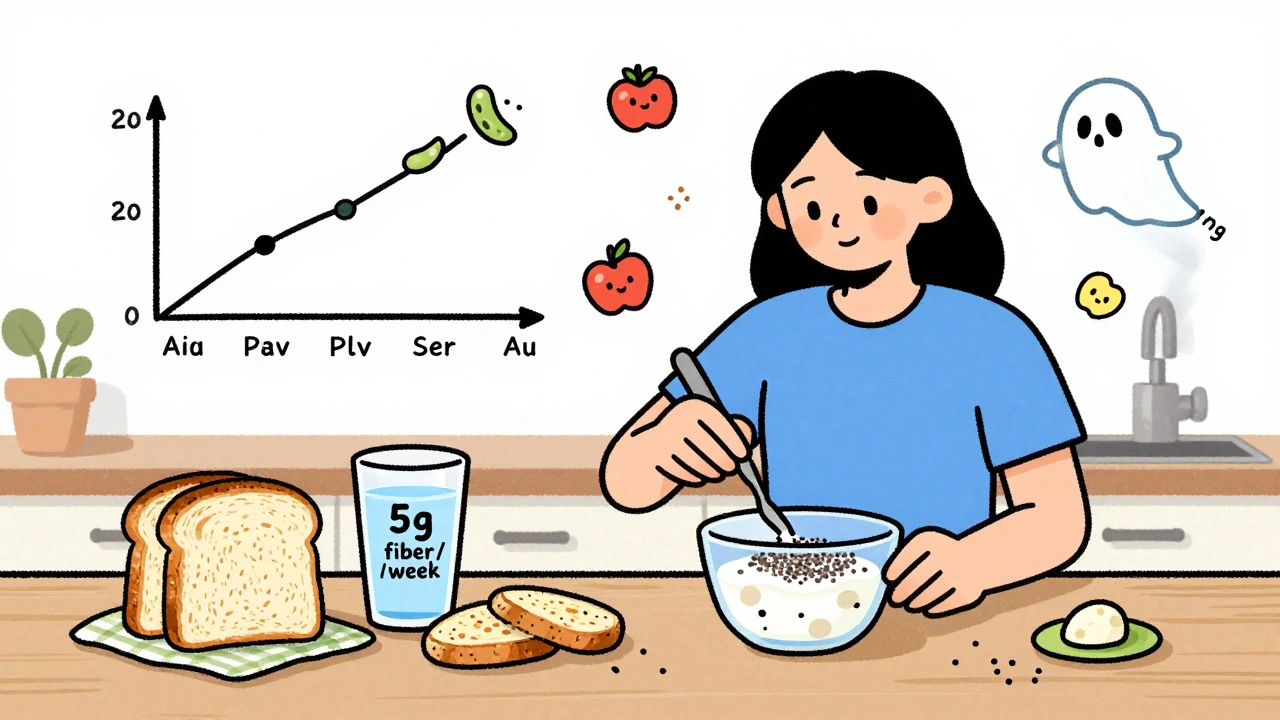
Many people try to boost fiber quickly-and pay for it with bloating, gas, or constipation. Here’s what usually goes wrong:- Going too fast. Increasing fiber by more than 5 grams per week leads to discomfort in 78% of cases.
- Not drinking enough water. Soluble fiber needs water to work. Without it, it can harden and cause blockages. Aim for 16-24 ounces of water for every 5 grams of supplemental fiber.
- Only using supplements. Whole foods give you more than fiber-they give you nutrients, flavor, and satisfaction. Supplements don’t replace meals.
- Expecting miracles. Fiber won’t make you lose weight if you’re still eating junk food. It’s a helper, not a magic pill.
Real People, Real Results
On Reddit’s r/loseit community, users who added psyllium husk to their routine reported reduced snacking within 3-5 days. About 68% said they ate less between meals. But 42% had initial bloating-until they slowed down their increase and drank more water. Amazon reviews for psyllium products show 4.2 out of 5 stars, with most 5-star reviews mentioning “less hunger” and “no more afternoon cravings.” Inulin products? Only 3.8 stars, with bloating as the top complaint. A Healthline survey of 1,245 people found that 63% who succeeded with fiber for weight control did it through food-not pills. Beans, oats, and apples were the top three choices.How to Make It Stick
The key to long-term success isn’t taking a supplement. It’s building habits. Try this simple plan:- Start with 5 extra grams of fiber per week-add one serving of oats or beans to your meals.
- Drink a glass of water with every meal and snack.
- Take soluble fiber 15-30 minutes before your biggest meals to reduce hunger.
- Focus on whole foods: vegetables, legumes, fruits, whole grains, nuts, and seeds.
- Don’t panic if you get gassy. It usually fades after 1-2 weeks as your gut adjusts.
The Bottom Line
Soluble fiber helps you lose weight by making you feel full, slowing digestion, and improving gut bacteria. Insoluble fiber keeps things moving-but doesn’t touch your appetite. For weight control, prioritize soluble fiber from whole foods: oats, beans, apples, flaxseeds, chia seeds. Use supplements like psyllium only if you’re struggling to get enough from food. And remember: fiber isn’t a cure. It’s a tool. Used right, it helps you eat less without feeling deprived. Used wrong, it just gives you gas.Can soluble fiber help me lose belly fat?
Yes. A 2023 study found that people taking psyllium lost 4.3% of their visceral fat (the dangerous fat around organs) over eight weeks, compared to just 1.2% in the placebo group. Viscous soluble fibers like psyllium and glucomannan improve insulin sensitivity and reduce inflammation, both linked to belly fat reduction.
Is it better to get fiber from food or supplements?
Food is better. Whole foods provide fiber along with vitamins, antioxidants, and other compounds that help with metabolism and appetite control. Supplements like psyllium can help fill gaps, but they don’t replace the benefits of eating vegetables, legumes, fruits, and whole grains. Studies show people who get fiber from food stick to healthy habits longer and lose more weight over time.
How long does it take for fiber to start working for weight loss?
You may feel fuller after just one meal if you take soluble fiber before eating. But noticeable weight loss takes time. Most studies show measurable results after 6-10 weeks of consistent intake. The key is daily use-not occasional use. Think of it like exercise: small, regular efforts create lasting change.
Can too much fiber cause weight gain?
No-fiber itself doesn’t cause weight gain. But if you’re adding fiber-rich foods that are high in calories (like nuts, dried fruit, or avocado) without cutting other foods, you might eat more overall. Fiber helps you eat less, but only if you’re mindful of portions. Also, if you take fiber without enough water, you can become constipated, which may cause temporary bloating that feels like weight gain.
Should I take fiber in the morning or at night?
For weight control, take soluble fiber 15-30 minutes before your biggest meals-usually lunch and dinner. This helps reduce how much you eat during the meal. Insoluble fiber can be helpful at breakfast to kickstart digestion. Some emerging research suggests taking soluble fiber at night may help control overnight hunger, but more studies are needed. For now, timing before meals is your best bet.
vinoth kumar
December 2, 2025 AT 14:33I started adding oats and chia to my breakfast last month and honestly? I haven't felt like snacking after lunch once. No magic pill, just real food. My waistband is looser and I’m not even trying.
Also, drinking water with it? Game changer. I used to get bloated until I figured out the hydration thing.
Gene Linetsky
December 3, 2025 AT 01:18So let me get this straight-you’re telling me the same fiber that’s been in bran cereal since 1987 is now a ‘weight loss miracle’ because some study says so? Where’s the double-blind, placebo-controlled, peer-reviewed trial funded by someone who doesn’t sell psyllium?
Also, ‘viscous soluble fiber’? Sounds like a pharmaceutical euphemism for ‘glue that makes you gassy.’
Ignacio Pacheco
December 3, 2025 AT 08:47Okay but if soluble fiber slows digestion, doesn’t that mean it also slows nutrient absorption? What’s the trade-off here?
And why do all the studies mention psyllium but never talk about how many people quit because they felt like their intestines were stuffed with wet cardboard?
Also, 8 grams per meal? That’s like eating a whole bag of flaxseeds before lunch. Who has time for that?
Jim Schultz
December 3, 2025 AT 15:42Let’s be real: fiber isn’t the hero-it’s the sidekick. The real villain? Sugar. Processed carbs. Ultra-palatable garbage masquerading as food. You can take all the psyllium in the world, but if you’re still eating a bag of chips after dinner, you’re not losing weight-you’re just pooping out Doritos.
Also, ‘viscous’? That’s just science-speak for ‘mucous.’ You’re eating snot. And you’re proud of it.
And yes, I’ve read the studies. And no, I don’t trust them. Because someone funded them. And they probably sell supplements.
Also: hydration. Always hydration. Don’t be that guy who chugs fiber and then wonders why he’s constipated. You’re not a rock. You’re a human. With plumbing.
Kidar Saleh
December 5, 2025 AT 08:45In the UK, we’ve known this for decades-oatmeal for breakfast, beans on toast for lunch. No supplements. No hype. Just food that’s been around longer than your smartphone.
My grandmother ate lentil soup every Tuesday. She lived to 94. Never counted calories. Never took a pill. Just ate what was in front of her.
Modern nutrition has overcomplicated the simplest thing: eat whole things, slowly, and stop eating when you’re not hungry anymore.
Fiber isn’t a tool. It’s a tradition.
And traditions don’t need marketing.
Chloe Madison
December 6, 2025 AT 23:02Y’all are overthinking this. Fiber isn’t complicated. It’s not a supplement. It’s not a trend. It’s just… food. Add one more serving of vegetables to your plate. Swap white rice for brown. Eat an apple instead of a granola bar. That’s it.
And yes, drink water. Always. Especially if you’re adding fiber. Your colon will thank you.
And no, you don’t need to start with 15 grams a day. Start with 5. Then 10. Then 15. Your gut isn’t a racecar-it’s a slow cooker. Give it time.
You’re not failing because you’re lazy. You’re failing because you’re rushing. Slow down. Eat. Breathe. Let your body do what it’s meant to do.
This isn’t a diet. It’s a lifestyle. And you’re already doing it right if you’re reading this.
You’ve got this.
Vincent Soldja
December 7, 2025 AT 09:57Insoluble fiber doesn't help with weight loss. Soluble fiber does. Whole foods better than supplements. Drink water. Go slow. That's it.
Makenzie Keely
December 8, 2025 AT 18:23Thank you for writing this so clearly-I’ve been trying to explain this to my clients for years, and no one listens until they see it laid out like this.
One thing I’d add: the timing matters. Taking soluble fiber 20 minutes before your largest meal? That’s the secret. It’s not about how much you eat-it’s about when you eat it.
And yes, the bloating? Real. But temporary. Your microbiome is rebuilding. It’s like a gym for your gut. Sore at first. Stronger later.
Also, chia seeds are underrated. One tablespoon in your yogurt? Full for hours. No sugar. No guilt.
And for the love of all that is holy-stop buying those flavored fiber bars. They’re just candy with a fiber label. Eat real food.
You’re not broken. You’re just underfed-with the right stuff.
Start tomorrow. One apple. One bowl of oats. One glass of water.
That’s your new routine.
You’ve got this.