HIV Drug Interaction Checker
Check Your Medications
When someone is diagnosed with HIV today, the news doesn’t mean a death sentence anymore. It means starting a daily routine with medications that keep the virus under control. But behind those pills lies a complex battle - one where the virus fights back, where drugs clash with other medications, and where missing a single dose can change everything. This isn’t just about taking pills. It’s about understanding how these drugs work, why they sometimes stop working, and what happens when they interact with everything else in your body.
How Antiretroviral Drugs Actually Work
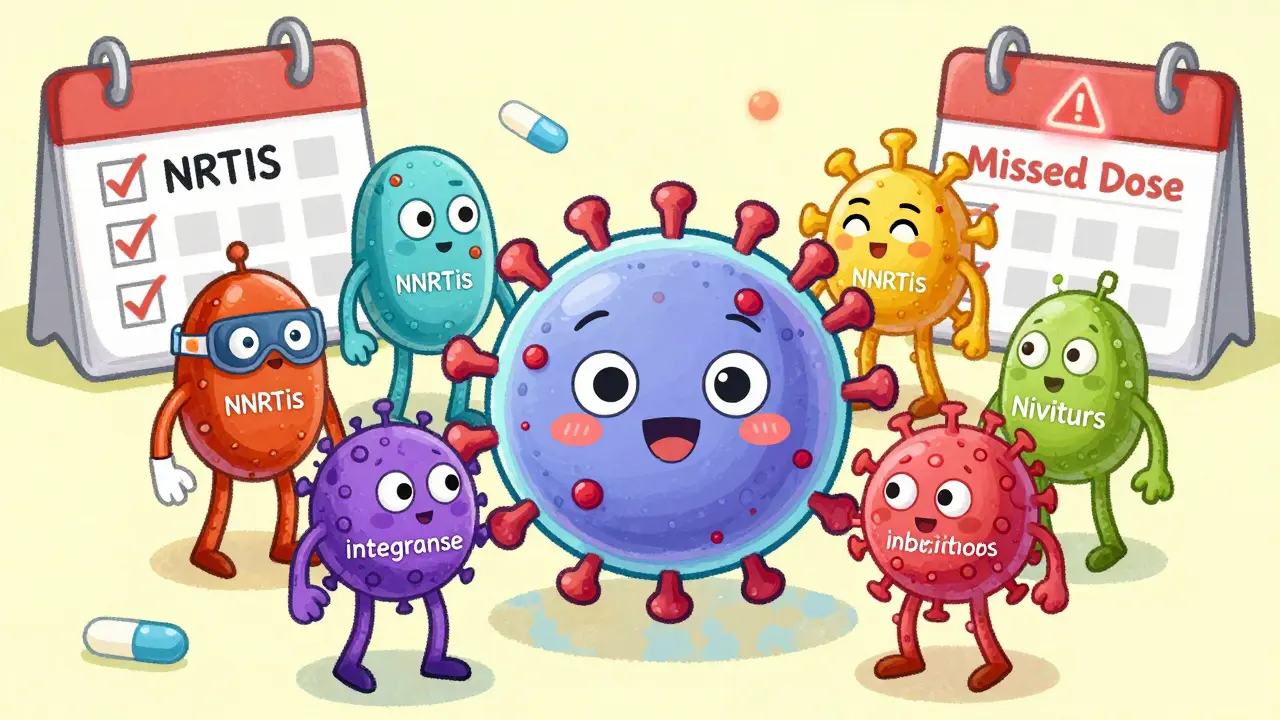
Antiretroviral therapy (ART) doesn’t cure HIV. It stops it from multiplying. There are six main classes of these drugs, each targeting a different step in the virus’s life cycle. NRTIs and NNRTIs block reverse transcriptase, the enzyme HIV uses to copy its RNA into DNA. Protease inhibitors stop the virus from cutting its proteins into usable pieces. Integrase inhibitors prevent HIV from inserting its genetic material into your cells. Fusion inhibitors and CCR5 antagonists stop the virus from even entering the cell. The most common modern regimens combine two NRTIs with one drug from another class - usually an INSTI like dolutegravir or bictegravir. These combinations are called fixed-dose combinations, like Biktarvy or Dovato. They’re designed to be simple: one pill, once a day. But simplicity hides complexity. Each drug has its own metabolic path, its own side effects, and its own way of interacting with other substances in your body.Why Resistance Happens - And Why It’s So Dangerous
HIV mutates fast. Every time it copies itself, it makes mistakes. Most of those mistakes don’t help the virus survive. But sometimes, a mutation lets it shrug off a drug. That’s resistance. And once it happens, that drug - and sometimes others in the same class - stops working. Some drugs are more forgiving than others. INSTIs like dolutegravir and bictegravir have high genetic barriers to resistance. It takes several mutations for the virus to escape them. NNRTIs like efavirenz? One mutation - like K103N - and they’re useless. That’s why newer guidelines push INSTIs as first-line therapy. In 2024, only 0.4% of people on dolutegravir developed resistance after 144 weeks. For efavirenz, it was over 3%. But resistance isn’t just about the drug. It’s about adherence. A 2025 Reddit survey of 247 people with HIV found that 68% of treatment failures were linked to missed doses. People skip pills because of side effects - insomnia from efavirenz, nausea from older regimens, or just life getting in the way. And when drug levels drop, even briefly, the virus gets a chance to mutate.Drug Interactions: When Your HIV Meds Clash With Everything Else
Most people with HIV take other medications. Statins for cholesterol. Antidepressants. Blood pressure pills. Pain relievers. And many of these interact dangerously with HIV drugs. Boosted protease inhibitors - like darunavir with ritonavir or cobicistat - are especially troublemakers. They slow down the liver enzyme CYP3A4, which breaks down other drugs. That means those other drugs build up to toxic levels. Simvastatin? Absolute no-go. Midazolam? Can cause fatal respiratory depression. Even some heartburn meds and herbal supplements like St. John’s wort can tank your ART levels. Newer drugs are better. Doravirine (in Pifeltro and Delstrigo) doesn’t induce CYP3A4 like efavirenz does. Only 12% of people on doravirine needed dose adjustments for other meds, compared to 35% on efavirenz. Tenofovir alafenamide (TAF) replaced tenofovir disoproxil fumarate (TDF) in most new regimens because it’s effective at 90% lower doses, reducing kidney and bone damage. But even TAF can interact with certain antacids and kidney-toxic drugs. The Liverpool HIV Interactions Database tracks over 500 known interactions. Clinicians use it daily. But in community clinics, especially outside big cities, access to these tools is spotty. A 2024 NASTAD survey found 63% of rural providers struggled to get resistance testing within 30 days - let alone check every interaction.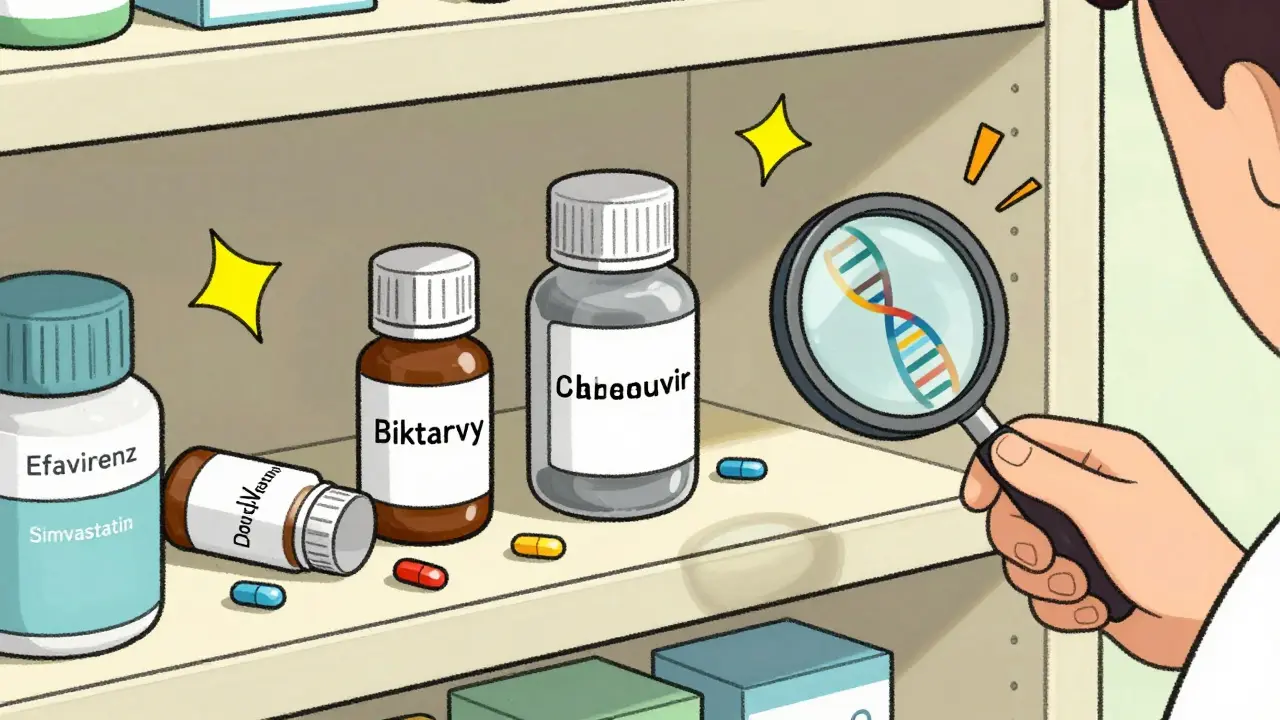
Testing and Monitoring: The Lifeline of Effective Treatment
You can’t manage what you don’t measure. That’s why resistance testing is mandatory at diagnosis and after any treatment failure. The test looks for mutations in the virus’s genetic code. It tells you which drugs are still likely to work. In the U.S., Medicaid now covers 100% of genotype testing at diagnosis. But turnaround times vary. Academic centers deliver results in 14 days. Community labs? Often 21. And not all mutations are created equal. The M184V mutation kills lamivudine and emtricitabine but can actually make HIV less fit. The K65R mutation weakens tenofovir. R263K plus G118R? That’s a red flag for dolutegravir resistance. Tools like the Stanford HIVdb algorithm help doctors interpret these results. But training matters. A 2024 NIAID study showed community providers scored 85% accuracy on resistance reports. Infectious disease specialists? 98%. That gap means some patients get suboptimal regimens - not because of bad intent, but because of lack of support.The Future: Long-Acting Injections and Next-Gen Drugs
The biggest shift in HIV treatment isn’t a new pill. It’s no pill at all. Long-acting injectables like Cabenuva (cabotegravir plus rilpivirine) are given once a month. In the ATLAS trial, 94% of patients preferred injections over daily pills. But here’s the catch: if you miss an injection, drug levels drop slowly - over months. That creates the perfect storm for resistance. Dr. Sharon Lewin warned at CROI 2025: "Subtherapeutic levels linger. The virus adapts quietly. Then it’s too late." New drugs are coming. ViiV Healthcare’s VH-184, a third-generation INSTI, showed in a 2025 phase 2a trial that it can knock down even dolutegravir-resistant strains. The mean viral load drop was 1.8 log10 - a massive change. It’s being tested as a six-month injection. If approved, it could be the first true long-term option for people with complex resistance. Lenacapavir, approved in 2022 for multi-drug-resistant HIV, is now recommended by WHO for prevention too. Injected every six months, it’s changing how we think about PrEP. But it’s expensive. And in low-resource settings - where 29% of new HIV cases already show transmitted resistance - access remains a barrier.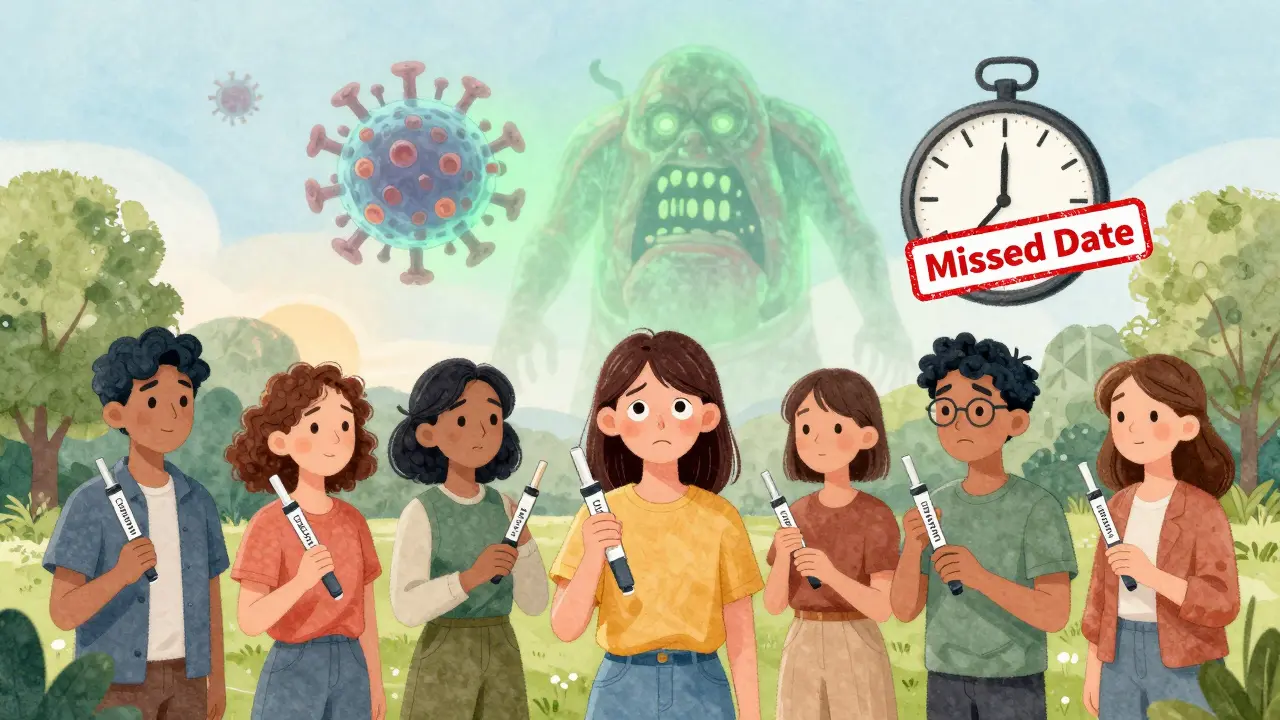
Real-World Challenges: From Side Effects to Access
The science is advancing. But real life doesn’t always keep up. A 2024 survey of 3,215 people with HIV found 22% had switched regimens due to side effects or resistance. Bone pain from TDF? That was the top reason. Neuropsychiatric issues from efavirenz? Close behind. Meanwhile, 89% of people on dolutegravir-based regimens reported no adherence-harming side effects. And then there’s the cost. Branded Truvada cost $2,800 a month in 2025. Generic tenofovir? $60. But switching isn’t always safe. If you’ve had prior resistance, generics might not be enough. And in places without routine resistance monitoring - like 60% of low-income countries - people are getting stuck on failing regimens because there’s no way to know what’s wrong.What You Need to Know
If you’re on ART, here’s what matters most:- Take your meds exactly as prescribed. Even one missed dose can matter.
- Tell every doctor - even your dentist - you’re on HIV meds. Many interactions are silent until it’s too late.
- Ask for resistance testing at diagnosis and if your viral load rises.
- Don’t switch to generics without checking your resistance history.
- Long-acting options are powerful, but they demand discipline. Miss an injection? Talk to your provider immediately.
Can HIV become resistant to all antiretroviral drugs?
Yes, but it’s rare. Most people develop resistance to one or two drugs, not the entire class. Multi-drug resistance happens when someone has been on multiple failing regimens over years, often due to poor adherence or lack of access to testing. Drugs like lenacapavir and the experimental VH-184 are designed to work even when other drugs fail. But prevention - through consistent treatment and resistance testing - is far more effective than trying to fix resistance after it develops.
Do I need to stop other medications if I start HIV treatment?
Not necessarily. But you must review every medication - prescription, over-the-counter, and herbal - with your HIV provider. Some drugs, like simvastatin or certain sedatives, are absolutely unsafe with boosted PIs. Others, like statins or antidepressants, can be safely used with dose adjustments or by switching to a different HIV drug. Tools like the NIH HIV Drug Interaction Checker or the Liverpool database help providers make these decisions safely.
Why is dolutegravir preferred over efavirenz?
Dolutegravir has a higher barrier to resistance - it takes multiple mutations for HIV to escape it. Efavirenz can be defeated by just one mutation. Dolutegravir also has fewer drug interactions, causes less neuropsychiatric side effects, and is safer in pregnancy. In clinical trials, only 0.4% of people on dolutegravir developed resistance after 144 weeks, compared to 3.2% on efavirenz. It’s now the global first-line standard.
Can I switch from a daily pill to a monthly injection?
Yes - if you’ve been virally suppressed for at least 3 months on an oral regimen and your virus shows no resistance to the injectable components. Cabenuva (cabotegravir + rilpivirine) is FDA-approved for this. But you must start with a month of oral lead-in to check for side effects. And you must commit to monthly injections. Missing one can lead to drug resistance, because the drug stays in your system for months - but not enough to fully suppress the virus.
Is resistance testing covered by insurance?
In the U.S., Medicaid and most private insurers cover genotype resistance testing at diagnosis and after treatment failure, as required by DHHS guidelines. However, delays happen - especially in rural areas. Some community labs take up to 21 days for results. If you’re waiting longer than 30 days, ask your provider about expedited testing through academic centers or the CDC’s network.
What should I do if I miss a dose of my HIV medication?
If you miss one dose of a daily pill, take it as soon as you remember - unless it’s almost time for your next dose. Then skip the missed dose and continue as usual. Never double up. For long-acting injectables, if you miss a scheduled shot by more than a week, contact your provider immediately. They may need to restart you on oral meds temporarily to prevent resistance. Always document missed doses - it helps your provider interpret viral load changes later.
Are generic HIV drugs as effective as brand-name ones?
For treatment-naïve patients with no prior resistance, yes - generics are just as effective. Generic tenofovir and lamivudine cost 98% less than branded versions. But if you’ve had treatment failure in the past, or your virus has known resistance mutations, switching to generics without testing can be risky. Always confirm your resistance profile before switching. Some generics may not be available in all combinations, limiting your options.
Jeffrey Hu
January 9, 2026 AT 22:49Let’s cut through the noise: HIV isn’t some mystical beast you can ‘beat’ with willpower. It’s a virus with a 10^-4 mutation rate per base per replication cycle. That means every infected cell churns out thousands of variants daily. INSTIs like dolutegravir work because they bind the integrase active site with picomolar affinity-hard to escape without multiple coordinated mutations. Efavirenz? One K103N and it’s toast. No magic, just biochemistry.
And yes, adherence matters-but not because you’re ‘lazy.’ It’s because subtherapeutic drug levels create selective pressure. Miss a dose? You’re not just being irresponsible-you’re letting the virus evolve in your body. That’s not moralizing. That’s virology 101.
Drew Pearlman
January 10, 2026 AT 17:26I just want to say-this post gave me chills. Not because it’s scary, but because it’s so *true*. I’ve been on ART for 11 years now, and honestly? The hardest part wasn’t the pills. It was learning how to talk to my cardiologist about my meds without sounding like a medical textbook. I used to panic every time I had to refill something. But now? I keep a little card in my wallet-list of meds, interactions, emergency contacts. It’s my lifeline.
And to anyone out there feeling overwhelmed-you’re not alone. Every dose you take, every doctor’s appointment you show up to? That’s courage. Keep going. You’re doing better than you think.
Meghan Hammack
January 11, 2026 AT 04:51OMG I JUST REALIZED I FORGOT TO TELL MY DENTIST I’M ON HIV MEDS. I’M SO SORRY I DIDN’T THINK OF IT BEFORE 😭
But seriously-this is why we need to talk about this stuff more. I had a friend who took St. John’s wort for ‘anxiety’ and her viral load spiked. She didn’t even know it could do that. Please, please, please tell your doctors. Even the ones who just give you a flu shot. Your life depends on it.
RAJAT KD
January 12, 2026 AT 22:02Resistance is not a failure of will. It is a failure of access. In rural India, many patients receive generic ART without resistance testing. A single mutation goes undetected. The regimen fails. The patient is labeled non-adherent. The cycle continues. This is not science-it is systemic neglect.
Lindsey Wellmann
January 14, 2026 AT 01:48OKAY BUT CAN WE TALK ABOUT HOW CABENUVA IS LIKE A VAMPIRE’S SLEEPING PILL?? 🧛♀️💉
One shot. One month. You’re basically a superhero who just needs to remember to go to the clinic. BUT-IF YOU MISS IT? THE VIRUS IS JUST… WAITING. LIKE A SLEEPING DRAGON. AND THEN-BAM. RESISTANCE. 😱
Also-dolutegravir is my spirit animal. No insomnia. No brain fog. Just chill. I love it. 🙌
Pooja Kumari
January 14, 2026 AT 12:35I just want to say… I’ve been on ART for 17 years. I’ve lost friends. I’ve been shamed. I’ve been told I’m a burden. I’ve had doctors look at me like I’m dirty. And now? I’m healthy. I’m working. I’m in love. I’m alive.
But every time I see someone say ‘if you just took your meds’ like it’s that easy… I feel it all over again. The weight. The shame. The loneliness.
This post? It didn’t just explain science. It saw me. And I’m crying. Thank you.
Jacob Paterson
January 15, 2026 AT 11:49Wow. So let me get this straight: you’re telling me that people who miss doses are basically playing Russian roulette with their own immune system AND the global drug supply?
And then we wonder why drug-resistant HIV is spreading?
Let me guess-you’re also the person who thinks ‘it’s just one pill’ doesn’t matter. Newsflash: it does. You’re not just risking your life-you’re risking the future of treatment for everyone. Stop being selfish. Take your meds. Or get out of the conversation.
Angela Stanton
January 17, 2026 AT 01:19Let’s unpack the pharmacokinetics here. CYP3A4 inhibition by ritonavir/cobicistat doesn’t just raise statin levels-it alters the AUC, Cmax, and half-life of >200 co-administered drugs. Simvastatin’s AUC increases 10-fold. That’s not ‘interaction.’ That’s pharmacological sabotage.
And don’t get me started on TAF vs. TDF. TAF’s 90% lower dose? That’s not ‘better’-it’s targeted delivery. But it still accumulates in proximal tubules. Nephrotoxicity risk is lower, not zero. And yes-antacids still chelate TAF if taken within 2 hours. This isn’t ‘convenient.’ It’s a high-stakes metabolic tightrope.
Most patients don’t realize they’re living inside a biochemical warzone. And clinicians? Half of them are winging it with outdated guidelines.
Johanna Baxter
January 18, 2026 AT 12:30Jerian Lewis
January 20, 2026 AT 09:01It’s funny how we treat HIV like it’s a moral test. As if resistance is a personal failing. But the virus doesn’t care about your job, your trauma, your depression. It just replicates. The system fails people-not the other way around.
Access to testing. Access to stable housing. Access to mental health care. Those are the real barriers. Not ‘laziness.’ Not ‘ignorance.’
Stop blaming. Start fixing.
Phil Kemling
January 21, 2026 AT 23:47There’s a quiet paradox here. We’ve engineered drugs that can suppress HIV indefinitely, yet we still treat adherence like a personal virtue rather than a structural support system.
Imagine if diabetes required you to inject insulin every day, and we blamed people for missing doses instead of fixing the cost, the stigma, the lack of support. We wouldn’t. We’d redesign the system.
HIV treatment isn’t broken because people are weak. It’s broken because we refuse to treat it like the chronic condition it is-with dignity, resources, and compassion.
The science is ahead of us. Are we ready to catch up?