
More than 4 in 10 adults over 65 in the U.S. take five or more prescription drugs every day. Some take ten or more. In Canada, the numbers are rising just as fast. It’s not because people are overmedicated-it’s because they’re living longer with multiple chronic conditions like diabetes, heart disease, arthritis, and high blood pressure. Each condition needs its own treatment. But when those treatments stack up, the risk of dangerous drug interactions grows too.
What Is Polypharmacy, Really?
Polypharmacy isn’t just having a lot of pills. It’s taking five or more medications regularly at the same time. The number itself isn’t the problem-it’s whether each one still makes sense for you. Some people need all five because their health depends on them. That’s appropriate polypharmacy. Others are taking drugs that no longer help, or that cause side effects that lead to more prescriptions. That’s inappropriate polypharmacy-and it’s where things get risky.Think of it like a house of cards. One card might hold up fine. Add a few more, and it’s still stable. But keep adding, and the whole thing wobbles. A new medication might cause dizziness. So you get a pill for dizziness. That pill makes you constipated, so you get a laxative. Now you’re on six meds instead of three. This is called a prescribing cascade, and it’s one of the most common reasons people end up with too many drugs.
Why Drug Interactions Are More Dangerous Than You Think
When two or more medications interact, they can change how each one works. One might make the other stronger, weaker, or even toxic. Some interactions cause drowsiness that leads to falls. Others raise your blood pressure or damage your kidneys. A 2023 study in the Journal of the American Geriatrics Society found that older adults on five or more medications were nearly three times more likely to be hospitalized for adverse drug reactions than those on fewer.It’s not just prescription drugs. Over-the-counter painkillers like ibuprofen can interfere with blood pressure meds. Herbal supplements like St. John’s wort can make antidepressants useless-or cause serotonin syndrome, a life-threatening condition. Even something as simple as grapefruit juice can block how your body breaks down cholesterol drugs, causing dangerous buildup in your system.
The Five-Step Safety Plan for Managing Multiple Medications
Managing polypharmacy isn’t about cutting pills. It’s about making sure every pill still has a job to do. Experts from the World Health Organization and the American Academy of Family Physicians agree on a clear, five-step approach:- Review every medication-prescription, over-the-counter, and supplement-at least once a year. Don’t wait for a crisis. Ask: Is this still helping? Could it be causing harm?
- Link each drug to a diagnosis. If you can’t say why you’re taking it, it might be time to stop. For example: “I take metformin because my A1C is 7.8.” Not: “I take this because my doctor gave it to me.”
- Use the Beers Criteria. This is a trusted list of medications that are risky for older adults. If your doctor prescribes something on this list, ask why-and if there’s a safer alternative.
- Start low, go slow. New medications should begin at the lowest possible dose. Your body changes as you age. What worked at 55 might be too strong at 75.
- Never stop or change a dose on your own. Some drugs need to be tapered. Stopping blood pressure meds or antidepressants suddenly can cause rebound effects-like a spike in blood pressure or severe anxiety.
Deprescribing: When Less Is More
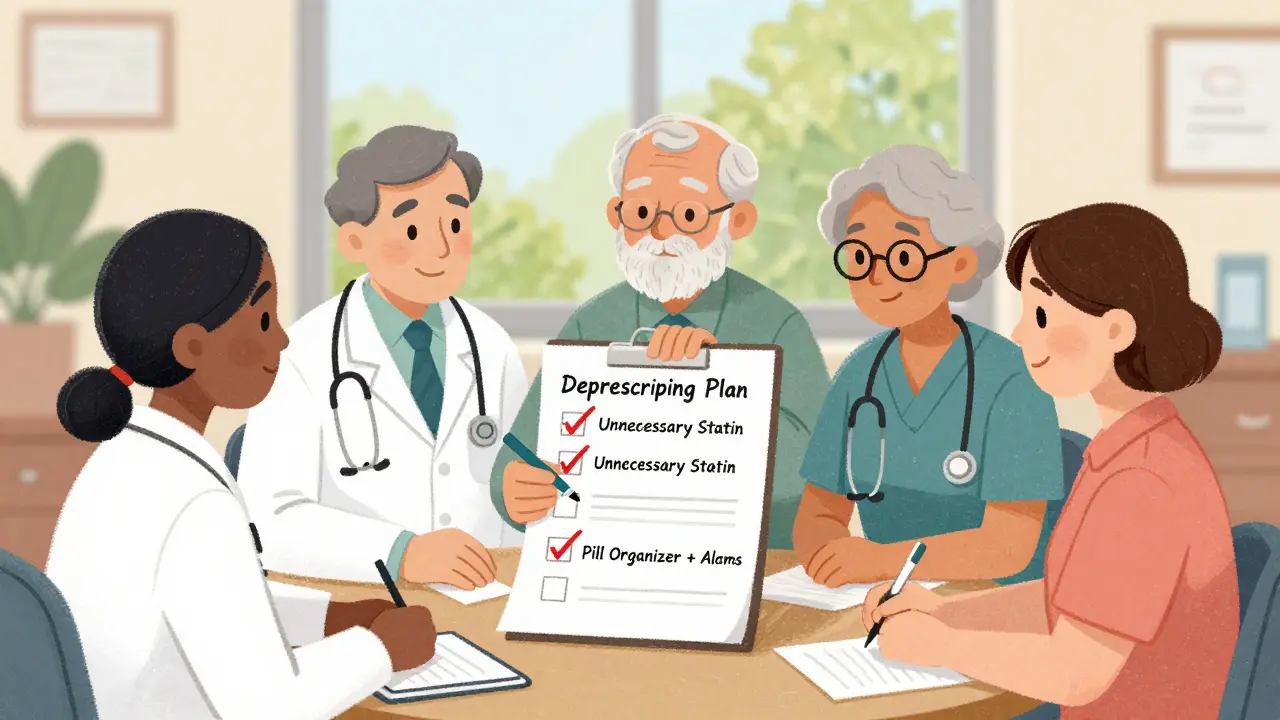
Deprescribing isn’t quitting meds. It’s carefully removing the ones that no longer serve you. It’s not about reducing the total number-it’s about improving safety and quality of life.For example, an 80-year-old with advanced dementia may no longer benefit from a cholesterol-lowering statin. The risk of side effects like muscle pain or liver stress now outweighs the tiny chance of preventing a heart attack years down the line. That’s when deprescribing makes sense.
But here’s the catch: you can’t just stop. Some medications need to be lowered slowly. Benzodiazepines for anxiety, for instance, can cause seizures if stopped cold. Antidepressants can trigger withdrawal symptoms like brain zaps or nausea. Always work with your doctor or pharmacist to create a safe plan.
Your Medication Master List: The Single Most Important Tool
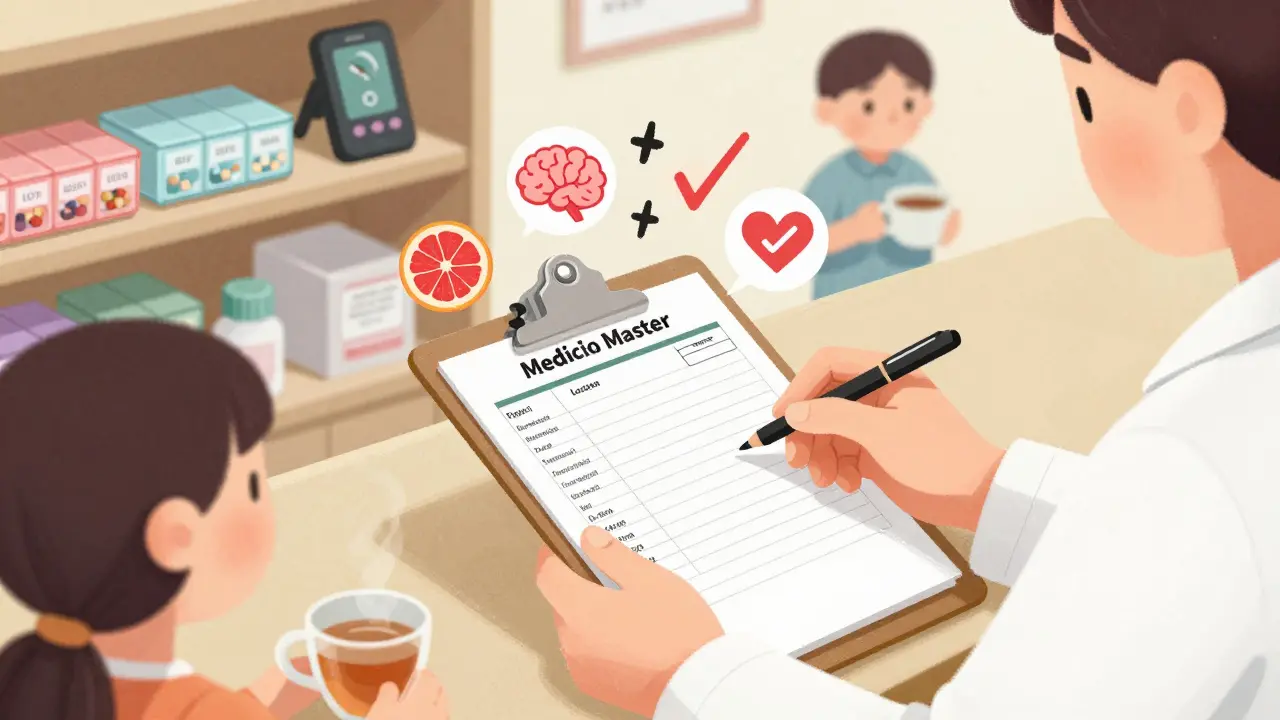
The most effective way to prevent dangerous interactions is to know exactly what you’re taking-and share that list with every provider.Build a Medication Master List with these details for each drug:
- Brand and generic name
- Dosage and how often you take it
- Why you take it (the diagnosis)
- Who prescribed it
- Special instructions (e.g., “Take with food,” “Avoid grapefruit,” “Don’t drink alcohol”)
Keep a printed copy in your wallet. Save a digital version on your phone. Bring it to every appointment-even if you think nothing changed. Pharmacists see this list more often than your doctor does. They’re trained to spot interactions you might miss.
And here’s a tip: Use one pharmacy for all your prescriptions. That way, their system can flag dangerous combinations before you even leave the counter.
Who Should Be on Your Team?
Managing multiple medications isn’t something you do alone. It needs a team:- Your doctor-to decide what’s needed and what can be stopped
- Your pharmacist-to check for interactions, explain how to take things, and spot red flags
- Your nurse or care coordinator-to help schedule reviews and track changes
- Your caregiver or family member-to help remember doses, notice side effects, and speak up if something feels off
At every hospital discharge or clinic visit, ask: “Can we do a full medication reconciliation?” That means comparing what you’re supposed to be taking with what you’re actually taking-and fixing any mismatches. Studies show this cuts hospital readmissions by up to 30%.
How to Make Taking Medications Easier
If you’re juggling ten pills a day, it’s easy to forget, double-dose, or skip one. Simple habits can help:- Link your meds to daily routines: Take your morning pills after brushing your teeth. Take your evening ones with dinner.
- Use a pill organizer with compartments for morning, afternoon, evening, and night.
- Set phone alarms-but don’t rely on them alone. Pair them with a physical action, like opening the fridge.
- Ask if any meds can be switched to once-daily versions. Many blood pressure and cholesterol drugs now come in extended-release forms.
Adherence isn’t just about remembering-it’s about making it easy. The simpler your routine, the safer you are.
When to Speak Up
You know your body better than anyone. If you notice any new symptom after starting or changing a medication-dizziness, confusion, fatigue, rash, nausea, swelling, or unusual bruising-tell your provider immediately. Don’t wait. Don’t assume it’s “just aging.”Also speak up if:
- You’re taking a drug because your doctor said “it might help,” but you’ve never seen improvement
- You’re on a drug that was prescribed by a specialist you haven’t seen in over a year
- You’re taking supplements because you “heard they help,” but no one on your team knows about them
These are warning signs your medication list may be out of control.
Is it safe to stop taking a medication if I feel fine?
No. Feeling fine doesn’t mean the medication isn’t working-or that stopping it is safe. Some drugs, like blood pressure or antidepressant medications, need to be tapered slowly. Stopping suddenly can cause dangerous rebound effects, including spikes in blood pressure, seizures, or severe anxiety. Always talk to your doctor or pharmacist before making any changes.
Can over-the-counter drugs and supplements cause interactions?
Absolutely. Common OTC drugs like ibuprofen can raise blood pressure and harm kidneys when taken with certain heart or kidney meds. Supplements like St. John’s wort can make antidepressants, birth control, or blood thinners ineffective. Even vitamin K can interfere with warfarin. Always tell your pharmacist or doctor about every pill, powder, or herbal product you take-even if you think it’s harmless.
How often should I get a medication review?
At least once a year, or anytime you see a new doctor, are discharged from the hospital, or start or stop a medication. If you’re on five or more drugs, aim for a review every six months. Many clinics now offer “medication therapy management” services at no extra cost through your insurance.
What’s the difference between polypharmacy and inappropriate polypharmacy?
Polypharmacy just means taking five or more medications. Inappropriate polypharmacy means taking drugs that aren’t helping, are causing harm, or aren’t aligned with your goals of care. For example, taking a statin for high cholesterol when you have advanced dementia and a life expectancy of less than a year is inappropriate. The goal isn’t to take fewer drugs-it’s to take only the ones that truly improve your life.
Can a pharmacist help me reduce my medications?
Yes. Pharmacists are medication experts trained to spot interactions, assess appropriateness, and recommend deprescribing. Many work directly with doctors in clinics to review patient lists. You can ask your pharmacist to do a free medication review-no appointment needed. They’ll check your list against your conditions, age, and other drugs to find opportunities to simplify or stop something safely.
What Comes Next?
Managing multiple medications isn’t a one-time task. It’s an ongoing conversation-with your body, your providers, and your life goals. As you age, your needs change. What kept you healthy last year might be unnecessary-or even harmful-this year.Start today: Make your Medication Master List. Bring it to your next appointment. Ask your pharmacist to review it. Ask your doctor: “Is this still right for me?”
Safe medication use isn’t about taking more. It’s about taking only what matters-and nothing more.
McCarthy Halverson
January 11, 2026 AT 13:31Been there. Took 12 pills a day until my pharmacist sat me down and we cut it to 5. One was just for a headache I hadn’t had in 3 years.
Michael Marchio
January 11, 2026 AT 23:08Let’s be real-most doctors don’t have a clue. They write scripts like they’re playing bingo. I watched my uncle go from 8 meds to 14 because he got dizzy, so they gave him something for dizziness, then constipation, then a laxative, then anxiety from the laxative, then a sedative… it’s a pyramid scheme of pharmaceuticals. And no one takes responsibility. The system is broken. You need to fight for your own health because no one else will.
Jake Kelly
January 13, 2026 AT 04:36This is such an important topic. I’ve seen friends lose months of their lives to hospitalizations from drug interactions. The key is communication-not just with your doctor, but between all your providers. A simple list saved my mom’s life last year. She didn’t even know her new pain med conflicted with her heart drug. Just asking the question changes everything.
Ashlee Montgomery
January 14, 2026 AT 00:55I think we’ve lost sight of what healing means. We treat symptoms like enemies to be eradicated rather than signals to be understood. Every pill is a compromise. Sometimes the body needs space to heal itself. The real question isn’t how many drugs you’re on-it’s whether you’re still living or just surviving. Deprescribing isn’t giving up. It’s choosing quality over quantity. And that’s a deeply human decision, not just a medical one.
neeraj maor
January 14, 2026 AT 05:42Big Pharma loves polypharmacy. It’s a $1.5 trillion racket. Every time you take a pill, they win. The FDA is bought off. Doctors get kickbacks. Even your pharmacist is paid to push more meds. That ‘medication review’? It’s a box-ticking exercise. They don’t want you off anything. They want you hooked. Watch the documentary ‘The Truth About Pills’-it’ll open your eyes. And don’t even get me started on grapefruit juice. That’s not a warning-it’s a cover-up.
Ritwik Bose
January 16, 2026 AT 02:56Thank you for sharing this thoughtful and deeply necessary guide. 🙏 I am from India, and here, polypharmacy is even more rampant due to over-the-counter access and lack of coordination between specialists. Your five-step plan is brilliant. I’ve shared it with my elderly aunt who was on 9 medications-now she’s down to 4 after a pharmacist review. Small steps, big impact. Let’s keep spreading awareness.
Paul Bear
January 17, 2026 AT 10:10While the article presents a commendable framework, it lacks rigorous clinical nuance. For instance, the Beers Criteria is not a binary exclusionary tool-it's a risk-benefit heuristic requiring individualized application. Furthermore, deprescribing protocols must account for pharmacokinetic shifts in geriatric populations, particularly CYP450 enzyme downregulation. The assertion that ‘feeling fine’ equates to therapeutic irrelevance is empirically flawed; asymptomatic control is still control. And yes, pharmacists are valuable, but they are not diagnosticians. Interprofessional collaboration, not substitution, is the gold standard.
lisa Bajram
January 17, 2026 AT 19:01OMG this is SO TRUE!! I used to be the queen of ‘I’ll just take this pill for that thing’-until I ended up in the ER with a serotonin spike from mixing St. John’s wort and my SSRI. My pharmacist literally yelled at me (in the nicest way possible) and helped me clean up my whole list. Now I use a pill organizer, set alarms, and I bring my list to EVERY appointment-even the dentist. My energy? Skyrocketed. My anxiety? Gone. Don’t wait for a crisis. Do this now. You deserve to feel like yourself again!! 💪✨
Jaqueline santos bau
January 19, 2026 AT 19:01I’ve been on 11 meds for 8 years and I’m terrified to stop anything. What if I die? What if my blood pressure spikes? What if my brain zaps again? My doctor says ‘it’s fine’ but I don’t believe him. My daughter says I’m overreacting but she doesn’t know what it’s like to feel like your body is betraying you every day. I just want to feel normal again. I don’t know who to trust anymore. 😭
Kunal Majumder
January 21, 2026 AT 01:21My dad took 8 pills daily. We sat down with his pharmacist and cut 4. He sleeps better now. No more dizziness. No more confusion. He said he feels like he’s 70 again, not 85. Just ask. Just check. It’s not about taking less-it’s about taking right.
Aurora Memo
January 22, 2026 AT 21:34Thank you for writing this with such care. I’ve worked as a geriatric care coordinator for over a decade, and this is exactly what families need to hear. The most powerful moment? When a patient realizes they can ask, ‘Is this still helping?’ It’s not defiance-it’s dignity. Keep reminding people: your body, your life, your choices. You’re not a checklist. You’re a person.