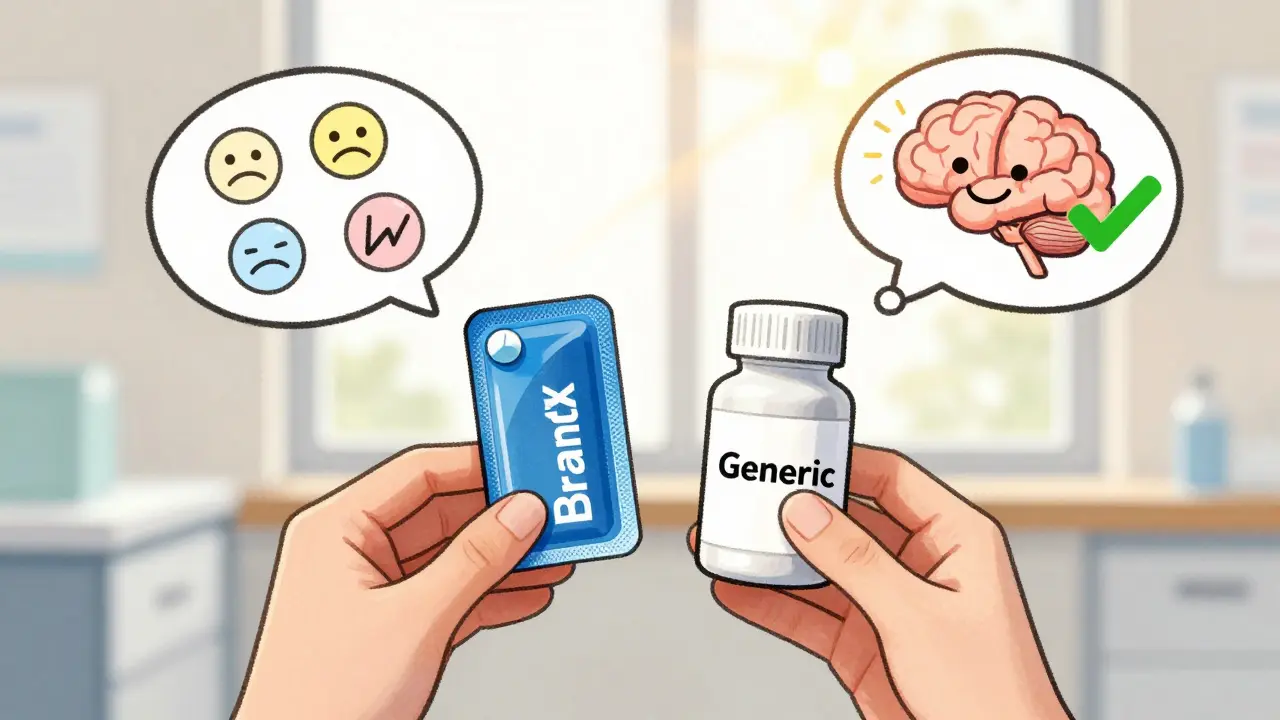
When a patient switches from a brand-name drug to a generic, they don’t just get a cheaper pill. They get a perception-one that can change how their body responds, even if the chemistry is identical. This isn’t myth. It’s science. And it’s happening every day in clinics, pharmacies, and homes across North America.
Why a Generic Can Feel Like a Different Drug
You’ve probably heard the phrase: "It’s the same active ingredient." And technically, that’s true. The FDA requires generics to deliver the same amount of medicine into the bloodstream at the same rate as the brand. But here’s what no one tells you: patients often feel worse after switching-not because the drug changed, but because their expectation changed. A 2025 study at a Toronto research center tested this with 196 healthy volunteers. Everyone got a fake nasal spray-no active ingredient at all. Half were told it was a generic: a long, complicated name, low price, plain packaging. The other half were told it was a brand: simple name, high price, sleek packaging. Those who believed they were using the generic reported significantly more side effects: headaches, dizziness, nausea-even though the spray was just saline. The difference? Their minds told them it wouldn’t work. And their bodies believed them. This is the nocebo effect: when negative expectations cause real physical symptoms. It’s the flip side of the placebo effect. And it’s powerful enough to make people quit their meds-even when the science says they shouldn’t.The Numbers Don’t Lie
In the U.S., 89.7% of prescriptions filled in 2022 were for generic drugs. That’s nearly 9 out of 10. But here’s the problem: 38% of patients still believe generics are less effective than brand-name versions. That’s not based on data. It’s based on fear. A 2023 study in PLOS Medicine found that even when patients were switched to an "authorized generic"-the exact same pill made in the same factory as the brand-they still reported more side effects. Why? Because the label changed. The color changed. The name changed. And suddenly, their brain started scanning every ache, every yawn, every mood swing as proof the drug wasn’t working. In New Zealand, when the brand venlafaxine was replaced with a generic, adverse effect reports stayed flat-until the media started running stories about "cheap drugs causing problems." Then reports spiked. It wasn’t the medicine. It was the message.How Packaging and Price Trick Your Brain
A 2024 study in Science showed something chilling. Researchers gave 49 people a cream with no active ingredient. One group got it in a sleek blue box labeled "Solestan® Creme." The other got the same cream in a plain orange box labeled "Imotadil-LeniPharma Creme." The people with the "expensive" cream reported more pain sensitivity. Not because the cream did anything. But because they believed it should hurt more. Price became a proxy for quality-and in their minds, cheap meant weak. Packaging matters. A lot. A generic pill that looks like a chewable vitamin, or comes in a bottle with a flimsy cap, triggers subconscious alarms. The brain says: "This isn’t serious medicine." And then it starts finding reasons to back that up.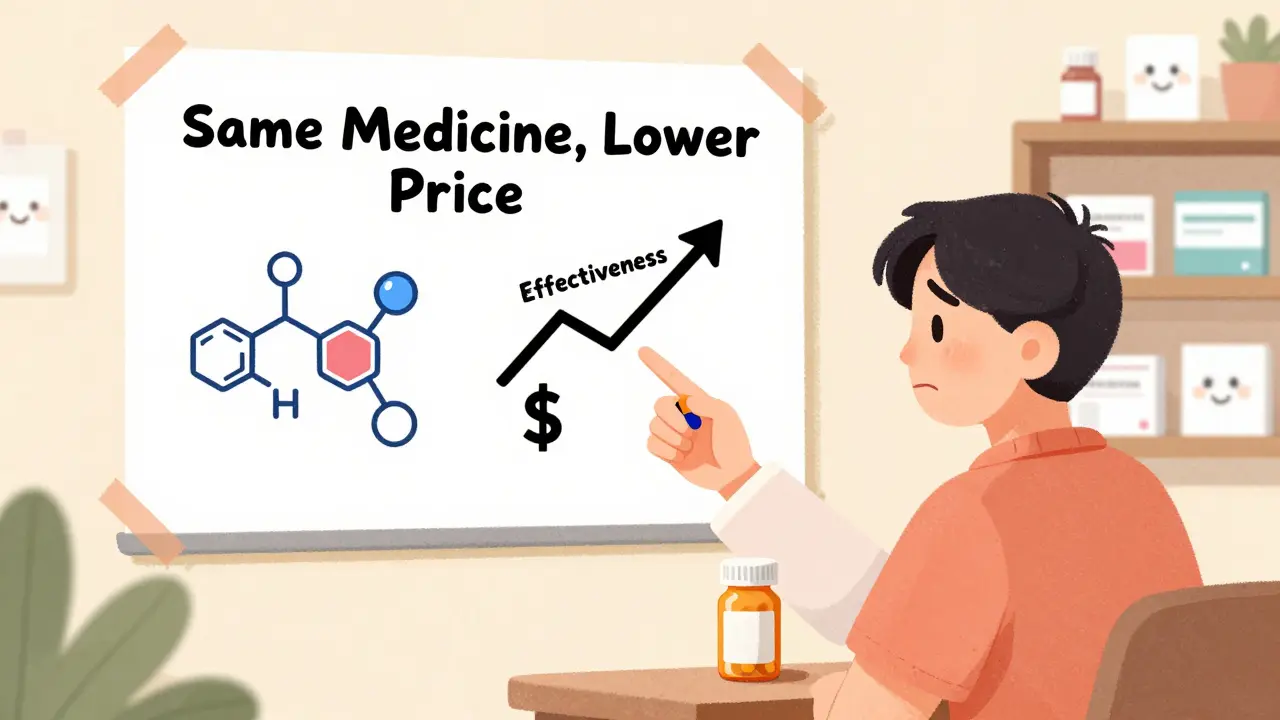
What Doctors and Pharmacists Can Do
You can’t fix this with a pill. You fix it with words. Kaiser Permanente’s protocol is simple: when switching a patient to a generic, the provider says: "This medication has the exact same active ingredient as your old one. Studies show patients do just as well on it. The only difference is the price-it saves you over $3,000 a year." That last part? Crucial. A 2022 JAMA Internal Medicine study found that when patients were told about the cost savings and the effectiveness, nocebo effects dropped by 37%. Money talks. But only if it’s paired with trust. Avoid saying things like: "This is just a generic." That phrase alone plants doubt. Instead, say: "This is the same medicine, approved by the FDA to work just like the brand. Many patients save hundreds without losing effectiveness." Don’t list every possible side effect during consent. That’s not informed-it’s suggestive. Instead, say: "Most people tolerate this well. If you notice anything unusual, we’ll figure it out together." Build a therapeutic alliance. When patients feel heard, their brains are less likely to misinterpret normal sensations as drug reactions.When Patients Say, "It’s Not Working Anymore"
A common Reddit thread from r/pharmacy reads: "My doctor switched me to generic sertraline. Now I’m anxious, tired, and crying for no reason. I never had this on the brand." The blood levels? Identical. The active ingredient? Identical. The side effects? Likely nocebo. But telling the patient, "It’s all in your head," makes things worse. Instead, validate their experience: "I hear how upsetting this is. Your symptoms are real. Let’s look at what’s changed-and what hasn’t." Then walk them through the facts: bioequivalence standards, FDA testing, the 80-125% range for absorption. Show them the science. But don’t stop there. Ask: "What did you expect when you took the brand? What are you expecting now?" Often, patients aren’t just reacting to the pill. They’re reacting to the loss of familiarity. The brand was a ritual. The generic feels like a compromise. That emotional shift matters.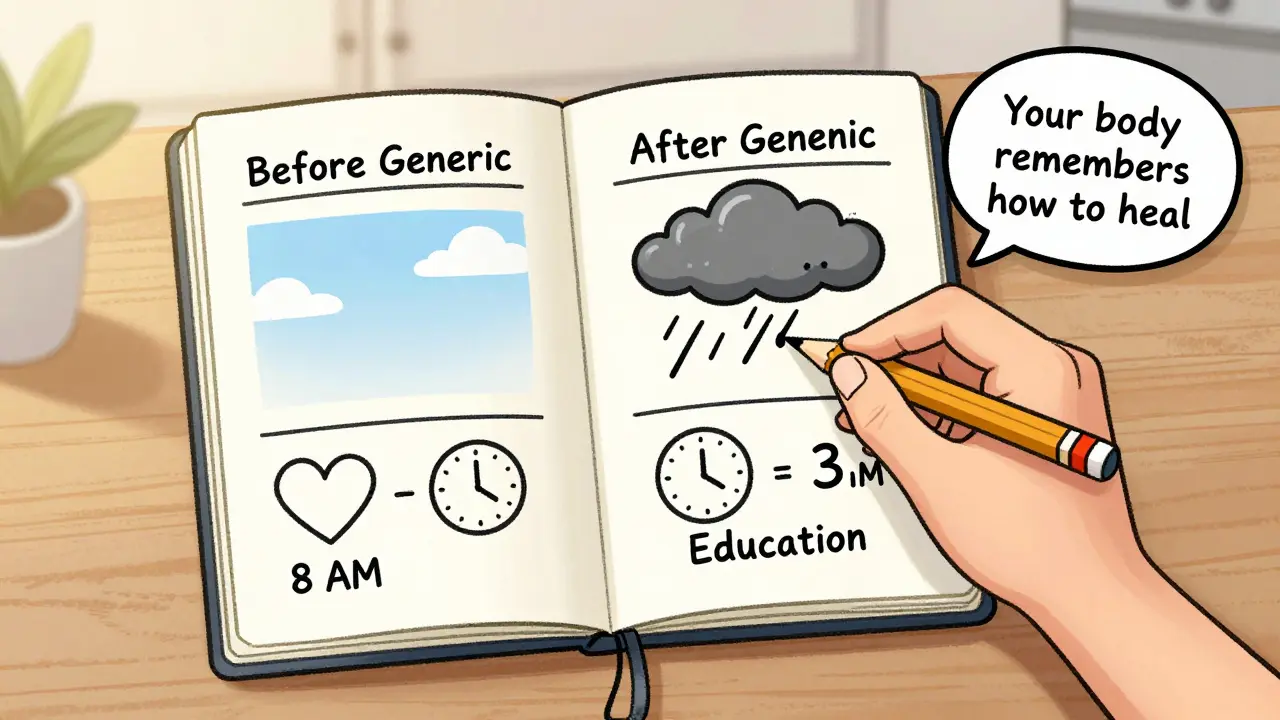
What Patients Can Do
If you’re switching to a generic and worried about side effects, try this:- Ask your pharmacist: "Is this the same as the brand?" If they say yes, ask: "Can you show me the FDA bioequivalence data?" Most can pull it up on their screen.
- Keep a symptom journal for two weeks. Note timing, intensity, and what else was going on (stress, sleep, diet). You’ll often see patterns that aren’t linked to the drug.
- Don’t Google side effects. Search instead: "generic sertraline patient experience"-not "side effects of generic sertraline." You’ll find more balanced stories.
- Remember: if you felt fine on the brand, your body knows how to handle this medicine. The change is in your mind, not your bloodstream.
The Bigger Picture
The nocebo effect isn’t just about generics. It’s about how we treat medicine as a product-not a tool. We’ve turned pills into brands, and brands into status symbols. We’ve let advertising, packaging, and pricing shape our trust in treatment. But here’s the truth: a $3 generic pill can save someone’s life just as well as a $300 brand. The difference isn’t in the chemistry. It’s in the conversation. Health systems that train providers to talk about generics with confidence and clarity see fewer discontinuations, fewer emergency visits, and better adherence. The patients who stay on their meds? They’re not the ones who got the cheapest pill. They’re the ones who got the clearest explanation.What’s Next?
Some pharmacies are now using "branded generics"-same medicine, same factory, but with packaging that looks more like the original brand. It’s not deception. It’s design that reduces anxiety. In Canada and Europe, regulators are pushing for standardized patient education materials to be handed out with every generic switch. That’s the future: not more pills, but better communication. The goal isn’t to stop generic use. It’s to stop the fear around it. Because the real danger isn’t the cheap pill. It’s the quiet, invisible force that makes people think it won’t work-and then makes it true.Are generic medications really the same as brand-name drugs?
Yes. The FDA requires generics to contain the same active ingredient, strength, dosage form, and route of administration as the brand. They must also prove they deliver the medicine into the bloodstream at the same rate and amount-with 90% confidence that the absorption falls within 80-125% of the brand. This is called bioequivalence. The only differences are inactive ingredients (like fillers or dyes), packaging, and price. These don’t affect how the medicine works.
Can a generic medication cause more side effects than the brand?
Not because of chemistry. But yes, patients often report more side effects after switching-due to the nocebo effect. Studies show that when people believe they’re taking a cheaper or less reliable version, their brains start interpreting normal sensations (like fatigue or mild headaches) as drug side effects. In controlled trials, identical pills given with different labels produce different side effect reports. The medicine didn’t change. The expectation did.
Why do some people feel worse after switching to a generic?
It’s rarely the drug. It’s the switch. Changing the pill’s appearance, name, or price triggers subconscious doubts. If you’ve been on a brand for years, your brain associates that specific shape, color, or logo with feeling stable. A new pill-even if identical-feels unfamiliar. Your brain scans for problems to justify the change. This is called expectation bias. It’s not weakness. It’s how the mind works.
Does the price of a medication affect how well it works?
Not pharmacologically. But psychologically, yes. Studies show people report more side effects from cheaper versions-even when the drug is identical. In one experiment, a fake cream labeled as expensive caused more pain sensitivity than the same cream labeled as generic. Price becomes a signal of quality in the brain. When you pay less, your brain assumes less benefit-and more risk. That’s why telling patients about cost savings alongside efficacy reduces nocebo effects by up to 37%.
What should I do if I think my generic medication isn’t working?
Don’t stop taking it. Don’t assume it’s broken. First, track your symptoms for two weeks: note when they started, how intense they are, and what else changed around the same time (sleep, stress, diet). Then talk to your provider. Say: "I switched to the generic and noticed X. I’m worried it’s the medicine. Can we check if this is likely the nocebo effect?" Your provider can review bioequivalence data, check for other causes, and help reframe your expectations. Many patients feel better once they understand what’s happening.
Can I ask for the brand-name drug instead of the generic?
Yes. You have the right to request the brand. But your provider may need to write "Do Not Substitute" on the prescription, and your insurance may require prior authorization or charge a higher copay. If cost is a barrier, ask if an authorized generic is available-it’s the same as the brand, just sold under a different name. It’s often cheaper than the brand but avoids the perception issues of a standard generic.
Are there any long-term risks to using generic medications?
No. Generics are held to the same strict manufacturing standards as brand-name drugs. The FDA inspects generic facilities just as often as brand facilities. There’s no evidence that generics are less safe over time. The only risk is psychological: if you believe the drug won’t work, you may stop taking it-and that’s when real harm happens. Staying on your medication, even if you’re unsure, is safer than stopping because of fear.
Catherine Scutt
January 8, 2026 AT 22:22Ugh, I switched to generic sertraline last year and felt like I was drowning in fog for weeks. My doctor told me it was 'all in my head'-like that helped. Turns out, it wasn’t the drug. It was the damn packaging. Looked like a children’s vitamin. My brain just refused to believe it could work. Now I ask for the exact same pill but in the brand’s bottle. Worth every extra dollar.
Darren McGuff
January 9, 2026 AT 04:08As a pharmacist for 18 years, I’ve seen this play out a hundred times. Patients don’t hate generics-they hate the *uncertainty*. The color change, the weird logo, the way the bottle feels flimsy-it triggers a primal alarm. I keep a stack of FDA bioequivalence printouts behind the counter. Sometimes, just handing someone a chart with the 80-125% range on it is all they need to breathe again. It’s not magic. It’s math. But the mind needs to see it to believe it.
Alicia Hasö
January 10, 2026 AT 18:22Let me tell you something that changed my life: I stopped saying 'it’s just a generic' and started saying 'this is the same medicine, approved by the FDA, and it’s saving you $200 a month.' The difference in patient compliance? Night and day. I used to get 3-4 calls a week from people panicking about side effects. Now? Maybe one a month. And guess what? Most of them were never actually having side effects-they were just scared they would be. Language isn’t just words. It’s medicine.
Drew Pearlman
January 10, 2026 AT 20:54Okay, I’m gonna go long on this because I’ve been there. My mom was on brand-name Lipitor for 12 years. When they switched her to generic, she swore up and down she felt 'off'-fatigue, brain fog, weird muscle twitches. We went to the doctor, got blood work, everything looked perfect. Then I found that study about the fake nasal spray. I printed it out. I sat with her. I said, 'Mom, your body isn’t broken. Your brain is just scared because the pill looks different.' We did the symptom journal thing. Two weeks in, she realized half the 'side effects' happened on days she didn’t sleep well or had coffee after 3 PM. She cried. Not because she was mad. Because she finally understood. She’s been on the generic for 3 years now. No issues. And she saves $1,200 a year. That’s a vacation. That’s groceries. That’s peace of mind. Don’t underestimate the power of a calm, clear conversation.
Patty Walters
January 12, 2026 AT 10:06my dr told me the generic was 'the same' but i noticed the pill was smaller and white instead of blue. i started having headaches and blamed it. turns out i was stressed about the switch. now i keep the brand bottle and just refill with generic inside. no one knows. i feel better. 🤫
Phil Kemling
January 13, 2026 AT 03:30There’s a deeper layer here that no one talks about: we don’t just trust medicine-we trust *rituals*. The brand was part of our identity. The morning pill with coffee. The way the bottle felt in our hand. The color we associated with 'feeling stable.' When you take that away, even if the chemistry is unchanged, you’re dismantling a psychological anchor. The nocebo effect isn’t irrational. It’s the mind trying to preserve a sense of order in a world that keeps changing the rules. Maybe the real solution isn’t better education-it’s better preservation of the ritual. Keep the bottle. Keep the color. Keep the name-even if the pill inside is the same.
Diana Stoyanova
January 14, 2026 AT 13:02Y’all, I’m a nurse and I’ve watched this play out with so many patients. I used to think it was all in their heads-until I saw a 72-year-old man cry because his generic metoprolol looked different from the one he’d taken for 15 years. He said, 'This one doesn’t feel like my heart medicine.' I didn’t argue. I just said, 'Let’s try something.' I got him the exact same generic but in the brand’s bottle. He took one. Smiled. Said, 'Now that’s my pill.' We didn’t change the medicine. We changed the story. And guess what? His BP stabilized. He’s been on it for two years. Sometimes, the placebo isn’t sugar. It’s the *feel* of the bottle.
Elisha Muwanga
January 15, 2026 AT 07:35Let’s be real-this is why America’s healthcare system is a joke. We let corporations make pills look like candy, then act shocked when people think cheap = bad. The FDA doesn’t care. Insurance companies don’t care. But patients? They’re not stupid. They see the price tag and the packaging and they think, 'They’re trying to trick me.' And they’re right. This isn’t psychology-it’s corporate greed dressed up as science. If you want people to trust generics, stop making them look like discount store crap. Make them look like medicine. And stop pretending it’s all in their heads when it’s really in your profit margin.
Maggie Noe
January 16, 2026 AT 10:16OMG YES. I switched to generic Adderall and felt like a zombie for 3 weeks. My brain was screaming 'this isn’t right!' Then I found out the generic was made by a company that also makes pet meds. 🤢 I asked for a different manufacturer and boom-back to normal. It’s not the active ingredient. It’s the fillers. And yeah, the packaging matters too. I now only take generics from companies that make the pill look *exactly* like the brand. I don’t care if it costs $5 more. My brain needs to feel safe. 😌
Gregory Clayton
January 16, 2026 AT 23:34So let me get this straight-some guy in a lab in India makes a pill that’s 'bioequivalent' but looks like a Tic Tac, and suddenly people are having panic attacks? And we’re supposed to feel bad for them? No. They’re weak. If you can’t handle a different-shaped pill, maybe you shouldn’t be on medication at all. Grow up. This is America. We don’t coddle people because their brain is triggered by a different color. Just take the damn pill.
Ian Long
January 18, 2026 AT 23:22I used to side with the 'it’s all in your head' crowd. Then I had a patient who was on generic fluoxetine and started having night sweats. Blood work? Normal. Drug levels? Perfect. But she swore it started the day she switched. I dug into her history-she’d lost her husband six months before. The brand pill was the last thing he bought her. The generic? She felt like she was betraying his memory. That’s when I realized: the nocebo effect isn’t just about chemistry. It’s about grief. Loss. Identity. We treat patients like machines. But they’re human. And sometimes, the pill isn’t the problem. The story is.
Pooja Kumari
January 19, 2026 AT 18:43Oh my god I’m so glad someone finally said this. I switched to generic citalopram and I felt like I was melting inside. My anxiety went from 7 to 10. I cried every night. I thought I was losing my mind. I went to the pharmacy and asked if this was really the same. They said yes. But I looked up the manufacturer-turns out it was made in a facility that also makes laxatives. I asked for a different one. I got the same generic, but from a company that makes heart meds. I took one. And I swear to you, within 2 days, I felt like myself again. It wasn’t the drug. It was the *company*. My brain trusted the one that made heart pills more than the one that made constipation cures. I don’t care what the science says. My body knows.
Jacob Paterson
January 21, 2026 AT 17:26Wow. So we’re just gonna let people’s irrational fears dictate healthcare policy? Next thing you know, we’ll be giving people the brand-name insulin because they 'feel better' with it. This isn’t medicine. It’s witchcraft. If you can’t handle a different-colored pill, maybe you shouldn’t be taking pills at all. The FDA doesn’t care about your emotional attachment to the packaging. And neither should you. Just take the damn thing. Your insurance doesn’t care. Your body doesn’t care. Only your ego does.
Jerian Lewis
January 23, 2026 AT 15:14My dad took a generic blood pressure med for 6 months. Said it 'didn’t feel right.' We went back to brand. He died of a stroke two months later. He was 68. He thought he was saving money. He was wrong. Don’t be like him. If you feel weird on a generic, don’t just assume it’s 'in your head.' Go back to the brand. Your life is worth more than $100 a month.