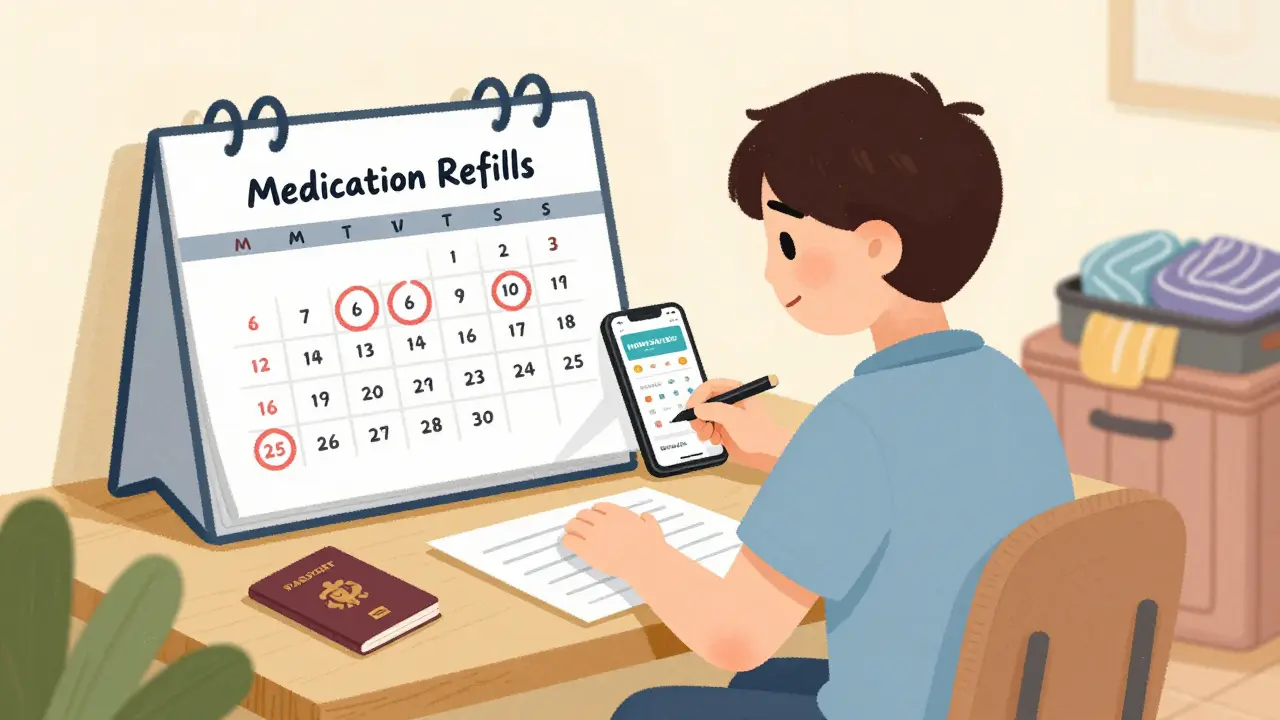
Running out of essential medicine while thousands of miles from home is a nightmare scenario that strikes fear into the hearts of many travelers. Whether you are managing diabetes, hypertension, or anxiety, an interruption in your treatment can lead to serious health complications. In fact, treatment interruptions account for nearly a quarter of all travel-related hospitalizations. The good news? You have more control than you think. By understanding insurance loopholes, packing strategies, and international laws, you can ensure your medication supply never runs dry.
This guide breaks down exactly how to secure early refills, navigate airport security with liquids, and handle emergencies abroad. We will move beyond generic advice to give you specific timelines, legal references like 'Kevin's Law,' and practical checklists that work whether you are visiting family across state lines or backpacking through Southeast Asia.
The Golden Rule: Plan Your Refills Before You Pack
The single most effective step you can take happens weeks before you even buy your plane ticket. Most people wait until they are down to their last few pills before calling the pharmacy. This is too late. Insurance companies operate on strict algorithms designed to prevent overuse, not to accommodate spontaneous vacations.
To avoid this friction, you need to trigger what is known as a vacation override. According to data from Express Scripts, 92% of major U.S. insurance providers now offer these standardized policies. However, they are not automatic. You must request them proactively.
- For 30-day supplies: Contact your insurer or pharmacy at least 14 days before your trip ends. Most commercial plans (like UnitedHealthcare, Aetna, and Cigna) allow refills 5-7 days early if you provide proof of travel dates.
- For 90-day supplies: You typically have a wider window, often 10-14 days early. Switching to a 90-day supply before a long trip can reduce refill frequency by 67%, according to a Kaiser Permanente study.
- The Documentation: Have your itinerary ready. Insurers often require a copy of your flight confirmation or hotel booking to process the override. Without this, your request may be denied automatically.
If your insurance denies the override, do not panic. Many national chains like CVS, Walgreens, and Rite Aid have their own emergency protocols. For instance, CVS MinuteClinic allows one-time renewals for maintenance medications twice a year, a feature many users describe as lifesaving.
Navigating Airport Security: Liquids and Pills
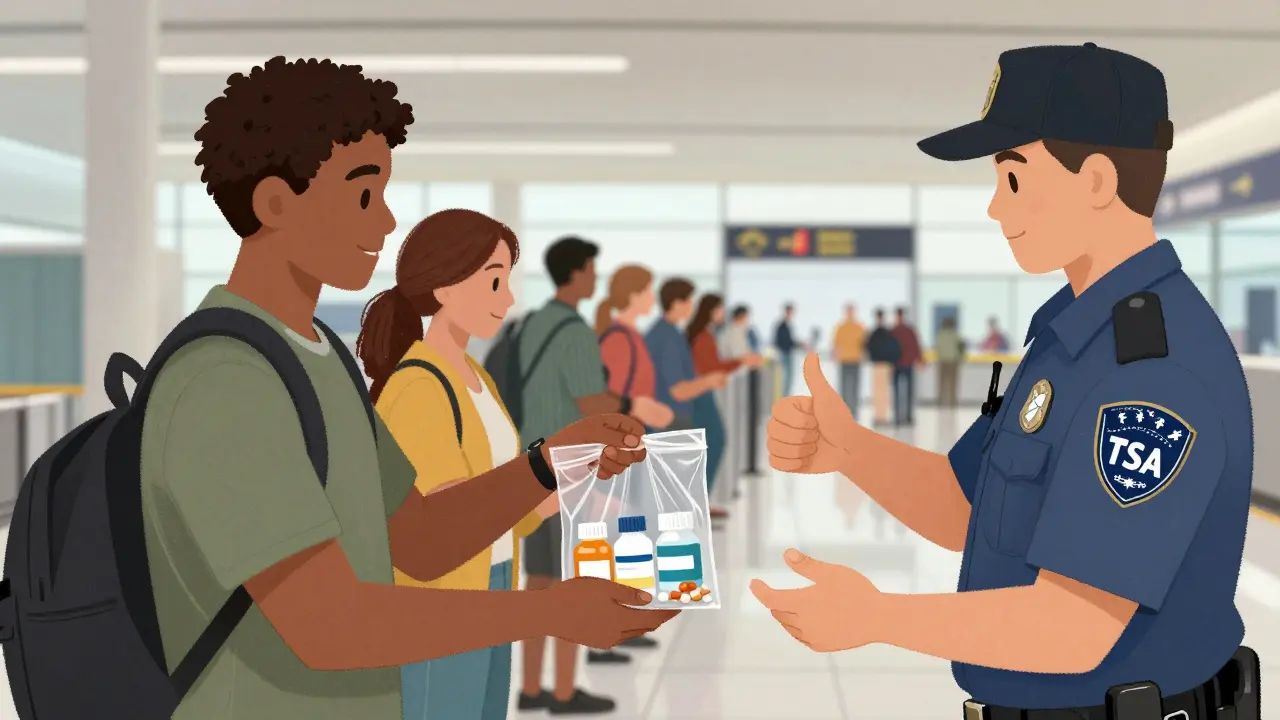
Once your medication is in hand, the next hurdle is getting it through Transportation Security Administration (TSA) checkpoints. The standard "3-1-1" rule for liquids (containers under 3.4 ounces) has a critical exception for medically necessary items.
You are allowed to carry insulin, liquid diet foods, and other medical liquids in quantities exceeding 3.4 ounces. However, there is a catch: you must declare them to security officers at the start of the screening process. Do not hide them in your bag hoping they will slip through. Declare them clearly. While TSA does not require FDA approval for medications, they reserve the right to test substances if they appear suspicious.
Here is how to pack smart:
- Keep medications in original containers: Pill organizers are convenient, but they strip away vital information. If questioned, an officer cannot verify the drug’s legitimacy without the pharmacist’s label showing your name and the prescribing doctor.
- Separate your bags: Place your liquid medications and any injectables in a separate bin during screening. This speeds up the process and reduces the chance of your bag being pulled aside for secondary inspection.
- Carry-on only: Never check your essential medications. Checked luggage gets lost, delayed, or exposed to extreme temperatures in the cargo hold. Keep all daily necessities in your carry-on.
The Dual-Container Strategy for Peace of Mind
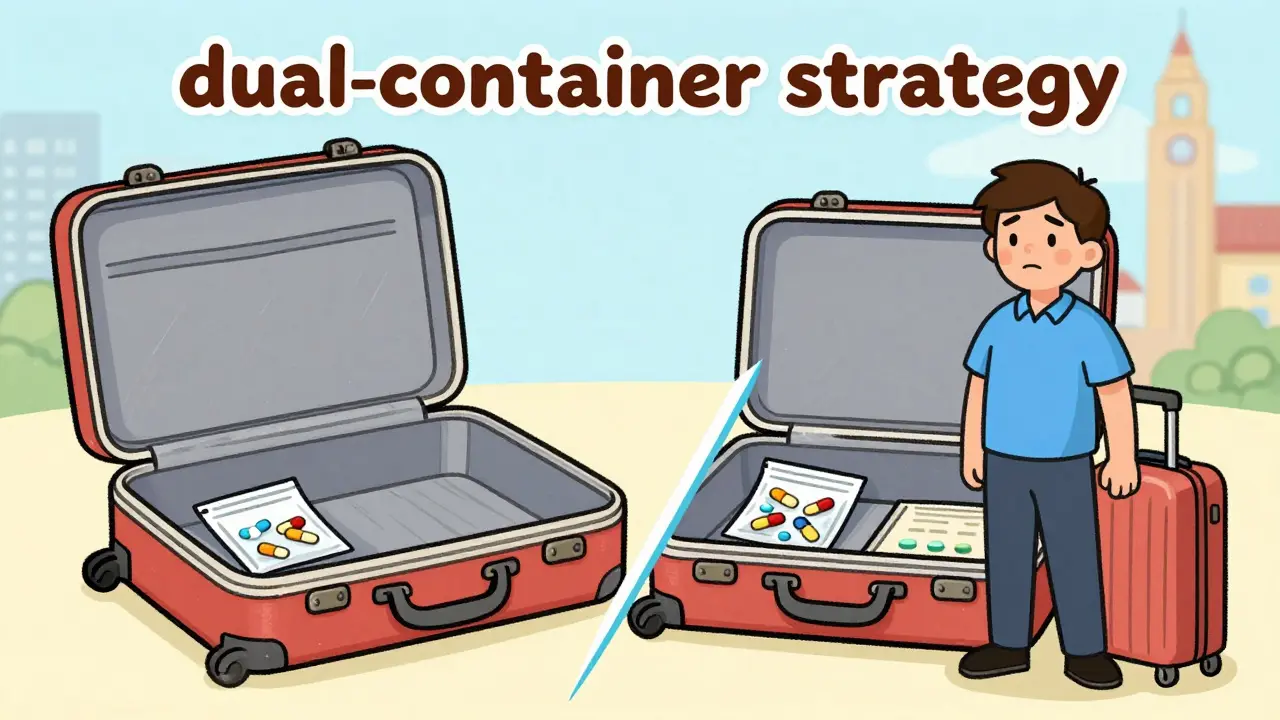
Even with perfect planning, things go wrong. Bags get misplaced, pharmacies run out of stock, or you simply miscount your doses. Dr. Jennifer Schaefer, Director of Clinical Services at the American Pharmacists Association, recommends a simple but powerful tactic: the dual-container strategy.
Split your medication supply between two separate pieces of luggage. Keep one container in your checked bag (if you must check anything) and the other in your carry-on. Alternatively, keep one in your daypack and the other in your main suitcase. If one bag goes missing, you still have a backup supply that lasts long enough for you to seek local assistance.
This strategy also helps with theft prevention. If you are staying in multiple locations, such as hostels or Airbnbs, splitting your stash means you don’t have to leave all your eggs in one basket. It is a small logistical effort that provides massive psychological relief.
Emergency Refills: Kevin's Law and Telehealth
What if you realize you have no refills left and your trip extends unexpectedly? Or perhaps you forgot your meds at home entirely? You are not stranded.
In the United States, you can rely on "Kevin's Law," officially known as the Patient Right to Emergency Refill Act of 2019. This federal regulation allows pharmacists to dispense a 72-hour emergency supply of chronic maintenance medications if you have consumed 75% of your previous refill. Note that this applies to non-controlled substances. Schedule II drugs (like ADHD stimulants or strong painkillers) are strictly regulated and generally exempt from this provision.
If you are traveling internationally, the rules change drastically. U.S. prescriptions are not valid in most foreign countries. Here is your contingency plan:
- Telehealth Services: Apps like Teladoc or Amwell can connect you with a U.S.-based doctor who can send a new prescription to a local pharmacy near you. In 2022 alone, telehealth facilitated over 1.2 million emergency prescription renewals.
- Local Clinics: Visit a local clinic with your empty pill bottle and original prescription. Explain your situation. While they cannot legally fill a U.S. script, they may be able to prescribe a local equivalent.
- Pharmacy Transfer: If you are within the U.S., use pharmacy chain transfer services. Studies show these transfers succeed in 82% of domestic cases, allowing you to pick up your meds at a nearby location.
International Travel: Legalities and Documentation
Traveling abroad with medication requires a higher level of diligence. Regulatory barriers vary wildly by country. According to the International Air Transport Association, 78 countries require specific prescription documentation for entry. Some nations, like Thailand, enforce strict quantity limits-often capping opioid imports at 30 days’ worth.
To avoid detention or confiscation at customs, prepare the following documents:
- Physician Letter: Obtain a letter on official letterhead from your doctor. It should list your diagnosis, the medication names (both brand and generic), dosage, and the total amount you are carrying.
- Notarized Copies: Carry notarized copies of your prescriptions. Digital photos on your phone are helpful, but physical copies are more reliable if your phone dies or is confiscated.
- Embassy Verification: Check the embassy website of every country you visit, including layover cities. As Dr. Michael Hodgson of the CDC advises, confirm that you can bring in your medications before you book your flights.
Be aware that controlled substances face the highest scrutiny. Only 56% of travelers successfully obtain early refills for Schedule II medications abroad compared to 89% for standard chronic condition drugs. Consider asking your doctor for alternative non-controlled medications for the duration of your trip if possible.
Managing Time Zone Changes
Jet lag affects more than just your sleep; it disrupts your medication schedule. The American Medical Association warns against adjusting medication times by more than three hours immediately upon arrival. Abrupt changes can lead to missed doses or double-dosing.
Use this transition strategy:
- First 24-48 Hours: Take your medications at your home time zone’s normal scheduled time. Use your watch set to home time to track this.
- Gradual Shift: After two days, gradually shift your dose time toward the local schedule. For example, if you usually take a pill at 8 AM and arrive in a timezone 5 hours ahead, take it at 8 AM home time (1 PM local time) for the first day, then slowly move it earlier each subsequent day.
- Set Alarms: Use multiple alarms on different devices. Label them clearly with the local time equivalent to avoid confusion.
| Feature | Domestic (U.S.) | International |
|---|---|---|
| Refill Validity | Valid nationwide with insurance | U.S. prescriptions invalid; local scripts needed |
| Emergency Supply | 72-hour supply via Kevin's Law | No universal law; depends on local clinic |
| Documentation Needed | Insurance ID card | Physician letter, notarized scripts, import permits |
| Controlled Substances | Strict 28-day refill rule | Often banned or heavily restricted (e.g., opioids) |
| Success Rate for Refills | 78% success with emergency refills | Only 29% success rate reported by travelers |
Frequently Asked Questions
How far in advance should I request a vacation override for my medication?
You should contact your insurance provider or pharmacy at least 14 days before your trip ends. For 30-day supplies, most insurers allow refills 5-7 days early, but processing times vary. Providing your travel itinerary early ensures they can approve the override before you run low.
Can I carry liquid medication larger than 3.4 ounces through TSA?
Yes, medically necessary liquids are exempt from the 3.4-ounce limit. However, you must declare them to security officers at the checkpoint. They may be subject to additional screening, so allow extra time for security checks.
What is Kevin's Law, and how does it help travelers?
Kevin's Law (Patient Right to Emergency Refill Act) allows pharmacists in the U.S. to dispense a 72-hour emergency supply of chronic maintenance medications if you have used 75% of your previous refill. It does not apply to controlled substances like opioids or stimulants.
Do I need a doctor's letter to travel internationally with medication?
While not always legally required for entry, it is highly recommended. A letter on official letterhead detailing your diagnosis, medication names, and dosage helps prove legitimacy to customs officials. Some countries, particularly those with strict drug laws, may require notarized copies or import permits.
How should I adjust my medication schedule when crossing time zones?
Maintain your home time zone schedule for the first 24-48 hours after arrival. Then, gradually shift your dose times toward the local schedule. Avoid changing your medication time by more than three hours in a single day to prevent missed doses or overdose.
Can I refill a U.S. prescription at a pharmacy abroad?
No, U.S. prescriptions are not valid in most foreign countries. You will need to see a local doctor who can write a new prescription for an equivalent medication. Bring your empty pill bottles and original prescriptions to assist the local physician.
amit kumar
May 18, 2026 AT 12:37Great guide! I always split my meds between my backpack and checked bag just in case. It gives me so much peace of mind when traveling to remote areas in India 🎒💊
Dana Ellington
May 19, 2026 AT 15:56Oh my gosh this is literally a lifesaver!! I had no idea about the vacation override thing and almost got stuck without my anxiety meds last summer 😱 thank you for posting this, seriously!!
victoria catharinaa
May 21, 2026 AT 06:28You need to keep your meds in original containers or TSA will hassle you dont even think about using a pill organizer unless you want to miss your flight it is not worth the risk i have seen people get detained for silly reasons
Glen Speck
May 23, 2026 AT 00:43the concept of kevin's law is interesting but often misunderstood by travelers who assume it applies universally across borders which it does not each nation has its own sovereignty regarding pharmaceutical importation
Sam Mackellar
May 24, 2026 AT 06:24It is imperative that one consults with their physician well in advance to obtain the necessary documentation for international travel as customs officials are increasingly stringent regarding controlled substances.
Justina Ingram
May 24, 2026 AT 20:30ugh why do we have to jump through so many hoops just to take our own medicine lol i hate declaring liquids at security it feels like an interrogation every single time :/
Emma Olliff
May 25, 2026 AT 16:33Most people simply lack the discipline to plan ahead properly which is why they end up in such pathetic situations relying on emergency loopholes rather than exercising basic foresight and responsibility regarding their own health management protocols.
Diana Wiechecka
May 27, 2026 AT 06:09I love the tip about setting alarms on different devices! So simple but effective 📱✨
Anthony Red
May 27, 2026 AT 20:30Hey everyone, just wanted to add that if you are traveling within the US, pharmacy transfer services are way easier than most people think. Just call the new pharmacy and they handle the paperwork with your old one. Saves a ton of stress.
Yuvraj Singh
May 29, 2026 AT 10:32Thanks for sharing Amit! That dual-container strategy is indeed a great habit. Dana, I am glad you found the override info helpful, it really makes a difference. Victoria, you are absolutely right about the original containers, TSA agents look for the pharmacist label specifically. Glen, good point on the international limitations, it is crucial to check embassy websites before booking flights.
Tanya KLIMCHUK Klimchuk
May 30, 2026 AT 09:00People really need to stop complaining and just read the guidelines carefully because ignorance is not an excuse when it comes to medication laws especially abroad where penalties can be severe so please do your homework before you travel
Lori Wildrick
June 1, 2026 AT 06:39I always print out extra copies of my prescriptions and keep them in separate bags just in case my phone dies or gets lost. It is a small step but it helps me feel more secure while exploring new places.
Desirea Gaona
June 2, 2026 AT 16:44It is essential to adhere strictly to the recommended timelines for requesting refills to ensure uninterrupted treatment during travel periods.