
Anticholinergic Cognitive Burden (ACB) Calculator
Your Anticholinergic Burden Result
Medications Contributing to Your Score:
Recommended Actions:
Have you ever taken an over-the-counter sleep aid or a prescription for bladder control without realizing it might be affecting your memory? You are not alone. Millions of people use anticholinergic medications, which are drugs that block the neurotransmitter acetylcholine in the central and peripheral nervous systems. These medications treat common conditions like allergies, insomnia, depression, and overactive bladder. However, growing evidence suggests a troubling link between long-term use of these drugs and an increased risk of dementia and cognitive decline.
The concern is not just about temporary side effects like dry mouth or drowsiness. Research indicates that cumulative exposure to anticholinergics may contribute to sustained cognitive deficits. This article breaks down what the science says, which medications carry the highest risk, and what you can do to protect your brain health.
What Are Anticholinergic Medications?
To understand the risk, we first need to define what these drugs actually do. Acetylcholine is a chemical messenger in your brain that plays a crucial role in learning, memory, and mood. Anticholinergic medications work by blocking the action of acetylcholine. While this helps relieve symptoms of certain conditions, it also interferes with normal brain function.
There are approximately 100 prescription and over-the-counter medications with anticholinergic properties. They fall into several major categories:
- Antihistamines: Such as diphenhydramine (Benadryl), often used for allergies or sleep.
- Bladder Antimuscarinics: Like oxybutynin (Ditropan) and solifenacin, used for overactive bladder.
- Tricyclic Antidepressants: Including amitriptyline (Elavil), prescribed for depression and nerve pain.
- Antipsychotics: Some older antipsychotic medications have strong anticholinergic effects.
- Antiparkinson Drugs: Used to manage symptoms of Parkinson’s disease.
The key factor here is how easily these drugs cross the blood-brain barrier. Tertiary amines, like doxepin, penetrate the central nervous system more readily than quaternary ammonium compounds, such as glycopyrrolate. This difference explains why some drugs pose a higher cognitive risk than others.
The Science Behind the Risk
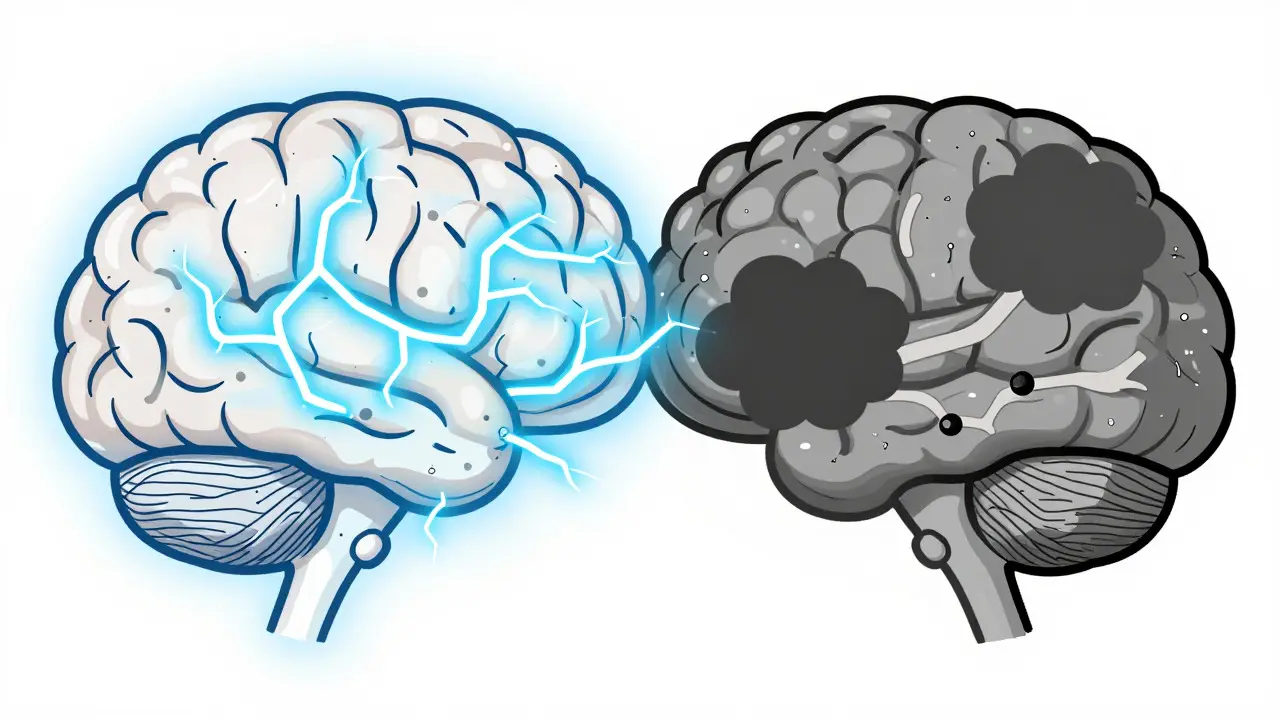
Why should you care about anticholinergic burden? Because the data shows a clear dose-response relationship. A landmark study published in JAMA Neurology in 2016 found that participants taking medications with medium or high anticholinergic activity performed significantly worse on memory and executive function tests compared to non-users.
Brain imaging studies provide even more concrete evidence. Researchers using FDG-PET scans observed that participants with high anticholinergic exposure showed 4-8% greater hypometabolism in critical brain regions compared to those with no exposure. Furthermore, structural MRI scans revealed 0.5-1.2% greater annual volume loss in the hippocampus and amygdala-areas essential for memory formation-in users of these drugs.
A large-scale study using the French National Health Insurance database quantified this risk further. It found that individuals exposed to more than 1,095 total standard daily doses (TSDDs) of anticholinergics had a 49% increased risk of developing dementia compared to those with no exposure. The risk increased incrementally with lower levels of exposure as well, starting at a 6% increase for those taking 1-90 TSDDs.
Which Medications Carry the Highest Risk?
Not all anticholinergics are created equal. A comprehensive analysis in JAMA Internal Medicine highlighted significant variations in dementia risk across different drug classes. Here is how they stack up based on adjusted odds ratios (OR):
| Drug Class | Example Medication | Adjusted Odds Ratio (OR) | Risk Level |
|---|---|---|---|
| Anticholinergic Antidepressants | Amitriptyline | 1.29 | Highest |
| Antipsychotics | Various | 1.20 | High |
| Bladder Antimuscarinics | Oxybutynin | 1.13 - 1.23 | Moderate-High |
| Antiparkinson Drugs | Various | 1.10 | Moderate |
| Non-Anticholinergic Bladder Tx | Trospium | 1.03 | Low/None |
Note that trospium, another treatment for overactive bladder, showed no significant association with dementia risk. This distinction is vital because it means safer alternatives exist for many conditions.
Measuring Your Anticholinergic Burden
You might wonder, "How much is too much?" Healthcare providers use standardized scales to measure anticholinergic burden. The two most common tools are the Anticholinergic Cognitive Burden (ACB) scale and the Anticholinergic Risk Scale (ARS). These scales classify medications into categories based on their receptor affinity and potency.
The ACB scale assigns scores from 0 to 3: 0 = No known anticholinergic effect; 1 = Weak anticholinergic effect; 2 = Moderate anticholinergic effect; 3 = Strong anticholinergic effect.
If you take multiple medications, your total score adds up. A higher cumulative score correlates with greater cognitive impairment. For example, taking amitriptyline (score 3) plus diphenhydramine (score 2) results in a total burden of 5, which places you at significantly higher risk than someone taking only one low-risk medication.

Practical Steps to Protect Your Brain Health
Knowing the risks is empowering. Here is what you can do to mitigate your exposure:
- Review Your Medications: Make a list of all prescription and over-the-counter drugs you take. Check them against an anticholinergic burden calculator, which are now integrated into many electronic health records like Epic Systems.
- Talk to Your Doctor: Ask if there are non-anticholinergic alternatives. For instance, SSRIs can replace tricyclic antidepressants, reducing your ACB score by 3-4 points. For overactive bladder, mirabegron has an ACB score of 0, compared to 3 for oxybutynin.
- Deprescribe Safely: If you need to stop a medication, do not quit cold turkey. The Canadian Deprescribing Guidelines recommend a gradual tapering process over 4-8 weeks to avoid withdrawal effects.
- Consider Non-Pharmacological Options: Cognitive behavioral therapy for insomnia (CBT-I) is highly effective and avoids the risks of sedating antihistamines entirely.
Dr. Lisa Delano-Wood of UC San Diego emphasized that reducing the use of anticholinergic drugs before any cognitive problems develop is a key preventive strategy, especially for those with elevated Alzheimer's risk factors like the APOE-ε4 gene variant.
Current Trends and Future Outlook
The medical community is taking notice. The American Geriatrics Society launched the Anticholinergic Risk Reduction Initiative in 2022, aiming to cut inappropriate prescribing by 50% by 2027. Regulatory bodies like the FDA have added stronger cognitive risk warnings to 14 anticholinergic medications since 2020.
However, challenges remain. Only 37% of primary care physicians routinely screen for anticholinergic burden when prescribing to patients over 65. Patient awareness is also low; surveys show that while many report physical side effects, fewer recognize the potential neurological impact.
On the positive side, pharmaceutical development is shifting. As of mid-2023, several new bladder treatments and antidepressants are in Phase III trials, specifically designed to minimize central nervous system penetration. This trend toward safer alternatives offers hope for better management of chronic conditions without compromising brain health.
Can short-term use of anticholinergics cause dementia?
Research suggests that short-term use (less than 1 year) shows no significant increase in dementia risk. The substantial risk appears with long-term use, particularly exceeding 3 years. However, even short-term use can cause temporary cognitive impairment, so caution is still advised.
Are over-the-counter sleep aids safe for seniors?
Many OTC sleep aids contain diphenhydramine, a strong anticholinergic. Regular use by seniors contributes significantly to anticholinergic burden. Experts generally recommend avoiding them for long-term sleep issues due to the associated cognitive risks.
What is the safest alternative to oxybutynin for overactive bladder?
Mirabegron is a beta-3 adrenergic agonist that treats overactive bladder without anticholinergic effects, carrying an ACB score of 0. Trospium is another option with minimal cognitive risk. Always consult your doctor for personalized recommendations.
Does stopping anticholinergics reverse cognitive decline?
While research is ongoing, some patient reports and small studies suggest stabilization or slight improvement in cognitive metrics after discontinuation. However, full reversal is not guaranteed, highlighting the importance of prevention rather than cure.
How can I check my anticholinergic burden?
You can ask your healthcare provider to calculate your Anticholinergic Cognitive Burden (ACB) score. Many electronic health record systems now include automated calculators. Online resources and apps based on the ACB or ARS scales are also available for self-assessment.