Medication Side Effect Response Guide
Select the symptom you are experiencing to see the recommended action based on the clinical framework.
Recommended Action
TimelineDetailed advice will appear here.
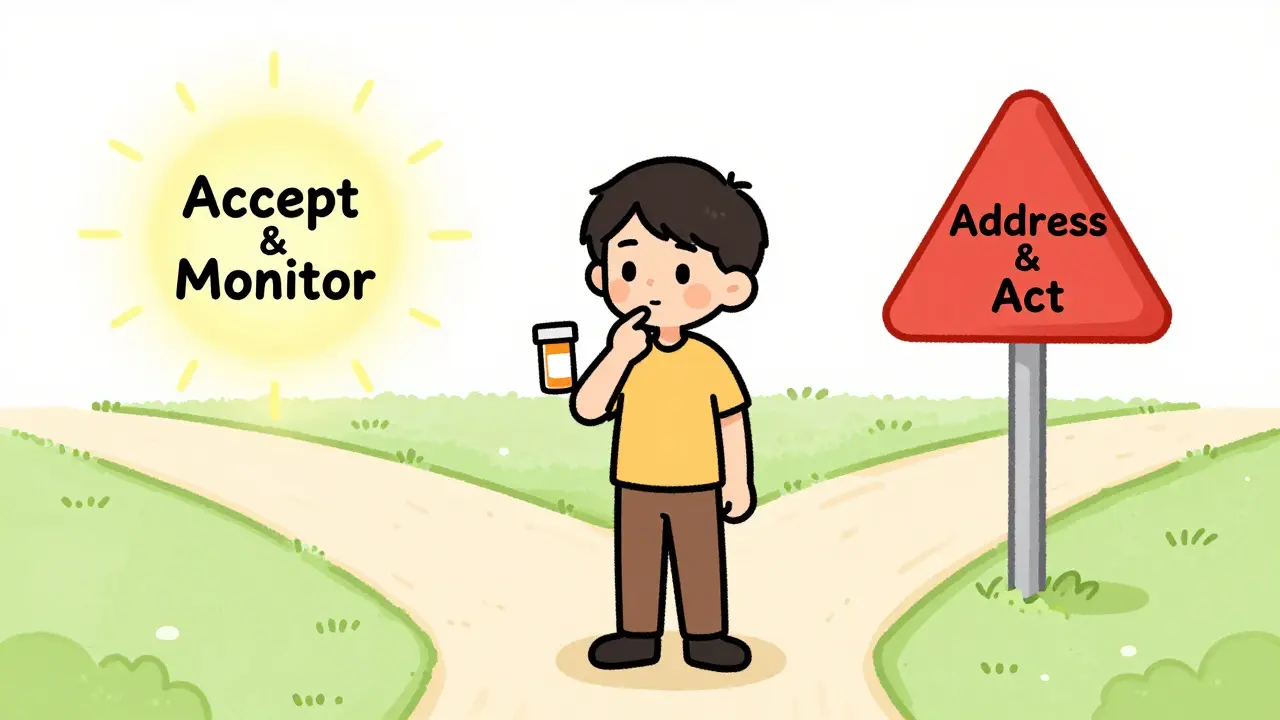
You start a new prescription, and a few days later, you notice something is off. Maybe your mouth feels like a desert, or you're suddenly exhausted by 2 PM. Now you're faced with a tough choice: is this just a "normal" part of the process that you should push through, or is it a red flag that you need to call your doctor immediately? Making the wrong call can lead to unnecessary suffering or, worse, a dangerous health crisis.
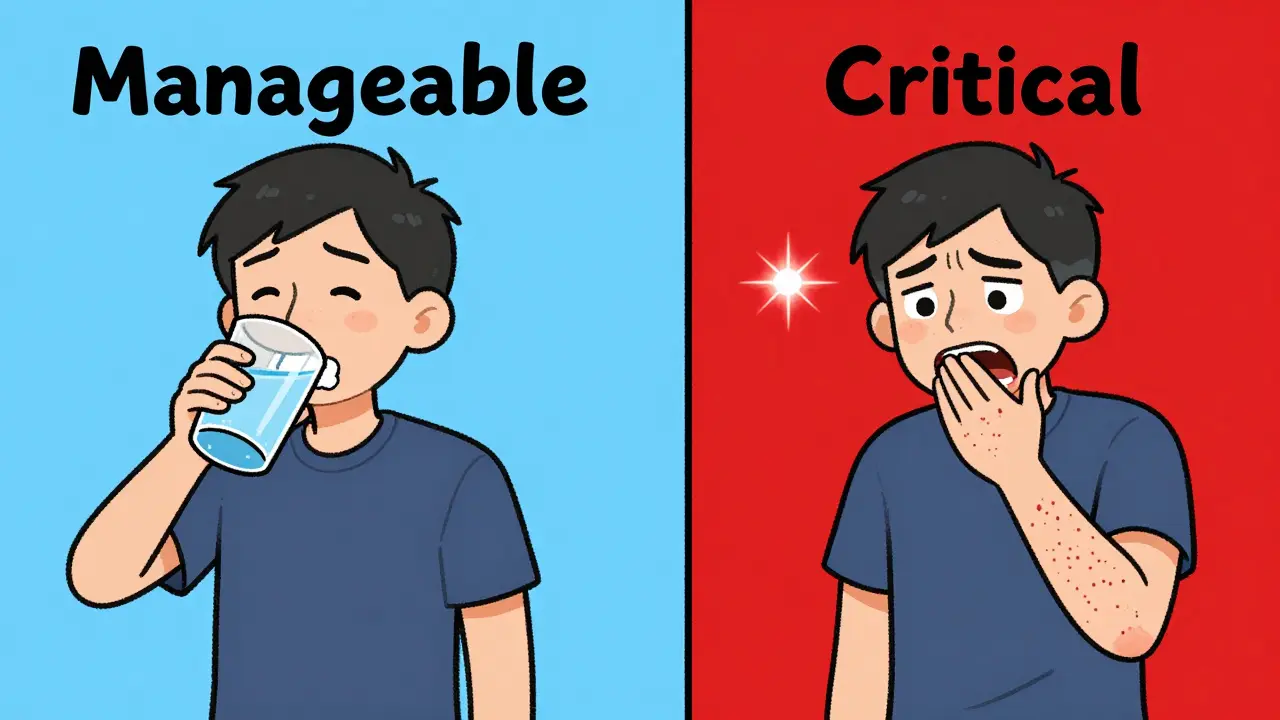
Understanding the difference between a manageable nuisance and a critical warning sign is a skill every patient needs. While some reactions are temporary and expected, others are medication side effect management is the process of identifying, monitoring, and mitigating unintended responses to drugs to maintain treatment adherence and patient safety. The goal isn't to have zero side effects-that's rarely possible-but to decide which ones are a fair trade-off for your health and which ones are non-negotiable.
| Symptom Type | Common Examples | Typical Action | Timeline for Action |
|---|---|---|---|
| Mild/Transient | Dry mouth, slight drowsiness | Monitor & self-manage | Wait 7-14 days |
| Moderate/Functional | Dizziness, significant weight gain | Consult provider | Within 2 weeks |
| Severe/Critical | Hives, swelling, confusion | Emergency care | Immediately |
When it's Okay to Just "Deal With It"
Not every odd symptom requires a pharmacy visit. Some reactions are simply the way a drug interacts with your system, and they often fade as your body adjusts. For instance, SSRIs (Selective Serotonin Reuptake Inhibitors) often cause initial gastrointestinal discomfort in about 50% of users. Usually, this is a short-term hurdle that disappears after the first few weeks.
You might choose to accept a side effect if the benefit of the drug is massive compared to the annoyance of the symptom. If you're treating a severe, life-threatening condition, a bit of dry mouth or mild nausea is often a price worth paying. According to data from the beMedWise program, many patients successfully manage these minor issues without changing their dose. If you're experiencing mild dry mouth, trying sugar-free gum or drinking more water is often enough to solve the problem without needing a new prescription.
Another example is initial drowsiness. About 20-25% of people starting certain psychotropic medications feel sleepy at first. If it doesn't interfere with your ability to drive or work safely, and it starts to improve after 7 to 10 days, it's generally considered a transient effect that you can monitor rather than treat.
The Red Flags You Can't Ignore
While some symptoms are nuisances, others are dangerous. You should never "tough out" a reaction that affects your basic safety or vital organ function. The FDA (Food and Drug Administration) distinguishes between a side effect and an adverse reaction-the latter being harmful and unintended responses that require immediate intervention.
Immediate emergency care is required if you experience a severe allergic reaction. This includes facial swelling, hives, or difficulty breathing. While this only happens in about 1-2% of cases, it can be fatal if ignored. Similarly, the CDC (Centers for Disease Control and Prevention) warns that neurological shifts-like sudden confusion, memory gaps, or loss of coordination-are serious, especially in elderly patients who may be taking multiple medications.
Keep an eye out for "Black Box Warnings." These are the most serious warnings the FDA can put on a drug label. For example, some medications like allopurinol carry a risk of severe skin reactions. If you see a rash while taking a drug with this warning, the instruction is simple: stop the medication immediately and call your doctor.
Simple Tweaks That Fix Common Problems
Before you give up on a medication that is working well for your condition, consider if a simple adjustment could fix the side effect. You'd be surprised how often the way you take the medicine is the problem, not the medicine itself.
- Timing Shifts: If your medication makes you sleepy, ask your doctor if you can take it at bedtime instead of the morning. This simple change helps 30-40% of patients avoid daytime fatigue.
- Food Pairing: Many drugs, such as metformin, cause stomach upset. Taking them with a meal can reduce gastrointestinal discomfort in up to 70% of cases. For antibiotics that cause nausea, try pairing them with a high-protein snack.
- Hydration: For mild dry mouth, simply increasing your water intake or using oral lubricants can manage the symptom without needing a dosage change.

How to Talk to Your Doctor (And Actually Get Results)
Walking into a doctor's office and saying "I feel weird on this medicine" rarely gets you the help you need. Doctors need concrete data to make a clinical decision. If you provide vague descriptions, you're less likely to get an accurate dosage adjustment.
To get the best outcome, start tracking your symptoms in a journal. Record the severity on a scale of 1 to 10, the exact time the symptom appears after you take the dose, and how long it lasts. When you have a specific log-for example, "I feel dizzy for 30 minutes every day at 10 AM"-your provider can pinpoint whether the issue is the dose, the timing, or the drug itself.
When you sit down with your provider, ask these three specific questions to get clear answers:
- Is this side effect expected with this specific medication?
- What is the realistic timeline for this symptom to resolve?
- What specific signs should I look for that mean this is getting worse and requires a change?
The Danger of the "DIY" Approach
It's tempting to just stop taking a pill if it makes you feel bad. However, this is one of the most dangerous moves a patient can make. Research into online health communities shows that a huge number of people try to manage side effects independently, often misjudging how severe a symptom actually is. The CDC has noted that nearly 28% of patients who experience side effects stop their meds entirely without telling their doctor, which leads to treatment failure in over 70% of those cases.
Stopping a medication abruptly can cause withdrawal symptoms or a "rebound effect" where the original condition returns more aggressively. Instead of quitting, the goal should be shared decision-making. Your doctor can help you pivot by adjusting the dose, changing the timing, or switching you to a different drug in the same class that your body might tolerate better.
How long should I wait for side effects to go away?
For many medications, especially antidepressants or blood pressure meds, mild side effects like drowsiness or dry mouth often resolve within 7 to 14 days as your body adjusts. However, if a side effect persists beyond two to four weeks or worsens over time, you should contact your healthcare provider to discuss a dosage adjustment or an alternative medication.
What is the difference between a side effect and an adverse reaction?
A side effect is an unintended but typically predictable response to a medication at a normal dose (like mild nausea). An adverse reaction is a more harmful, unintended response that can be dangerous or life-threatening (like an anaphylactic allergic reaction or organ failure). Side effects are often managed; adverse reactions usually require immediate medical intervention.
Can I just take my medication with food to stop nausea?
In many cases, yes. Taking medications with food can reduce gastrointestinal distress for a large percentage of patients. However, you must check with your pharmacist or doctor first, as some medications must be taken on an empty stomach to be absorbed properly. Never change how you take your medication without professional confirmation.
What should I do if I can't afford a different medication that has fewer side effects?
Cost is a real barrier for many. If a more expensive alternative is suggested, ask your doctor about generic versions or patient assistance programs. You can also ask your pharmacist if there are therapeutically equivalent drugs in the same class that are covered better by your insurance.
When is a side effect considered "too severe" to accept?
A side effect is generally too severe if it causes functional impairment-meaning it stops you from performing daily activities, like dizziness that prevents you from walking or insomnia that prevents you from working. If a symptom affects more than 20% of your daily activities, it is typically time to seek an alternative treatment.
Danielle Kelley
April 5, 2026 AT 13:07These "side effects" are just a cover for how they actually control your brain and keep you dependent on the system. They tell you to wait two weeks so you're already hooked before you realize the drug is destroying your natural chemistry. Don't trust the FDA, they're basically paid off by the pharmaceutical giants to ignore the real damage. It's all a game to make money while we suffer through "manageable nuisances" that are actually permanent injuries. Wake up and stop letting them dictate what's "normal" for your body!
Toby Sirois
April 6, 2026 AT 14:46People just lack the discipline to handle basic health. If you can't handle a little dry mouth, you're just weak. Most of you just want a magic pill and then complain when it doesn't feel like candy. It's simple: take the med and shut up.
charles mcbride
April 7, 2026 AT 18:58It is truly heartening to see such a comprehensive guide for those struggling with new treatments. Keeping a journal is a fantastic way to advocate for oneself in a clinical setting. I believe most people will find great success by simply following these organized steps. Wishing everyone a smooth recovery and better health!
Alexander Idle
April 8, 2026 AT 22:26Imagine actually spending the time to write a journal for a doctor who's just gonna spend five minutes with you anyway. Absolute tragedy. Like, who has the energy to track dizziness at 10 AM? I'm just exhausted by the sheer effort this post suggests. Truly a nightmare scenario for anyone who just wants to feel better without becoming a part-time data analyst for Big Pharma.
Sarabjeet Singh
April 10, 2026 AT 21:19The timing shift tip is actually very useful. I've seen a few friends do this with their meds and it really helps them stay productive during the day. Just keep pushing forward.
Christopher Cooper
April 11, 2026 AT 05:23The distinction between a side effect and an adverse reaction is a crucial point here. It really makes you think about how we perceive risk versus reward in medicine. I wonder if there's more data on how the psychological expectation of a side effect actually increases the likelihood of feeling it. It's fascinating how the body and mind interact during these pharmaceutical trials. I'm definitely going to try the food pairing trick if I ever start a new course of meds. It's a practical approach that makes a lot of sense from a biological standpoint. Let's keep exploring these options to improve patient quality of life!
Daniel Trezub
April 13, 2026 AT 02:14Actually, the "wait 7-14 days" thing is kind of a lazy generalization. Some meds never stabilize, and you're just wasting time suffering. But hey, the formatting of the table is cute, I guess.
Rupert McKelvie
April 14, 2026 AT 08:01Great advice on not quitting cold turkey. Many people don't realize the danger of rebound effects. Stay positive everyone.
Vivek Hattangadi
April 15, 2026 AT 06:34I totally agree with the advice on talking to doctors with concrete data! I've helped a few colleagues organize their symptoms this way and the doctors respond way better. It turns the appointment into a partnership instead of just a lecture. We can all get through this if we support each other and share these tips. Let's keep helping each other out!
Rauf Ronald
April 15, 2026 AT 17:02Spot on! As someone who works in the field, I can't stress enough how much the timing of the dose matters. If you're feeling wiped out by noon, just move that dose to 8 PM and you'll feel like a new person. Also, don't forget that hydration isn't just for dry mouth, it helps your kidneys clear some of these metabolites faster too. Keep grinding and keep communicating with your providers!
Del Bourne
April 16, 2026 AT 18:01This is an incredibly helpful breakdown. For those who are worried about cost, I'd also suggest looking into GoodRx or similar apps, as they can often find coupons that make the "better" drug much more affordable. It's all about being proactive. I've seen so many patients feel defeated by a side effect that was easily fixed with a simple dose adjustment or a change in when they ate. The key is exactly what was mentioned: detailed logging. When you can tell your doctor that a symptom happens exactly 45 minutes after a dose, it eliminates the guesswork and gets you to the solution much faster. Just keep a small notebook by your pill bottle and you'll be set. You've got this!