When you pick up a prescription, you might see a different name on the bottle than what your doctor wrote. It could be the brand name you recognize, or a plain label with just the drug’s chemical name. If it’s the latter, you might be holding an authorized generic-a drug that’s chemically identical to the brand-name version, down to the last inactive ingredient. Yet most people don’t know the difference between authorized generics, traditional generics, and brand drugs. And that confusion can cost you money-or worse, make you skip your medication because you think it’s "not the same."
What Exactly Is an Authorized Generic?
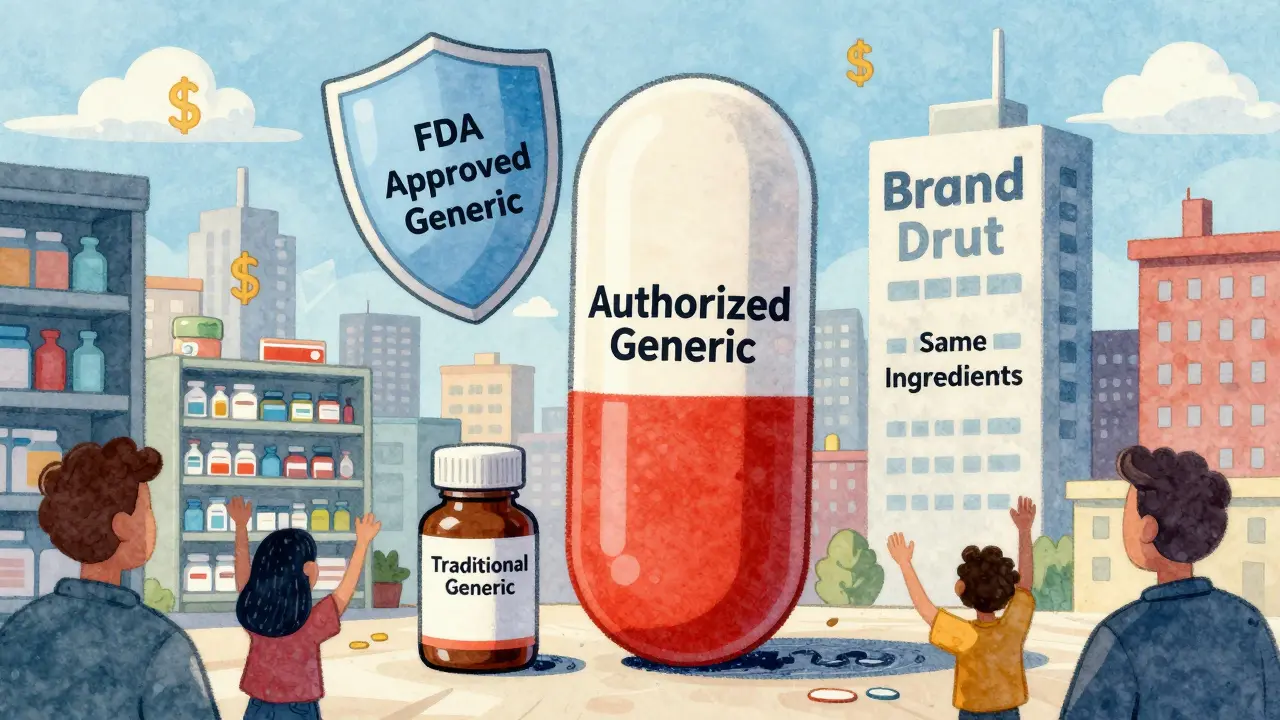
An authorized generic is the exact same pill, capsule, or injection as the brand-name drug. Same active ingredient. Same dosage. Same shape, color, and coating. Even the same fillers, dyes, and preservatives. The only difference? No brand name on the label.
These aren’t knockoffs. They’re made by the same company that makes the brand drug, often on the same production line. The U.S. Food and Drug Administration (FDA) defines them as "an approved brand name drug that is marketed without the brand name on its label." That’s it. No extra testing. No reformulation. No compromises.
How is that possible? Because authorized generics don’t go through the usual generic approval process. Instead, they’re sold under the original brand’s New Drug Application (NDA). That means the FDA already approved every detail of the product years ago. The manufacturer just removes the brand logo and sells it under a different name-usually at a lower price.
How Are Authorized Generics Different from Traditional Generics?
This is where things get messy. Traditional generics are approved through an Abbreviated New Drug Application (ANDA). That means they must prove they’re "bioequivalent" to the brand drug-meaning they work the same way in your body. But here’s the catch: they’re allowed to use different inactive ingredients.
That sounds minor, but for some people, it’s not. Lactose intolerance? A dye allergy? A sensitivity to a specific filler? Traditional generics might contain those ingredients. Authorized generics won’t. They’re exact copies.
Take a common example: the allergy medication cetirizine. The brand version is Zyrtec. A traditional generic might use cornstarch as a filler. The authorized generic? Same filler as Zyrtec. Same coating. Same everything. If you’ve ever had a reaction to a generic version of Zyrtec and then switched to the authorized version and noticed it worked better? That’s why.
And here’s another key difference: traditional generics show up in the FDA’s Orange Book with a therapeutic equivalence rating (like "AB1"). Authorized generics? They don’t appear there at all. That’s because they’re not separate products-they’re the brand drug in disguise.
Why Do Brand Companies Sell Authorized Generics?
You might think: why would a drug company that spent millions developing a drug turn around and sell a cheaper version of it? It sounds like self-sabotage. But it’s business.
When a brand drug’s patent expires, other companies can make traditional generics. That’s the law. But those generics can cut the price by 80-85%. That’s a huge hit to profits. So some brand companies launch their own authorized generic-right when the patent expires.
It’s a smart move. They keep control of the supply. They undercut the competition. And they keep customers who might otherwise switch to a cheaper, but different-looking, generic. The result? The authorized generic often costs less than the brand, but more than the traditional generic. Sometimes only 15-20% cheaper.
According to a 2022 Health Affairs study, there were 152 authorized generic products across 55 different drugs in the U.S. market. Many of them came from the same companies that originally made the brand versions-like Pfizer, AbbVie, and Johnson & Johnson.
Are Authorized Generics Safe and Effective?
Yes. Absolutely.
The FDA says it plainly: "An authorized generic is therapeutically equivalent to the brand name drug because it is exactly the same drug." There’s no wiggle room. No "may be similar." No "likely works the same." It’s identical.
Studies back this up. A 2018 analysis of over 5,000 patients across seven drugs found no meaningful difference in hospital visits, emergency room trips, or medication discontinuation rates between those taking brand drugs and those taking authorized generics.
Even the American Academy of Allergy, Asthma & Immunology confirms that authorized generics contain the same active and inactive ingredients as the brand version-making them the safest choice for people with sensitivities to fillers or dyes.
Some patients report better results with authorized generics after bad experiences with traditional generics. One patient on a patient forum wrote: "I’ve been using the authorized generic of Xyzal for two years with identical results. No more headaches or stomach issues I had with the other generic."
Why Don’t More People Know About Authorized Generics?
Because the system is designed to confuse you.
Pharmacists are trained to substitute generics unless the doctor writes "DAW" (dispense as written). But they’re not always trained to explain the difference between authorized and traditional generics. Most patients don’t even know the terms.
Pharmacy Times reported that about 30% of patients question the switch to an authorized generic when they see a different-looking bottle. They think it’s a lower-quality product. It’s not. It’s the same pill.
Insurance companies add to the confusion. Some cover authorized generics at the same tier as traditional generics-meaning you pay the same low copay. Others treat them like brand drugs and charge more. It depends on your plan, your state, and the drug.
Bottom line: you might be paying more than you need to. Or worse, you might be avoiding a cheaper option because you think it’s "not the real thing."
How to Get an Authorized Generic
It’s simple, but you have to ask.
- Check your prescription. If your doctor wrote the brand name, you’re eligible for the authorized generic unless they specifically wrote "DAW."
- Ask your pharmacist: "Is there an authorized generic for this drug?" They can look it up in their system.
- Compare prices. Sometimes the authorized generic costs the same as the traditional generic. Other times, it’s slightly more-but still cheaper than the brand.
- If you’ve had side effects with traditional generics, request the authorized version. It’s your right.
Some pharmacies even list authorized generics separately in their system. Others don’t. Don’t assume it’s available-ask.
And if your insurance denies coverage for the authorized generic because it’s "not on the formulary," call them. Ask if they’ll cover it as a brand drug alternative. Sometimes they will, especially if you explain you’re switching from the brand.
When Should You Avoid Authorized Generics?
Almost never.
There’s no medical reason to avoid them. They’re not inferior. They’re not experimental. They’re the original drug.
The only time you might want to stick with the brand is if you’ve been on it for years, your body is used to it, and your doctor recommends staying on it for stability reasons. But even then, switching to the authorized generic is safe.
What you should avoid is assuming all generics are the same. If you’ve had a bad reaction to a generic before, don’t just accept the next one. Ask for the authorized version.
What’s the Future of Authorized Generics?
The market for authorized generics is growing-but not because of demand. It’s because drug companies are using them as a tool to slow down price drops.
Some lawmakers are pushing back. The Affordable Prescriptions for Patients Act of 2023 proposed limiting brand manufacturers from launching authorized generics right after patent expiry, calling it an anti-competitive tactic.
Meanwhile, the FDA is considering requiring authorized generics to be listed in the Orange Book with clear labeling so patients and pharmacists can tell them apart.
For now, they’re a hidden advantage in the drug system. A way to get the exact same medication for less-without the guesswork.
If you’re paying full price for a brand drug and your condition is stable, ask your pharmacist: "Is there an authorized generic?" It could save you hundreds a year. And you won’t have to wonder if you’re getting the real thing.
Are authorized generics as safe as brand-name drugs?
Yes. Authorized generics are manufactured under the same New Drug Application (NDA) as the brand-name drug. They contain the exact same active and inactive ingredients, are made on the same production lines, and are subject to the same quality controls. The FDA confirms they are therapeutically equivalent.
Why are authorized generics sometimes more expensive than traditional generics?
Because they’re often sold by the original brand manufacturer or its affiliate. While traditional generics come from competing companies that drive prices down, authorized generics are priced to compete with those competitors-not to undercut the brand entirely. They usually cost 15-20% less than the brand, not 80-85% like traditional generics.
Can I ask my pharmacist for an authorized generic?
Absolutely. You have the right to request any FDA-approved version of your medication. Just say: "Is there an authorized generic for this drug?" Pharmacists can check their inventory and pricing. If it’s available and cheaper, they’ll dispense it unless you or your doctor asked for the brand.
Do authorized generics work the same for people with allergies or sensitivities?
Yes, and that’s one of their biggest advantages. Traditional generics can use different inactive ingredients like dyes, fillers, or preservatives that might trigger reactions. Authorized generics use the exact same ones as the brand. If you’ve had issues with a generic before, the authorized version is often the safest alternative.
How do I know if my prescription has an authorized generic?
Ask your pharmacist or check the FDA’s website for a list of authorized generics. You can also search for your drug name plus "authorized generic" online. Many drug manufacturers list them on their websites. If your brand drug is older and has been on the market for several years, there’s a good chance an authorized version exists.
If you’ve ever wondered whether a generic drug is "real"-the answer for authorized generics is yes. They’re not a compromise. They’re the original, just without the label.
Kipper Pickens
January 26, 2026 AT 12:03Authorized generics are a regulatory loophole disguised as consumer benefit. The FDA’s definition is technically accurate, but the real story is pharma’s strategic suppression of true market competition. Same pill, same line, same company-this isn’t transparency, it’s monopolistic theater. You’re not getting a cheaper alternative, you’re getting the brand’s version of a discount bin.
And don’t get me started on the Orange Book omission. That’s not an oversight, it’s a feature. It keeps pharmacists and patients in the dark so the manufacturer can charge 15-20% more than a real generic while still capturing market share. It’s brilliant. And unethical.
Meanwhile, patients with allergies are being sold a myth that ‘exact same ingredients’ means ‘safe.’ But if the brand had a problem with a filler, why wasn’t it reformulated? The answer: because it’s cheaper to keep selling the same formula than to fix it. Authorized generics aren’t safer-they’re just the original sin with a new label.
Joanna Domżalska
January 28, 2026 AT 07:19So what you’re saying is… the drug company is just being nice by selling the same thing cheaper? Lol. They’re not doing it for you. They’re doing it to stop real generics from taking over. You think you’re saving money? You’re just paying less to the same guy who was charging you too much before. Welcome to capitalism, sweetheart.
Josh josh
January 28, 2026 AT 22:29yo i just switched to the authorized generic for my zyrtec and my allergies stopped acting up like a drama queen
no more headaches no more weird stomach crap
turns out the other generic had cornstarch and i didnt even know that was a thing
pharmacist was like yeah its the same pill just no zyrtec logo
mind blown
bella nash
January 29, 2026 AT 01:08It is imperative to acknowledge that the authorized generic, by virtue of its derivation from the original New Drug Application, constitutes a therapeutically indistinguishable entity from its branded counterpart. The FDA’s regulatory framework, while ostensibly transparent, operates with a degree of obfuscation that undermines patient autonomy. One must question whether the absence of Orange Book listing constitutes a failure of disclosure or a deliberate strategy to maintain pricing asymmetry. The ethical implications are profound.
Sally Dalton
January 29, 2026 AT 10:17OMG I had no idea this was a thing!! I’ve been switching generics for years and always thought I was getting the cheap version… but I had that weird rash once and blamed the generic, never thought it could be the filler 😭
Just asked my pharmacist for the authorized generic for my blood pressure med and she said yes, it’s cheaper than the brand and same as the original!! I feel so silly for not asking sooner… thank you for this post!! 🙌💖
Betty Bomber
January 30, 2026 AT 22:24My pharmacy didn’t even know what an authorized generic was. I had to Google it and show them. They looked at me like I was asking for a unicorn.
Turns out they had it. Same price as the regular generic. I’m switching. No more weird side effects.
Mohammed Rizvi
January 31, 2026 AT 11:27Pharma companies are geniuses at turning your health anxiety into profit. They make you think you need the brand, then they sell you the exact same thing for less but still more than it should cost. Meanwhile, real generics are out here trying to compete, but they’re stuck with weird fillers because they’re not allowed to copy the brand’s secret sauce.
Authorized generics? More like authorized exploitation.
Shawn Raja
February 1, 2026 AT 04:32Let’s be real - if you’re still paying full price for a brand drug when an authorized generic exists, you’re basically handing cash to a corporation that didn’t invent anything new.
This isn’t about safety. This is about inertia. People are scared of change. They think ‘no brand name = no good.’ But if the pill came out of the same machine, with the same coating, same dye, same everything - why are you still scared?
It’s not about science. It’s about branding. And you’re the product.
Ask for it. Save your money. Stop letting logos control your health decisions.
Ryan W
February 2, 2026 AT 22:04Authorized generics are a joke. The FDA lets the same company that patented the drug sell the same product under a different name to avoid competition? That’s not innovation, that’s crony capitalism. And now we’re supposed to be grateful they’re not charging $500 a bottle? No. They should be fined for anti-competitive behavior. This isn’t healthcare - it’s a rigged game.
Allie Lehto
February 3, 2026 AT 15:25People don’t realize how much they’re being manipulated. You think you’re saving money with a generic? Nope. You’re getting a version that might have lactose or red dye #40 and you didn’t even know you were allergic. Meanwhile, the authorized generic? Same as the brand. No guesswork. No risk.
Why are we letting corporations decide what’s ‘safe’ for us? Because we’re too lazy to ask. And now we pay for it with our bodies. 😔
Neil Thorogood
February 5, 2026 AT 13:57Just got my authorized generic for my thyroid med. Same pill. Same results. Half the price. My wallet is crying happy tears. 🤑
Pharmacist didn’t even know what I was talking about at first. Took me 5 minutes to explain it. Now she’s like ‘ohhhhhhh that one!’
Why isn’t this common knowledge??
Jessica Knuteson
February 6, 2026 AT 13:54The FDA’s refusal to list authorized generics in the Orange Book is a failure of regulatory clarity. Patients are not equipped to discern between bioequivalent and chemically identical formulations. The system incentivizes ignorance. This is not consumer protection. This is regulatory capture.
Robin Van Emous
February 7, 2026 AT 11:26I appreciate the effort to clarify this, and I think it’s important for people to know their options. But I also worry that this might cause confusion. Some folks might think ‘authorized’ means ‘better’ and then feel bad if they can’t get it. Not everyone has access to pharmacists who know these details. Maybe we need better labeling on the bottles? Just a thought.
Angie Thompson
February 7, 2026 AT 23:52Wait so I’ve been paying $70 for my antidepressant and there’s an authorized generic that’s $15 and it’s literally the same pill??
My mind is BLOWN. I’ve been suffering from nausea from the other generic and thought it was just me.
Just called my pharmacy and they said YES it’s available and it’s covered at the generic tier.
I’m gonna cry. This is the best health tip I’ve ever gotten. THANK YOU. 🥹❤️
rasna saha
February 9, 2026 AT 15:12This is such a helpful post. I’ve been on the same med for years and never knew the difference between generics. My mom had a reaction to a generic last year and we thought it was the medicine - turns out it was the filler. Now I always ask for the authorized one. Small change, big difference. Thank you for explaining it so clearly.